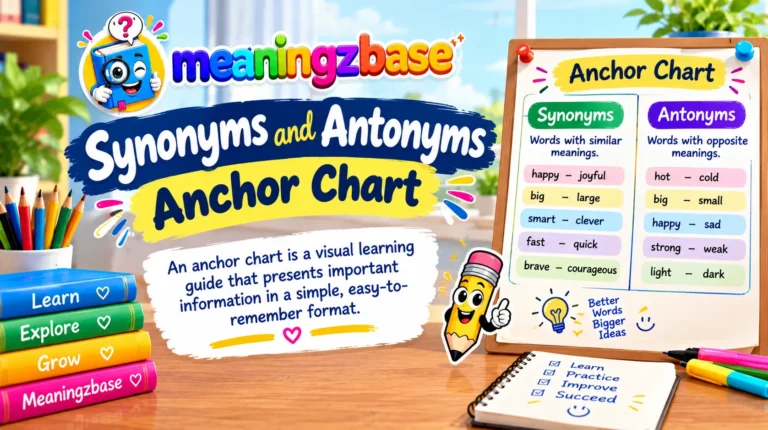
A synonyms and antonyms anchor chart is a simple but powerful learning tool that helps students understand how words are connected.
Instead of memorizing long vocabulary lists, learners can see related words together and quickly understand the difference between words with similar and opposite meanings.
People often search for a synonyms and antonyms anchor chart because they want an easy classroom resource, a printable study guide, or a quick way to teach vocabulary.
Teachers can use these charts during reading and writing lessons, while parents can use them at home to support language practice.
Students can also use them when they need better words for a sentence or want to understand an unfamiliar term.
Learning word variety is important in school, professional communication, and everyday conversation.
Using different words can make writing clearer, more interesting, and more precise.
A student who knows several ways to express an idea has more choices when writing a story, answering a question, or completing an assignment.
A good chart also teaches an important lesson: words are not always interchangeable. Two synonyms may have similar meanings but different tones, while two antonyms may show different degrees of contrast.
Understanding these small differences helps learners become stronger readers, writers, speakers, and communicators.
What Does “Anchor Chart” Mean?
An anchor chart is a visual learning guide that presents important information in a simple, easy-to-remember format. It is often displayed in a classroom so students can look at it while they work.
In a synonyms and antonyms lesson, an anchor chart normally places words into groups based on their meanings. For example:
- Happy: glad, joyful, cheerful
- Sad: unhappy, upset, miserable
- Big: large, huge, enormous
- Small: little, tiny, miniature
The chart acts like a reference point. Students can return to it when they need help choosing a word.
The word anchor suggests something that keeps information in place. An anchor chart does something similar for learning. It gives students a visual reminder of a concept that has already been taught.
The tone of “anchor chart” is mainly educational and classroom-based. It is commonly used by teachers, schools, tutors, parents, and educational websites. In casual conversation, people may simply call it a word chart, vocabulary chart, or reference chart.
A synonyms and antonyms anchor chart is especially useful because it teaches two connected ideas. Synonyms are words with the same or nearly the same meaning, while antonyms are words with opposite or strongly contrasting meanings.
15+ Best Synonyms for “Anchor Chart”
The phrase “anchor chart” is common in education, but several related terms can describe a similar learning resource. The best choice depends on the setting and the purpose of the material.
Reference Chart
Definition: A chart that provides information students can check whenever they need help.
Tone: Academic / Educational
Example: Students used the reference chart to find synonyms for common adjectives.
Learning Chart
Definition: A visual chart designed to help students understand and remember a lesson.
Tone: Educational / Casual
Example: The teacher created a learning chart about synonyms and antonyms.
Vocabulary Chart
Definition: A chart that collects words and explains their meanings or relationships.
Tone: Academic / Educational
Example: The vocabulary chart helped the class learn new words.
Word Chart
Definition: A simple display that organizes words for easy reading and review.
Tone: Casual / Educational
Example: We added five new words to the word chart.
Word Wall
Definition: A classroom display containing important words students are learning.
Tone: Educational / Casual
Example: The students checked the word wall before beginning their stories.
Study Chart
Definition: A visual resource used to review important information.
Tone: Academic
Example: I made a study chart to review synonyms before the test.
Classroom Chart
Definition: A chart displayed in a classroom to support learning.
Tone: Educational
Example: The classroom chart showed pairs of common antonyms.
Learning Guide
Definition: A resource that guides students through important ideas or information.
Tone: Academic / Formal
Example: The learning guide explained how synonyms can improve writing.
Reference Guide
Definition: A resource that can be consulted when someone needs specific information.
Tone: Formal / Academic
Example: The reference guide included synonyms for frequently used verbs.
Vocabulary Guide
Definition: A resource that helps learners understand, review, and use words.
Tone: Academic / Educational
Example: The vocabulary guide gave students several alternatives for “said.”
Word Reference
Definition: A source used to check word meanings, relationships, or usage.
Tone: Academic / Formal
Example: The word reference helped the student choose a more precise adjective.
Visual Guide
Definition: Information presented visually to make a concept easier to understand.
Tone: Academic / Educational
Example: The visual guide showed the difference between synonyms and antonyms.
Learning Resource
Definition: Any material used to support learning or teaching.
Tone: Formal / Academic
Example: The synonyms chart became a useful learning resource for the class.
Vocabulary Resource
Definition: A material designed to help learners build and use vocabulary.
Tone: Academic / Formal
Example: The vocabulary resource included simple examples for each word.
Educational Chart
Definition: A visual teaching tool created to explain or reinforce information.
Tone: Formal / Educational
Example: The educational chart was placed near the reading area.
Classroom Reference
Definition: A classroom resource students can use when they need quick information.
Tone: Educational / Academic
Example: The classroom reference helped students select stronger words.
Word Learning Tool
Definition: A resource that helps learners practice and understand vocabulary.
Tone: Casual / Educational
Example: The word learning tool made vocabulary practice more engaging.
These terms are related, but they are not always exact replacements. For example, a word wall is usually displayed on a wall, while an anchor chart often explains a lesson or concept in greater detail.
Stronger Alternatives
Sometimes you need a term that sounds more specific, powerful, or purposeful than “anchor chart.” The following options can work when describing a detailed or highly useful vocabulary resource.
Comprehensive Vocabulary Chart
Use this when the chart contains many words, meanings, examples, and word relationships.
Example: The teacher prepared a comprehensive vocabulary chart for the new unit.
Detailed Reference Guide
This works when the resource provides more than a basic list of words.
Example: Students received a detailed reference guide before starting their writing project.
Complete Word Guide
Use this when the material covers a broad range of vocabulary.
Example: The complete word guide included synonyms, antonyms, and example sentences.
Advanced Vocabulary Resource
This is useful for older students or learners studying more challenging vocabulary.
Example: The advanced vocabulary resource introduced stronger alternatives for common words.
Comprehensive Word Reference
This phrase suggests a resource that students can return to regularly.
Example: The comprehensive word reference remained available throughout the semester.
Detailed Learning Chart
Use this when the chart explains a concept with several examples or categories.
Example: The detailed learning chart showed different levels of word intensity.
Softer or Polite Alternatives
In some situations, “anchor chart” may sound too classroom-specific. Softer and more general terms can make your writing feel friendly and accessible.
Helpful Word Guide
This is friendly and easy for parents and younger learners to understand.
Simple Learning Resource
Use this when you want to highlight ease and usefulness rather than complexity.
Easy Reference Chart
This works well for beginner-friendly educational content.
Word Help Sheet
This is informal and suitable for casual learning materials.
Vocabulary Helper
This friendly term works particularly well for elementary students.
Quick Word Guide
Use this when the resource is designed for fast review.
Student-Friendly Chart
This emphasizes that the material is easy for learners to understand.
Academic & IELTS-Friendly Alternatives
Although “anchor chart” is mainly an educational term, academic writing may require more formal vocabulary. When describing a similar resource in an essay, lesson plan, research paper, or educational report, these alternatives may be more appropriate.
Educational Reference Material
A formal term for material used to support learning.
Instructional Resource
Common in academic and professional education writing.
Visual Learning Resource
Useful when the visual design is an important part of the teaching method.
Vocabulary Reference Tool
A precise phrase for a resource focused on word learning.
Instructional Chart
A formal alternative that highlights the teaching purpose.
Learning Support Material
Useful when discussing resources that help students understand a topic.
Vocabulary Development Tool
Best when the focus is on building students’ vocabulary skills.
Language Learning Resource
A broad term that works well in academic discussions about language education.
Visual Instructional Aid
A formal phrase for a visual tool used to explain information.
Classroom Learning Resource
Useful when discussing teaching methods, lesson planning, or classroom materials.
For IELTS-style writing, avoid using “anchor chart” repeatedly if the audience may not know the classroom term. Instead, introduce the term once and then use a more general phrase such as visual learning resource or instructional chart.
Synonyms You Should Avoid
Not every word that sounds similar to “anchor chart” is a true synonym. Some alternatives can create confusion or describe a different type of resource.
Dictionary
A dictionary explains words, meanings, spelling, pronunciation, and sometimes usage. It is much broader than an anchor chart.
Why avoid it: A dictionary is not normally a classroom chart designed around one lesson.
Thesaurus
A thesaurus lists synonyms and related words.
Why avoid it: A thesaurus is a reference source, not necessarily a visual teaching chart.
Worksheet
A worksheet usually contains activities or questions that students complete.
Why avoid it: An anchor chart is mainly a reference display, while a worksheet normally requires student responses.
Flashcards
Flashcards present information on individual cards, often for quick practice or memorization.
Why avoid it: Flashcards and anchor charts serve different learning purposes.
Encyclopedia
An encyclopedia provides detailed information about topics, people, places, and ideas.
Why avoid it: It is far broader than a classroom vocabulary chart.
Using the wrong term can make your content less clear. Choose the word that describes the actual resource instead of simply selecting a phrase because it sounds similar.
How to Choose the Right Synonym in Writing
Choosing the right synonym is not only about finding a word with a similar meaning. You should also think about context, tone, audience, and clarity.
Context
First, ask what you are describing.
If you are talking about a classroom display, anchor chart or classroom chart may be best. If you are talking about a resource students use for revision, study chart or reference guide may work better.
The situation should guide your word choice.
Tone
Think about how your writing should sound.
A school blog for parents can use friendly phrases such as helpful word guide. A teacher-training document may sound better with instructional resource.
The same idea can be expressed differently depending on the tone.
Audience
Always consider who will read your content.
Young students need simple language. Parents may prefer clear and friendly terms. Teachers and researchers may understand more formal educational vocabulary.
For Grade 3–5 learners, phrases such as word chart, vocabulary chart, and word wall are easy to understand.
Clarity
The most important rule is simple: choose the term that makes your meaning clear.
Do not replace “anchor chart” with a complicated phrase just to avoid repetition. If “anchor chart” is the clearest term, use it.
Good writing does not use difficult vocabulary for its own sake. It uses the right word for the right situation.
Example Paragraph Rewritten Using Synonyms
Original sentence:
The teacher used a synonyms and antonyms anchor chart to help students understand new vocabulary.
Rewrite 1:
The teacher used a vocabulary chart to help students understand new words and their opposites.
Rewrite 2:
The teacher displayed a word reference so students could quickly review synonyms and antonyms.
Rewrite 3:
The class used a visual learning resource to explore words with similar and opposite meanings.
Rewrite 4:
The teacher created a classroom reference that showed useful synonyms and antonyms.
These sentences have similar meanings, but each one has a slightly different focus. “Vocabulary chart” sounds direct and educational. “Word reference” emphasizes quick checking. “Visual learning resource” sounds more formal, while “classroom reference” highlights its role in the classroom.
This is an important lesson about synonyms: two expressions can be related without being perfect replacements. Good writers choose words based on meaning, purpose, and audience.
FAQs
What is a synonyms and antonyms anchor chart?
A synonyms and antonyms anchor chart is a visual learning resource that shows words with similar meanings and words with opposite meanings. It helps students understand vocabulary and improve word choice.
Why should students use a synonyms and antonyms chart?
Students can use the chart to expand their vocabulary, improve writing, understand reading passages, and choose more precise words.
What is an example of a synonym?
A synonym is a word with the same or nearly the same meaning as another word. For example, happy and joyful are synonyms.
What is an example of an antonym?
An antonym is a word with an opposite or strongly contrasting meaning. For example, hot and cold are antonyms.
Is an anchor chart the same as a word wall?
No. They are related classroom tools, but they usually have different purposes. An anchor chart often explains a lesson or concept, while a word wall usually displays important vocabulary words.
How can an anchor chart improve writing?
An anchor chart gives students quick access to alternative words. This can help them avoid repeating the same word and make their sentences more interesting and precise.
How do I make a synonyms and antonyms anchor chart?
Start with a common word. Place several synonyms in one section and suitable antonyms in another. Add short definitions and simple example sentences. Keep the layout clear so students can find information quickly.
Conclusion
A synonyms and antonyms anchor chart is more than a classroom decoration.
It can become a practical vocabulary tool that students use while reading, writing, speaking, and studying.
By learning groups of related words, students begin to understand that word choice can change the strength, tone, and meaning of a sentence.
For teachers, these charts provide a simple way to reinforce vocabulary lessons. For students, they offer a quick reference when a better word is needed.
For parents, they can make language practice easier at home.
The key is to focus on meaning rather than simply collecting long lists of words. A good chart should show useful relationships, clear examples, and words that students can actually use.
When learners understand how synonyms and antonyms work, they gain more control over language—and that can lead to stronger reading, clearer writing, and more confident communication.

Evan Blake is a passionate language enthusiast who creates simple and informative content about word meanings, slang, phrases, and modern expressions.
He focuses on making complex or unfamiliar words easy to understand through clear explanations and practical examples.