
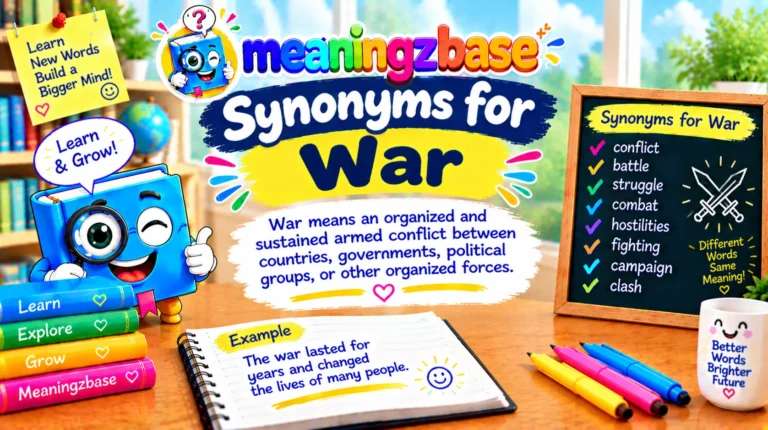
Finding the right synonyms for war can make writing clearer, stronger, and more precise.
The word war is common, but it does not always express the exact idea a writer wants to share. Sometimes you may be talking about a long military conflict.
At other times, you may mean a battle, armed struggle, fighting, or a serious clash between groups.
Choosing the right alternative helps readers understand the situation without confusion.
Word variety is also useful when you want to avoid repeating the same word. In academic essays, using suitable alternatives can make your vocabulary richer.
In professional writing, the right term can create a more serious and exact tone. In casual writing, a simple word such as fight or conflict may sound more natural.
However, synonyms are not always interchangeable. Some words describe a full military campaign, while others describe only one part of a conflict.
Some sound formal or academic, while others are emotional or informal.
This guide explains more than 15 useful alternatives to war, including stronger terms, softer choices, academic vocabulary, and words that can cause confusion.
The goal is simple: help you choose the word that best fits your meaning, audience, and tone.
What Does “War” Mean?
War means an organized and sustained armed conflict between countries, governments, political groups, or other organized forces. It usually involves military action and may continue for months or years.
The word has a serious, direct, and often emotional tone. It is commonly used when discussing major armed conflicts, military history, international relations, politics, and current events.
For example:
The two countries entered a war after years of rising tension.
War is broader than words such as battle or fight. A war can contain many battles, attacks, campaigns, and other military actions.
It is important to remember that the best synonym depends on what you mean. If you are describing one short military event, battle may be better. If you are describing disagreement without physical violence, conflict may be more suitable.
15+ Best Synonyms for “War”
1. Conflict
Definition: A serious disagreement or armed struggle between two or more groups, nations, or sides.
Tone: Formal / Academic
Example:
The conflict lasted for several years and affected millions of people.
Conflict is one of the closest alternatives to war, but it is broader. It can describe both violent and non-violent disputes.
2. Battle
Definition: A fight between opposing forces, usually as part of a larger war or military campaign.
Tone: Formal / Literary
Example:
The army won an important battle near the border.
Use battle when you mean a specific military fight rather than an entire war.
3. Warfare
Definition: The activity, methods, or practice of fighting a war.
Tone: Formal / Academic
Example:
Modern warfare depends heavily on technology and intelligence.
Warfare focuses on the way war is conducted rather than simply naming the conflict.
4. Fighting
Definition: Physical combat or violent action between opposing people or groups.
Tone: Casual / General
Example:
The fighting continued despite repeated calls for peace.
Fighting is simple and flexible. It can refer to military violence without sounding as broad as war.
5. Hostilities
Definition: Acts of war or aggressive military action between opposing sides.
Tone: Formal / Academic
Example:
Both governments agreed to stop hostilities for several weeks.
This word is common in diplomatic and political writing.
6. Struggle
Definition: A difficult fight or effort against an opposing force or condition.
Tone: General / Literary
Example:
The country faced a long struggle for control of the region.
Struggle can describe war, but it can also describe social, political, or personal challenges.
7. Armed Conflict
Definition: A violent conflict involving weapons and organized forces.
Tone: Formal / Academic
Example:
Thousands of families were displaced by the armed conflict.
This is a useful choice in reports because it sounds precise and neutral.
8. Combat
Definition: Direct fighting between armed forces or opposing fighters.
Tone: Formal / Military
Example:
The soldiers were removed from combat after the agreement was signed.
Combat usually refers to actual fighting rather than the entire political situation behind a war.
9. Campaign
Definition: A planned series of military actions carried out for a particular goal.
Tone: Formal / Military
Example:
The army began a major campaign in the northern region.
A campaign is usually one part of a larger war.
10. Offensive
Definition: A planned military attack designed to gain territory or weaken an opponent.
Tone: Formal / Military
Example:
The forces launched a new offensive at dawn.
An offensive is not a complete synonym for war. It describes a particular type of military operation.
11. Invasion
Definition: The act of entering another country or area with military forces.
Tone: Formal / Political
Example:
The invasion caused widespread damage to towns near the border.
Use this word when military forces enter another territory.
12. Clash
Definition: A short or limited fight between opposing groups.
Tone: General / Casual
Example:
A clash between the two forces left several buildings damaged.
Clash often suggests a smaller event than war.
13. Strife
Definition: Serious conflict, disagreement, or struggle between people or groups.
Tone: Literary / Formal
Example:
Years of political strife divided the nation.
Strife can describe violent conflict, but it can also refer to deep social or political disagreement.
14. Turmoil
Definition: A state of severe confusion, disorder, or unrest.
Tone: Formal / Literary
Example:
The country experienced years of political turmoil.
Turmoil is not a direct synonym for war. It describes the disorder that may result from war or other serious problems.
15. Bloodshed
Definition: The killing or loss of life during violent conflict.
Tone: Literary / Emotional
Example:
Leaders called for an end to the bloodshed.
This word focuses on death and violence rather than the military conflict itself.
16. Hostile Engagement
Definition: A military encounter between opposing forces.
Tone: Formal / Military
Example:
The report recorded several hostile engagements during the week.
This phrase works well in technical or military contexts.
17. Melee
Definition: A confused and violent fight involving several people or groups.
Tone: Literary / Formal
Example:
The peaceful gathering suddenly turned into a violent melee.
Melee is generally used for a chaotic fight, not a full-scale war.
18. Feud
Definition: A long-running conflict between individuals, families, groups, or communities.
Tone: General / Informal
Example:
The two families had a bitter feud that lasted for decades.
A feud is usually smaller and more personal than a war.
Stronger Alternatives
Sometimes war does not fully express the level of violence or destruction involved. The following terms can create a stronger effect.
- Bloodshed — Use this when you want to highlight death and suffering.
- Armed conflict — Useful when describing serious organized violence in a neutral way.
- Warfare — Strong when discussing sustained military activity or methods of fighting.
- Hostilities — Suitable for formal reports about aggressive actions between opposing sides.
- Invasion — Use this when one force enters another territory by military force.
- Offensive — Best for a major planned attack.
- Assault — Appropriate when describing a forceful attack on a person, position, or area.
- Devastation — Use this when focusing on the destruction caused by conflict rather than the conflict itself.
Be careful with strong alternatives. A dramatic word should match the facts. For example, invasion should not replace war unless one side actually entered another territory by force.
Softer or Polite Alternatives
In diplomatic, educational, or sensitive writing, you may want a less direct expression. These alternatives can reduce emotional force without hiding the subject.
- Conflict — A neutral and widely accepted choice.
- Tensions — Useful when violence has not yet become a full war.
- Dispute — Best for disagreement that may not involve major violence.
- Hostilities — Formal and less direct than war.
- Armed confrontation — A careful phrase for military opposition.
- Unrest — Suitable for public disorder or instability.
- Crisis — Useful when focusing on a dangerous political situation.
- Struggle — A broader term that can sound less militaristic.
These alternatives should not be used simply to make a war sound harmless. Clear writing should remain accurate.
Academic & IELTS-Friendly Alternatives
Students often need varied vocabulary when writing essays about international relations, history, politics, peace, or global issues. The following terms can help, but they should be used only when their meanings fit the sentence.
- Armed conflict — A precise academic term for organized violence involving weapons.
- Military conflict — Useful when focusing on fighting between military forces.
- Warfare — Appropriate when discussing military methods, systems, or strategies.
- Hostilities — Formal vocabulary for acts of aggression or fighting.
- Armed confrontation — Useful for describing opposing forces facing each other.
- Military engagement — Suitable for a particular encounter between forces.
- Violent conflict — Makes the presence of violence clear.
- Political conflict — Best when the disagreement is mainly political rather than military.
- Territorial dispute — Useful when two sides disagree over control of land.
- International conflict — Appropriate when countries or international actors are involved.
- Military campaign — Refers to a planned series of military operations.
- Geopolitical confrontation — An advanced term for serious tension between political powers or regions.
For IELTS, using a difficult word simply to sound advanced can hurt clarity. Strong vocabulary is useful only when it is accurate. For example, geopolitical confrontation is not a better choice than war in every sentence.
Synonyms You Should Avoid
Some words may look like synonyms for war, but replacing war with them can change the meaning.
1. Argument
An argument usually means a verbal disagreement. It is far too weak for a military conflict.
Incorrect:
The two nations had an argument that lasted ten years.
Better:
The two nations had a conflict that lasted ten years.
2. Disagreement
A disagreement can be serious, but it does not normally mean armed violence.
Incorrect:
The country entered a disagreement with its neighbor and sent troops.
Better:
The country entered an armed conflict with its neighbor.
3. Fight
Fight can mean physical violence, but it is often too informal or narrow for academic writing.
Better use:
The children had a fight.
Academic use:
The two states became involved in an armed conflict.
4. Argumentation
Argumentation refers to the process of presenting reasons or arguments. It has nothing to do with military war.
Incorrect:
The argumentation destroyed several cities.
Better:
The war destroyed several cities.
5. Competition
Competition involves rivals trying to succeed against each other. It does not normally mean armed conflict.
Incorrect:
The competition between the countries killed thousands.
Better:
The conflict between the countries killed thousands.
Choosing the wrong synonym can make an otherwise strong sentence inaccurate. Always check the exact meaning before replacing war.
How to Choose the Right Synonym in Writing
Choosing a synonym is not only about finding a different word. You need to consider four important points.
Context
First, ask what exactly you are describing.
If you mean an entire armed conflict, war or armed conflict may work.
If you mean one specific fight, choose battle or clash.
If you mean a planned military attack, offensive may be correct.
If you mean military methods, choose warfare.
Tone
Your audience affects your word choice.
For casual writing, fight or clash may sound natural.
For academic writing, armed conflict, military conflict, or hostilities may be better.
For literary writing, strife or bloodshed can create a stronger emotional effect.
Audience
Think about who will read your work.
A school essay needs clear vocabulary. A military report needs precise terminology. A news article may require neutral language. A novel may use emotional or dramatic terms.
Do not use a complex word just because it looks impressive.
Clarity
The best synonym is the one that makes your meaning easiest to understand.
For example:
The war continued for five years.
This is clear.
You could write:
The armed conflict continued for five years.
This sounds more formal.
But:
The geopolitical confrontation continued for five years.
may suggest a broader political struggle rather than direct warfare.
The goal is not to avoid war. The goal is to use the most accurate word.
Example Paragraph Rewritten Using Synonyms
Original Sentence
The war between the two countries caused major damage to homes, roads, and schools. The war also forced many families to leave their communities.
Rewritten Version
The armed conflict between the two countries caused major damage to homes, roads, and schools. The continued hostilities also forced many families to leave their communities.
Another Version
The military conflict between the two countries caused major damage to homes, roads, and schools. The fighting also forced many families to leave their communities.
The second versions avoid repeating war, but the meaning remains clear. Notice that the words are not identical in meaning. Armed conflict sounds formal, while fighting is simpler and more direct.
FAQs
What is the best synonym for war?
Conflict is one of the best general synonyms for war. However, armed conflict is often more precise in formal and academic writing.
What is a formal synonym for war?
Armed conflict, warfare, and hostilities are formal alternatives. The best choice depends on the exact context.
What is a simple synonym for war?
Fighting is a simple alternative. Conflict is also easy to understand and works in many situations.
What is a stronger word than war?
There is not one universal stronger synonym. Words such as bloodshed, warfare, invasion, and devastation can create a stronger effect, but they describe different aspects of war.
What are good synonyms for war in IELTS?
Useful IELTS vocabulary includes armed conflict, military conflict, warfare, hostilities, armed confrontation, violent conflict, and military campaign.
Is “battle” the same as “war”?
No. A battle is usually one specific fight, while a war can include many battles, campaigns, and military operations.
Can “conflict” always replace “war”?
No. Conflict is broader than war. It can describe political, social, personal, or military disagreement. Use it when the wider meaning fits your sentence.
Conclusion
The best synonyms for war depend on what you want to say. Conflict is a useful general alternative, while armed conflict works well in formal writing.
Battle describes a specific fight, warfare focuses on the practice of war, and hostilities suits diplomatic or political language.
Stronger terms such as bloodshed and invasion should be used carefully because they describe particular parts or effects of war rather than always meaning the same thing.
For students, professionals, journalists, and everyday writers, variety is helpful, but accuracy matters more than using difficult vocabulary.
Choose your word based on context, tone, audience, and clarity. When the original word war is the clearest option, there is no need to replace it.
Good vocabulary is not about sounding complicated—it is about saying exactly what you mean.

Evan Blake is a passionate language enthusiast who creates simple and informative content about word meanings, slang, phrases, and modern expressions.
He focuses on making complex or unfamiliar words easy to understand through clear explanations and practical examples.