
When you write a story, essay, article, or dialogue, using “said” again and again can make your writing feel flat.
That is why many writers search for synonyms for said in writing. The right alternative can show emotion, explain how a person speaks, or make a scene easier to imagine.
Words such as replied, explained, whispered, shouted, and stated can add useful detail when they fit the situation.
However, not every replacement works in every sentence. A strong writer chooses a word based on meaning, tone, audience, and context.
In academic writing, formal choices such as stated, noted, and argued can help introduce information or ideas.
In professional writing, explained, reported, and confirmed may sound more precise.
In stories and casual writing, words such as whispered, joked, and muttered can show how someone speaks.
The goal is not to remove said completely. Instead, use a wider range of words when they make the meaning clearer.
What Does “Said” Mean?
Said is the past tense of say. It means that someone spoke words aloud or expressed something through speech.
The word is neutral and works in almost any type of writing. It does not normally tell the reader whether the speaker was happy, angry, nervous, quiet, or excited.
For example:
Maria said, “I will finish the project tomorrow.”
Here, said simply tells us that Maria spoke. It does not explain how she spoke.
The word is common in dialogue, stories, articles, reports, and everyday writing. Because it is simple and natural, there is no need to replace it every time it appears. In fact, forcing a different synonym into every sentence can make writing sound unnatural.
The best approach is to use said when it is clear and choose another word when a specific meaning is important.
15+ Best Synonyms for “Said”
1. Stated
Definition: Expressed something clearly, often in a direct or formal way.
Tone: Formal
Example: The manager stated that the meeting would begin at nine.
2. Explained
Definition: Gave information or details to help someone understand something.
Tone: Formal / Academic
Example: The teacher explained why the answer was incorrect.
3. Replied
Definition: Spoke or answered after someone else had spoken.
Tone: Neutral
Example: “I already finished it,” she replied.
4. Answered
Definition: Responded to a question or statement.
Tone: Neutral
Example: “The library is across the street,” he answered.
5. Mentioned
Definition: Spoke about something briefly without giving many details.
Tone: Neutral
Example: Daniel mentioned that he might visit next week.
6. Added
Definition: Gave extra information after making another statement.
Tone: Neutral
Example: “We should leave early,” Sara added.
7. Noted
Definition: Pointed out or drew attention to a particular fact or idea.
Tone: Formal / Academic
Example: The researcher noted that the results were different.
8. Remarked
Definition: Made a comment about something.
Tone: Formal / Literary
Example: “That is an interesting idea,” the professor remarked.
9. Suggested
Definition: Put forward an idea, plan, or possibility.
Tone: Neutral / Formal
Example: James suggested that they take a different route.
10. Argued
Definition: Gave reasons to support an opinion or position.
Tone: Academic / Formal
Example: The writer argued that education should be available to everyone.
11. Reported
Definition: Gave information about something that happened or was discovered.
Tone: Formal / Academic
Example: The newspaper reported that the storm had damaged several buildings.
12. Confirmed
Definition: Said that something was true, correct, or certain.
Tone: Formal
Example: The doctor confirmed that the test results were ready.
13. Whispered
Definition: Spoke very quietly.
Tone: Literary / Casual
Example: “Please stay here,” she whispered.
14. Shouted
Definition: Spoke very loudly, often because of anger, excitement, or distance.
Tone: Casual / Literary
Example: “Watch out!” he shouted.
15. Yelled
Definition: Spoke or called out in a very loud voice.
Tone: Casual
Example: “Come back!” Mia yelled.
16. Muttered
Definition: Spoke in a low or unclear voice, often because of annoyance or embarrassment.
Tone: Literary / Casual
Example: “This is not fair,” he muttered.
17. Joked
Definition: Said something meant to be funny or playful.
Tone: Casual
Example: “Maybe I need a vacation from my vacation,” he joked.
18. Admitted
Definition: Accepted or revealed that something was true, especially something difficult to say.
Tone: Neutral / Formal
Example: “I made a mistake,” she admitted.
19. Insisted
Definition: Said something firmly and refused to change the position.
Tone: Neutral / Formal
Example: “I can do it myself,” he insisted.
20. Complained
Definition: Said that something was wrong, unpleasant, or unfair.
Tone: Neutral
Example: “This room is too cold,” she complained.
21. Promised
Definition: Said that someone would do something or that something would happen.
Tone: Neutral
Example: “I will call you tomorrow,” he promised.
22. Warned
Definition: Told someone about possible danger or trouble.
Tone: Neutral / Formal
Example: “The road may be dangerous tonight,” the officer warned.
Stronger Alternatives
Sometimes said does not show enough emotion or force. A stronger verb can make dialogue more vivid.
Shouted
Use this when a person speaks very loudly.
Example: “Stop the car!” she shouted.
Yelled
Use this for loud speech, especially during anger or excitement.
Example: “Get out!” he yelled.
Screamed
Use this when the voice is extremely loud and often linked to fear, pain, anger, or excitement.
Example: “Help me!” the child screamed.
Demanded
Use this when someone asks for something in a forceful way.
Example: “Give me the keys,” he demanded.
Insisted
Use this when someone strongly repeats a position or request.
Example: “I know what I saw,” she insisted.
Declared
Use this when someone makes a strong or official statement.
Example: “We will not give up,” the captain declared.
Protested
Use this when someone speaks against an action, decision, or idea.
Example: “That was not my fault,” he protested.
Exclaimed
Use this when speech expresses strong surprise, happiness, anger, or another strong feeling.
Example: “What an amazing view!” she exclaimed.
These words should be used carefully. A powerful speech verb should match the scene. Using screamed when someone is simply talking can make the writing feel exaggerated.
Softer or Polite Alternatives
Some situations need gentle language rather than strong or dramatic words.
Suggested
Use it when someone offers an idea without forcing it.
Example: “Maybe we could try again tomorrow,” she suggested.
Mentioned
Use it for a brief and low-pressure comment.
Example: He mentioned that the store would close early.
Noted
Use it when someone calmly points out information.
Example: The teacher noted that several students were absent.
Observed
Use it when someone comments after noticing something.
Example: “The sky looks darker today,” she observed.
Added
Use it when someone gives another piece of information.
Example: “We can meet after lunch,” he added.
Explained
Use it when someone gives information in a helpful way.
Example: She explained how the new system worked.
Remarked
Use it for a calm or thoughtful comment.
Example: “This place has changed a lot,” he remarked.
Replied
Use it when someone responds without adding unnecessary emotion.
Example: “That sounds good,” she replied.
Academic & IELTS-Friendly Alternatives
In academic and IELTS writing, said is often too general when you are reporting ideas, research, or opinions. More precise verbs can show exactly what the source or writer did.
Stated
Useful for presenting a clear fact or position.
Example: The report stated that public transport use had increased.
Explained
Useful when a source gives reasons or details.
Example: The author explained why the policy was introduced.
Argued
Useful when a writer presents reasons for an opinion.
Example: The study argued that early education can improve later outcomes.
Suggested
Useful when a source presents an idea or possibility.
Example: The findings suggested that exercise may improve concentration.
Claimed
Useful when reporting a statement or position, especially when you are not personally confirming it.
Example: The article claimed that the new method could reduce costs.
Reported
Useful for information gathered from research, surveys, or news sources.
Example: Researchers reported a rise in online learning.
Observed
Useful when an author or researcher points out a noticeable fact.
Example: The researchers observed a clear change in student behavior.
Noted
Useful for highlighting an important detail.
Example: The study noted several differences between the two groups.
Concluded
Useful when a researcher or writer gives a final judgment based on evidence.
Example: The researchers concluded that more data was needed.
Emphasized
Useful when a source gives special importance to an idea.
Example: The report emphasized the need for better training.
Demonstrated
Useful when evidence or research shows something clearly.
Example: The results demonstrated the value of regular practice.
For IELTS and academic writing, remember that a synonym should match the function of the original statement. For example, argued is not always a suitable replacement for said. If a researcher simply reports a fact, stated or reported may be more accurate.
Synonyms You Should Avoid
Not every word connected with speech is a good replacement for said. Some alternatives change the meaning.
Announced
Announced suggests that information is being made known publicly or officially.
Why avoid it: Do not use it for an ordinary private conversation.
Wrong: “I like pizza,” she announced.
Better: “I like pizza,” she said.
Asked
Asked means someone wants information or makes a request.
Why avoid it: It should not replace said when no question or request is involved.
Better: “Where are you going?” she asked.
Repeated
Repeated means that someone says something again.
Why avoid it: It adds the idea of repetition.
Promised
Promised means someone gives a commitment.
Why avoid it: A normal statement is not necessarily a promise.
Admitted
Admitted suggests that someone accepts or reveals something, often something they were reluctant to acknowledge.
Why avoid it: It adds a specific meaning that ordinary said does not have.
Choosing an incorrect synonym can make a sentence less accurate even if the replacement looks more interesting.
How to Choose the Right Synonym in Writing
Choosing the right alternative to said is less about finding the fanciest word and more about finding the most accurate one.
Context
First, look at what the speaker is doing.
Is the person answering a question? Use replied or answered.
Are they giving an explanation? Use explained.
Are they speaking quietly? Use whispered.
Are they warning someone? Use warned.
The situation should control the word.
Tone
Think about the feeling of the scene.
A formal report may need stated, reported, or confirmed. A children’s story may use whispered, shouted, or joked. A serious academic essay may need argued, noted, or concluded.
Audience
Consider who will read your writing.
Young readers usually benefit from simple words. Professional readers may expect precise vocabulary. Academic readers need words that clearly show the relationship between a source and its claim.
Do not use a complicated word simply because it sounds advanced.
Clarity
The most important goal is clear communication.
If said works perfectly, keep it. There is no rule saying that every use of said must be replaced.
Compare:
“I am tired,” John said.
This sentence is simple and natural.
Now compare:
“I am tired,” John articulated.
The second sentence sounds unusual because articulated focuses on expressing something clearly rather than simply speaking. The more advanced word does not automatically make the sentence better.
Good writing uses variety and accuracy.
Example Paragraph Rewritten Using Synonyms
Original paragraph:
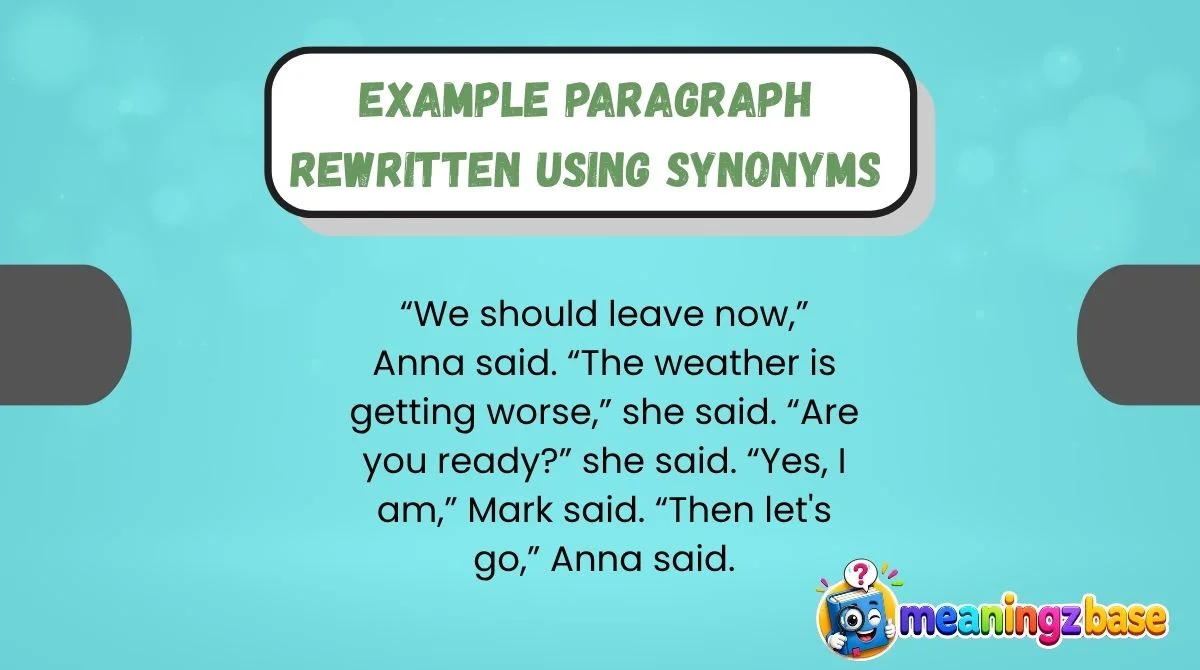
“We should leave now,” Anna said. “The weather is getting worse,” she said. “Are you ready?” she said. “Yes, I am,” Mark said. “Then let’s go,” Anna said.
The paragraph repeats said several times. Some repetition is acceptable, but the dialogue can be made clearer by choosing verbs that show the purpose or manner of each statement.
Rewritten paragraph:
“We should leave now,” Anna warned. “The weather is getting worse,” she explained. “Are you ready?” she asked. “Yes, I am,” Mark replied. “Then let’s go,” Anna insisted.
The revised version gives each line a clearer purpose. Warned shows concern, explained adds information, asked introduces a question, replied shows an answer, and insisted adds firmness.
However, writers should not replace every instance of said just to avoid repetition. If the action or emotion is already clear, said may still be the best choice.
FAQs
What are the best synonyms for said in writing?
Some useful synonyms include stated, explained, replied, answered, mentioned, noted, remarked, whispered, shouted, argued, suggested, admitted, insisted, warned, and reported. The best choice depends on context and tone.
What can I use instead of said in an essay?
In an essay, you can use stated, argued, explained, suggested, reported, noted, observed, claimed, or concluded when the meaning fits. Academic writing benefits from precise verbs rather than unnecessary variety.
What is a formal synonym for said?
Common formal alternatives include stated, reported, noted, confirmed, explained, argued, and declared. Choose one according to what the speaker or writer actually did.
What are good synonyms for said in dialogue?
For dialogue, useful choices include replied, answered, whispered, shouted, yelled, muttered, joked, admitted, insisted, warned, and asked. Each one gives the reader additional information about the speech.
What can I use instead of said to show anger?
Depending on the situation, you can use shouted, yelled, demanded, snapped, protested, or insisted. Choose the word that accurately describes the speaker’s action rather than simply choosing the strongest word.
Should I avoid using the word said in writing?
No. Said is a natural and useful word. It is often better than an unusual synonym. Replace it when another word adds important information about the speaker’s meaning, emotion, or manner.
How do I avoid repeating said in a story?
Use a mix of said, action descriptions, and accurate speech verbs. You can also describe what the character does before or after speaking. Avoid replacing said with dramatic words when the scene does not support them.
Conclusion
Finding the right synonyms for said in writing can make your work more varied, clear, and engaging.
Words such as replied, explained, stated, whispered, argued, and warned do more than replace one word—they can show the purpose, tone, or manner of speech.
Still, variety should never come at the cost of accuracy. Said remains a useful and natural choice, especially when the speaker’s action is already clear.
The strongest writers choose each alternative based on context, audience, tone, and meaning.
Whether you are writing a school assignment, academic essay, professional report, or creative story, use the word that communicates your idea most clearly.

Evan Blake is a passionate language enthusiast who creates simple and informative content about word meanings, slang, phrases, and modern expressions.
He focuses on making complex or unfamiliar words easy to understand through clear explanations and practical examples.