
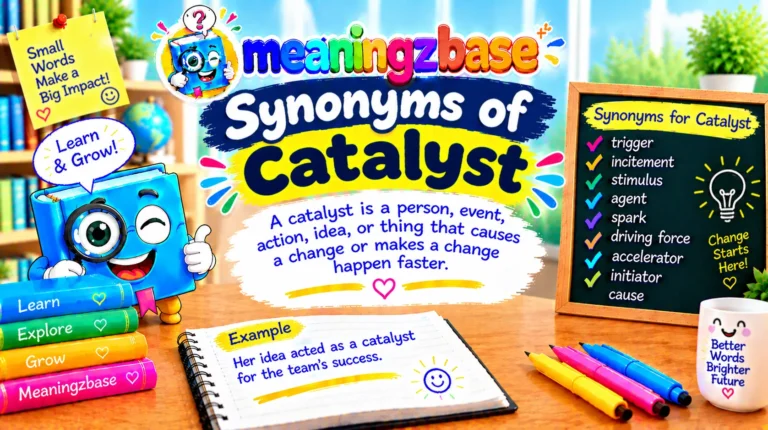
A catalyst is something that causes or speeds up change.
People often search for synonyms of catalyst because they want to make their writing clearer, more varied, or more precise.
The word is common in many areas, including science, business, education, politics, technology, and everyday conversation.
However, not every replacement has exactly the same meaning.
Using the right synonym can make a sentence sound more natural and help readers understand the exact role of a person, event, idea, or action.
For example, a business report may need a formal word such as driving force, while a casual sentence may work better with spark or trigger.
Word variety is especially useful in essays, reports, articles, presentations, and professional writing.
Students may also look for alternatives to avoid repeating the word “catalyst” in academic work or IELTS essays.
Understanding the differences between similar words helps you choose vocabulary based on context, strength, and tone.
This guide explains the best synonyms of catalyst, including stronger, softer, academic, and everyday alternatives.
Each option includes a simple meaning and example so you can use it correctly.
What Does “Catalyst” Mean?
A catalyst is a person, event, action, idea, or thing that causes a change or makes a change happen faster.
The word can be used in two main ways. In science, a catalyst is a substance that speeds up a chemical reaction without being used up in the reaction. In general writing, a catalyst is something that creates or speeds up an important change.
For example:
The new teacher was a catalyst for positive change in the school.
Here, the teacher helped bring about change.
“Catalyst” is usually neutral to formal in tone. It is common in academic, professional, scientific, and analytical writing. In casual conversation, words such as spark, trigger, or cause may sound more natural.
15+ Best Synonyms for “Catalyst”
1. Trigger
A trigger is something that starts a reaction, event, or change.
Tone: Neutral / Formal
Example: The sudden price increase was a trigger for public protests.
2. Stimulus
A stimulus is something that encourages activity, growth, thought, or change.
Tone: Academic / Formal
Example: The scholarship provided a stimulus for more students to attend college.
3. Spark
A spark is a small event or idea that starts a larger action or change.
Tone: Casual / Literary
Example: Her speech was the spark that started the community project.
4. Impetus
An impetus is a force or reason that encourages something to happen.
Tone: Formal / Academic
Example: The new law gave an impetus to environmental research.
5. Driving Force
A driving force is a person, idea, or factor that strongly pushes something forward.
Tone: Formal / Professional
Example: Innovation has become a driving force behind the company’s growth.
6. Motive
A motive is a reason that causes someone to act.
Tone: Neutral / Formal
Example: The desire to help others was her main motive for joining the project.
7. Cause
A cause is a person, event, or condition that produces a result.
Tone: Neutral / Academic
Example: Poor planning was a major cause of the project’s failure.
8. Influence
An influence is something that affects a person, decision, event, or development.
Tone: Neutral / Formal
Example: Technology has been a major influence on modern education.
9. Force
A force is something that produces movement, pressure, or change.
Tone: Neutral / Formal
Example: Social media has become a powerful force for cultural change.
10. Factor
A factor is one condition or element that contributes to a result.
Tone: Academic / Professional
Example: Population growth was an important factor in the city’s expansion.
11. Contributor
A contributor is something or someone that helps produce a result.
Tone: Formal / Academic
Example: Better transport was a major contributor to regional development.
12. Agent
An agent is a person, group, or thing that causes or brings about an action or change.
Tone: Academic / Formal
Example: Education can act as an agent of social change.
13. Provocation
A provocation is an action or event that causes a strong reaction.
Tone: Formal / Literary
Example: The controversial decision became a provocation for widespread criticism.
14. Initiator
An initiator is a person or thing that begins an action or process.
Tone: Formal / Professional
Example: She was the initiator of the neighborhood recycling program.
15. Precipitant
A precipitant is something that causes an event or situation to happen suddenly.
Tone: Formal / Academic
Example: The economic crisis was a precipitant of major political changes.
16. Activator
An activator is something that causes a process or activity to begin or become active.
Tone: Scientific / Technical
Example: The chemical acts as an activator in the reaction.
17. Generator
A generator is something that produces or creates an effect, idea, activity, or result.
Tone: Neutral / Professional
Example: Tourism has become a major generator of local income.
18. Promoter
A promoter is a person or thing that encourages growth, development, or activity.
Tone: Formal / Professional
Example: The program became a promoter of healthy habits among children.
19. Turning Point
A turning point is an event that marks a major change in direction.
Tone: Neutral / Literary
Example: The invention became a turning point in the history of communication.
20. Kick-Starter
A kick-starter is something that gives an activity or process an early push.
Tone: Informal / Casual
Example: The small grant was a kick-starter for her new business.
Stronger Alternatives
Sometimes “catalyst” does not fully show how powerful an event or force was. In these cases, stronger alternatives can make your meaning clearer.
1. Driving Force
Use driving force when something has a strong and continuing effect on change.
Example: Innovation was the driving force behind the company’s rapid expansion.
2. Major Trigger
Use major trigger when an event directly starts an important reaction.
Example: The factory closure was a major trigger for economic reforms.
3. Turning Point
Use turning point when the change represents a major shift in direction.
Example: The discovery marked a turning point in medical research.
4. Powerful Stimulus
Use powerful stimulus when something strongly encourages action or development.
Example: The competition provided a powerful stimulus for new ideas.
5. Transformative Force
Use transformative force when something produces deep or lasting change.
Example: Digital technology has become a transformative force in education.
6. Major Impetus
Use major impetus when something gives strong motivation or momentum.
Example: The award gave a major impetus to her writing career.
7. Primary Driver
Use primary driver when something is one of the main reasons behind a development.
Example: Consumer demand is a primary driver of product innovation.
Softer or Polite Alternatives
Not every situation involves a strong or sudden change. Softer alternatives are useful when the factor simply supports, encourages, or influences development.
1. Influence
Use influence when something affects a result without necessarily causing it directly.
Example: Family traditions have a strong influence on children’s behavior.
2. Contributor
Use contributor when something is only one part of a larger result.
Example: Good communication was an important contributor to the team’s success.
3. Factor
Use factor when you want to describe one condition among several.
Example: Weather was one factor in the delay.
4. Encouragement
Use encouragement when something gives a person confidence or motivation.
Example: Her teacher’s encouragement helped her continue writing.
5. Support
Use support when something helps a process develop without directly starting it.
Example: Financial support helped the organization expand its services.
6. Prompt
Use prompt when something encourages a particular response or action.
Example: The complaint prompted the company to improve its service.
7. Motivation
Use motivation when the focus is on the reason for someone’s action.
Example: Personal growth was her main motivation for learning a new skill.
Academic & IELTS-Friendly Alternatives
Academic writing requires precise vocabulary. Instead of using “catalyst” repeatedly, you can choose a word that matches the exact relationship between an event and its result.
1. Stimulus
A stimulus encourages activity, growth, or development.
Example: Government funding can provide a stimulus for scientific research.
2. Impetus
Impetus describes a force or reason that encourages progress.
Example: Rising demand provided an impetus for technological development.
3. Contributing Factor
This phrase identifies something that helps produce a particular result.
Example: Limited access to education is a contributing factor to income inequality.
4. Driving Force
This describes a strong factor that pushes development forward.
Example: Innovation is a driving force behind economic growth.
5. Influence
Influence describes an effect on a person, process, or outcome.
Example: Cultural traditions have a significant influence on social behavior.
6. Trigger
Trigger works well when an event starts a reaction or change.
Example: The economic downturn triggered changes in government policy.
7. Agent of Change
This phrase describes a person, organization, idea, or process that creates change.
Example: Education can serve as an agent of change in developing communities.
8. Precipitant
Precipitant is useful when an event quickly brings about another event.
Example: The shortage became a precipitant of major policy changes.
9. Mechanism
Mechanism can describe the process through which an effect occurs.
Example: Social pressure can be a mechanism that influences individual behavior.
10. Determining Factor
This phrase is useful when one factor has a particularly important role in an outcome.
Example: Access to reliable information was a determining factor in the decision.
Synonyms You Should Avoid
Some words may look similar to “catalyst,” but they should not be used as direct replacements in every sentence.
1. Reason
A reason explains why something happens, but it does not always cause or accelerate change.
Why to avoid it: It is broader than “catalyst” and may remove the idea of creating movement or change.
2. Purpose
A purpose describes the intended goal of an action.
Why to avoid it: A catalyst causes or encourages change, while a purpose explains what someone intends to achieve.
3. Result
A result is the outcome of an event.
Why to avoid it: A catalyst comes before the change, while a result comes after it.
4. Solution
A solution is an answer to a problem.
Why to avoid it: A catalyst may create change without solving a problem.
5. Effect
An effect is an outcome caused by something else.
Why to avoid it: A catalyst is generally the cause or trigger, while an effect is what happens afterward.
Choosing the wrong word can change the meaning of your sentence. Always check whether you are describing the cause, trigger, motivation, process, or result.
How to Choose the Right Synonym in Writing
Choosing a synonym is not simply about finding another word with a similar meaning. The best word depends on the situation.
Context
First, identify what the catalyst actually does.
If it starts something suddenly, trigger may be appropriate. If it encourages progress, impetus or stimulus may work better. If it strongly pushes development, driving force can be more precise.
For example:
The new rule was a catalyst for change.
Could become:
The new rule was a trigger for change.
Or:
The new rule provided an impetus for reform.
Both sentences are related, but they highlight slightly different ideas.
Tone
Consider whether your writing is academic, professional, casual, or creative.
For an academic essay, choose words such as stimulus, impetus, contributing factor, or driving force.
For casual writing, spark or kick-starter may sound more natural.
For scientific writing, activator may be more suitable when discussing a technical process.
Audience
Think about who will read your work.
Simple words such as cause, influence, factor, and trigger are easy for most readers. More advanced words such as precipitant may be suitable for specialist or academic audiences but can make general writing harder to understand.
Clarity
Never choose a difficult synonym simply because it sounds impressive.
The goal is clear communication. If cause explains the idea better than precipitant, use cause.
Good vocabulary is not about using the longest word. It is about using the most accurate word.
Example Paragraph Rewritten Using Synonyms
Original sentence:
The new technology became a catalyst for major changes in the company. It helped employees work faster and encouraged managers to develop new methods.
Rewritten with synonyms:
The new technology became a driving force behind major changes in the company. It acted as a stimulus for faster work and provided an impetus for managers to develop new methods.
Another version:
The new technology was a trigger for major changes in the company. It became an important factor in improving employee productivity and a spark for new management ideas.
These versions avoid repetition while keeping the main idea. Notice that each synonym adds a slightly different meaning.
FAQs
What is the best synonym for catalyst?
There is no single best synonym for every situation. Trigger, stimulus, impetus, driving force, spark, and influence are useful choices depending on the context.
What is a simple synonym for catalyst?
Cause, trigger, and spark are simple alternatives. “Spark” is especially useful in casual or creative writing.
What is a formal synonym for catalyst?
Impetus, stimulus, driving force, agent, and precipitant can work in formal writing. The best choice depends on the exact meaning.
What is a synonym for catalyst in academic writing?
Academic options include stimulus, impetus, contributing factor, driving force, influence, and precipitant. Choose the word that accurately describes the relationship between cause and change.
Is “trigger” the same as “catalyst”?
They are similar but not always identical. A trigger usually starts a reaction or event, while a catalyst can also speed up or encourage an ongoing process of change.
Can “spark” replace catalyst?
Yes, especially when describing an idea, event, or action that starts a larger development. “Spark” is usually more casual or expressive than “catalyst.”
What is the opposite of catalyst?
There is no single exact opposite in every context. Words such as barrier, obstacle, deterrent, hindrance, and inhibitor may describe something that slows, prevents, or blocks change.
Conclusion
The word catalyst describes something that causes, encourages, or speeds up change.
Its alternatives include trigger, stimulus, spark, impetus, driving force, influence, factor, agent, and turning point.
Each synonym carries a slightly different meaning and tone, so the right choice depends on your sentence.
For academic writing, precise terms such as stimulus, impetus, contributing factor, and driving force can improve clarity.
For everyday writing, simpler choices such as cause, spark, and trigger are often easier to understand. Instead of replacing “catalyst” with any random similar word, focus on what the original sentence is trying to say.
The most effective synonym is the one that preserves the meaning while making your writing clear, natural, and engaging.

Evan Blake is a passionate language enthusiast who creates simple and informative content about word meanings, slang, phrases, and modern expressions.
He focuses on making complex or unfamiliar words easy to understand through clear explanations and practical examples.