
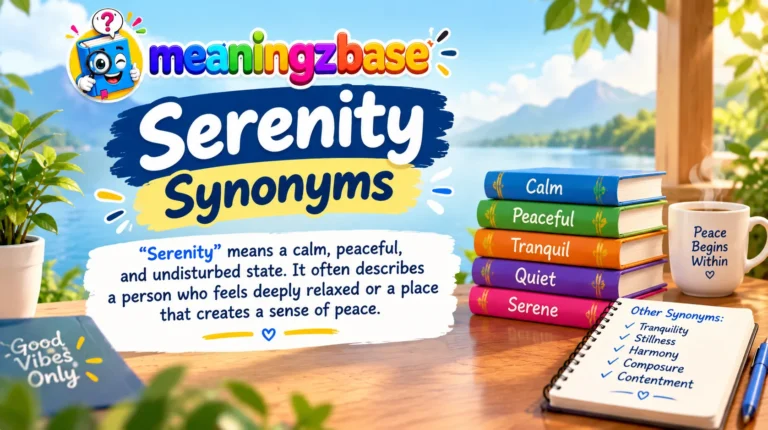
Serenity is a beautiful word, but using it again and again can make your writing feel limited.
That is why many people search for serenity synonyms when they want a fresh way to describe peace, calm, or a quiet state of mind.
The right alternative can make a sentence sound more natural, emotional, formal, or powerful.
Word variety is especially useful when writing essays, articles, emails, stories, speeches, and professional documents.
In academic writing, a well-chosen synonym can help avoid repetition and show stronger vocabulary.
In professional writing, it can make an idea sound polished without becoming difficult to understand. In casual conversation, simpler words may feel warmer and more natural.
However, not every synonym for serenity means exactly the same thing.
Some words focus on inner peace, while others describe a peaceful place, a calm person, or freedom from stress.
Learning these small differences helps you choose the best word for each situation.
This guide explores useful serenity synonyms, stronger and softer alternatives, academic vocabulary, common mistakes, and practical examples.
By the end, you will know how to use these words naturally instead of simply replacing one word with another.
What Does “Serenity” Mean?
Serenity means a calm, peaceful, and undisturbed state. It often describes a person who feels deeply relaxed or a place that creates a sense of peace.
The word has a gentle and slightly elegant tone. It is more expressive than simple words such as “calm” or “quiet.” Serenity can suggest emotional balance, mental peace, or a peaceful atmosphere.
For example:
She enjoyed the serenity of the garden after a busy day.
Here, serenity means the garden gave her a calm and peaceful feeling.
Serenity is commonly used when talking about nature, meditation, personal feelings, peaceful surroundings, and emotional well-being. It also appears often in literary, reflective, and descriptive writing.
The word can describe both a person and a place:
- A person may have serenity after overcoming stress.
- A lake may have a sense of serenity because it is still and quiet.
- A peaceful moment may bring serenity after a difficult experience.
The best synonym depends on what kind of peace you want to describe.
15+ Best Synonyms for “Serenity”
Calmness
Definition: A peaceful state without worry, excitement, or stress.
Tone: Casual / Formal
Example: Her calmness helped everyone remain focused during the crisis.
Calmness is one of the easiest replacements for serenity. It works well in everyday speech and general writing. It usually describes a person’s emotional state, but it can also describe an atmosphere.
Peacefulness
Definition: A state or quality marked by peace, quiet, and freedom from disturbance.
Tone: Formal / Casual
Example: We loved the peacefulness of the countryside.
Peacefulness is very close to serenity in meaning. It is useful when describing places, situations, or moments that feel free from noise and conflict.
Tranquility
Definition: A deep sense of quiet and peacefulness.
Tone: Formal / Literary
Example: The small village offered a welcome sense of tranquility.
Tranquility is one of the strongest direct synonyms for serenity. It often appears in travel writing, nature descriptions, essays, and reflective writing.
Peace
Definition: A state of quiet, freedom from conflict, or inner calm.
Tone: Casual / Formal / Academic
Example: Spending time near the sea gave him a feeling of peace.
Peace is simple and highly flexible. It can describe emotional calm, social harmony, or a quiet environment.
Stillness
Definition: A state in which there is very little movement, noise, or activity.
Tone: Literary / Formal
Example: She enjoyed the stillness of the forest before sunrise.
Stillness focuses more on the absence of movement and noise than serenity does. It is especially effective in descriptive and literary writing.
Composure
Definition: The ability to remain calm and controlled, especially under pressure.
Tone: Formal / Professional
Example: Despite the difficult questions, the speaker maintained her composure.
Composure is best used for people rather than peaceful locations. It suggests emotional control during a challenging situation.
Equanimity
Definition: A balanced and calm state of mind, even during difficulty.
Tone: Formal / Academic
Example: He handled the criticism with remarkable equanimity.
Equanimity is an advanced word that works well in academic and professional writing. It suggests calmness combined with emotional balance.
Quietude
Definition: A peaceful state with little noise or activity.
Tone: Literary / Formal
Example: The writer moved to the countryside to enjoy its quietude.
Quietude has a more artistic and literary feel. It is useful when you want to create a picture of deep, undisturbed quiet.
Repose
Definition: A state of rest, relaxation, or peaceful calm.
Tone: Formal / Literary
Example: The garden provided a place of repose after a long journey.
Repose can refer to rest as well as peacefulness. It is less common in everyday speech but can add variety to descriptive writing.
Placidity
Definition: A calm and gentle state with little disturbance or excitement.
Tone: Formal / Literary
Example: The placidity of the lake made the morning feel almost unreal.
Placidity is often used to describe calm people, animals, water, or settings. It can suggest a very steady kind of peace.
Relaxation
Definition: A state of physical or mental rest after tension or effort.
Tone: Casual / Formal
Example: Reading before bed gives me a feeling of relaxation.
Relaxation is a practical alternative when serenity refers to relief from stress. It is less poetic but very natural in everyday writing.
Contentment
Definition: A quiet feeling of satisfaction with one’s current situation.
Tone: Formal / Casual
Example: She felt a deep sense of contentment while sitting with her family.
Contentment is related to serenity but has an important difference. It focuses on being satisfied rather than simply being calm.
Inner Peace
Definition: A deep feeling of calm and emotional balance within oneself.
Tone: Casual / Formal / Literary
Example: Meditation helped him find greater inner peace.
Inner peace is a strong choice when discussing emotions, personal growth, mindfulness, or mental balance. It is especially common in modern self-development writing.
Ease
Definition: A relaxed state without worry, pressure, or discomfort.
Tone: Casual / Formal
Example: Her friendly voice immediately put the nervous students at ease.
Ease is a simple and natural word. It often works better than serenity when describing relief from tension.
Calm
Definition: A peaceful state with little stress, noise, or emotional disturbance.
Tone: Casual / Formal
Example: The calm of the evening helped her clear her thoughts.
Calm is one of the most useful alternatives because it can describe people, places, emotions, weather, and situations.
Harmony
Definition: A balanced and peaceful state in which things work well together.
Tone: Formal / Academic / Literary
Example: The design creates a sense of harmony between the building and its natural surroundings.
Harmony is not a perfect synonym for serenity, but it can work when peace comes from balance and agreement.
Restfulness
Definition: A quality that makes someone feel relaxed, peaceful, and ready to rest.
Tone: Casual / Formal
Example: The soft music gave the room a feeling of restfulness.
Restfulness is useful when serenity is connected to sleep, relaxation, or a comfortable environment.
Untroubledness
Definition: A state of being free from worry, trouble, or emotional disturbance.
Tone: Formal / Literary
Example: Childhood memories often gave her a sense of untroubledness.
This word is less common but can be useful in reflective writing. It highlights the absence of worry rather than simply the presence of peace.
Stronger Alternatives
Sometimes serenity is not strong enough to express the depth of peace you want to describe. In these cases, a more powerful expression can create greater emotional impact.
- Profound tranquility — Use this when the peace is very deep and meaningful.
The retreat gave her a sense of profound tranquility. - Deep inner peace — Best for personal growth, meditation, and emotional healing.
After years of stress, he finally discovered deep inner peace. - Complete calm — Useful when you want to show that tension has almost completely disappeared.
The room fell into complete calm after the announcement. - Absolute stillness — Best for nature, quiet places, and dramatic descriptions.
The mountain was surrounded by absolute stillness. - Deep repose — A more literary way to describe profound rest and calm.
The old house seemed to rest in deep repose. - Perfect tranquility — Useful in descriptive or promotional writing when a setting feels exceptionally peaceful.
The private garden offered perfect tranquility. - Unshakable composure — Best for a person who remains calm under serious pressure.
The leader showed unshakable composure during the debate.
These stronger expressions should be used carefully. If every peaceful moment is described as “absolute” or “perfect,” the writing can lose its natural feel.
Softer or Polite Alternatives
Not every sentence needs a powerful word. Sometimes a softer alternative sounds more natural, friendly, or polite.
- Calmness — A simple and safe choice for most situations.
- Peacefulness — Gentle and suitable for places or quiet moments.
- Quiet — Very simple and natural in casual writing.
- Ease — Good when someone feels less worried or tense.
- Comfort — Useful when peace comes from feeling safe or supported.
- Relaxation — Best when someone is resting after stress or work.
- Quiet time — A warm, everyday expression for peaceful personal time.
- A sense of calm — A polite and flexible phrase for both personal and professional writing.
For example, instead of saying:
The meeting created serenity.
you might say:
The meeting created a sense of calm.
The second sentence sounds more natural because “serenity” can feel too poetic for an ordinary business setting.
Academic & IELTS-Friendly Alternatives
Strong vocabulary can improve academic and IELTS writing, but advanced words should always be used correctly. A difficult word is not automatically a better word.
Here are useful alternatives:
| Vocabulary | Best Use |
|---|---|
| Tranquility | Peaceful places, environments, and conditions |
| Equanimity | Emotional balance under pressure |
| Composure | Controlled behavior during difficult situations |
| Placidity | A very calm person, setting, or environment |
| Quietude | Literary or formal descriptions of peaceful places |
| Repose | Rest and peaceful relaxation |
| Peacefulness | General descriptions of calm environments |
| Stillness | Lack of movement or noise |
| Contentment | Satisfaction with one’s circumstances |
| Harmony | Balance between people, ideas, or surroundings |
| Emotional stability | Formal discussion of balanced emotions |
| Mental calm | Academic or general discussion of a peaceful mind |
For IELTS, context matters more than vocabulary difficulty. For example, tranquility is a natural choice in an essay about tourism:
Rural tourism can provide visitors with tranquility away from crowded cities.
In contrast, equanimity would be more suitable for an essay discussing how people respond to stress:
Developing equanimity can help individuals respond to pressure in a more balanced way.
Avoid forcing advanced vocabulary into sentences where a simple word is clearer. Good IELTS vocabulary should sound natural, not memorized.
Synonyms You Should Avoid
Some words may look similar to serenity but can change the meaning of your sentence.
Silence
Silence means an absence of sound. A silent place may be peaceful, but silence itself does not always mean serenity.
Incorrect idea: The hospital was filled with serenity because nobody spoke.
A better choice might be silence if you are only talking about the lack of sound.
Solitude
Solitude means being alone or away from other people. A person may enjoy solitude and feel serene, but the two ideas are not identical.
Example: She valued solitude while working on her book.
The sentence does not necessarily mean she felt peaceful.
Happiness
Happiness describes pleasure or positive emotion. Serenity is usually calmer and less excited.
Someone can be serene without being especially happy.
Indifference
Indifference means a lack of interest, concern, or emotional reaction. It can sometimes look like calmness, but the meaning is very different.
A person who does not care about a problem may seem calm, but that does not mean they have serenity.
Boredom
Boredom means a lack of interest or excitement. A quiet afternoon can be serene, but it can also be boring.
Replacing serenity with boredom can completely change the emotional meaning of a sentence.
The key lesson is simple: related words are not always interchangeable. Always check what the sentence is actually trying to communicate.
How to Choose the Right Synonym in Writing
Choosing the right synonym is more than finding a word with a similar meaning. Consider four main points.
Context
First, ask what you are describing.
If you are describing a peaceful beach, tranquility, peacefulness, or stillness may work well.
If you are describing someone’s behavior during an emergency, composure or equanimity is usually better.
If you are describing personal satisfaction, contentment may be the best choice.
Tone
Think about how your writing should sound.
For casual writing, choose words such as:
- calm
- peace
- ease
- relaxation
For formal writing, consider:
- tranquility
- composure
- equanimity
- harmony
For literary writing, words such as quietude, stillness, and repose can create a more vivid mood.
Audience
Your reader also matters. A simple word is often better for a general audience.
For example:
The quiet garden helped her relax.
This is easy for almost everyone to understand.
A more advanced version is:
The garden provided a sense of tranquility.
Both sentences work, but the second has a more formal and descriptive tone.
Clarity
Never choose a synonym only because it sounds impressive. Make sure it carries the meaning you want.
For example, contentment is not always a replacement for serenity because it suggests satisfaction. Solitude focuses on being alone. Silence focuses on sound.
The strongest writing is not the writing with the hardest vocabulary. It is the writing that uses the most accurate vocabulary.
Example Paragraph Rewritten Using Synonyms
Original sentence:
After a stressful week at work, Maria visited a quiet lake. The serenity of the place helped her relax and think clearly. She enjoyed the peaceful surroundings and felt calm again.
Rewrite using different synonyms:
After a stressful week at work, Maria visited a quiet lake. The tranquility of the place helped her relax and clear her mind. The stillness of the water gave her a sense of inner peace, while the peaceful surroundings restored her calmness.
The rewritten version avoids repeating “serenity” and “calm” while keeping the original meaning. Each replacement also adds a slightly different shade of meaning.
Tranquility highlights the peaceful setting.
Stillness draws attention to the quiet water.
Inner peace focuses on Maria’s emotional state.
Calmness describes how she feels afterward.
This shows why good synonym use is not simply about replacing words. It is about choosing a word that fits the exact idea.
FAQs
What is the best synonym for serenity?
Tranquility is one of the closest synonyms for serenity. Other good choices include peacefulness, calmness, quietude, stillness, and inner peace, depending on the context.
What is a stronger word for serenity?
Expressions such as profound tranquility, deep inner peace, absolute stillness, and perfect tranquility can express a stronger sense of serenity.
What is a simple synonym for serenity?
Calm, peace, and calmness are simple and common alternatives. They are easy to understand and work well in everyday writing.
What is a formal synonym for serenity?
Tranquility, equanimity, composure, and placidity can work as formal alternatives. The correct choice depends on whether you are describing a person, place, or emotional state.
What is the synonym of serenity in IELTS?
Useful IELTS-friendly alternatives include tranquility, peacefulness, composure, equanimity, harmony, contentment, stillness, and repose. Use each only when its meaning fits the sentence.
Is tranquility the same as serenity?
They are very close, but they are not always identical. Both describe peace and calm, while tranquility often emphasizes a peaceful environment or undisturbed condition.
What is the opposite of serenity?
Common opposites include stress, anxiety, agitation, turmoil, unrest, tension, and distress. The best opposite depends on the original context.
Conclusion
Knowing different serenity synonyms can make your writing clearer, more varied, and more expressive.
Words such as tranquility, calmness, peacefulness, stillness, composure, equanimity, quietude, contentment, and inner peace all connect to the idea of serenity, but each carries its own shade of meaning.
The best choice depends on your context, tone, audience, and purpose. For everyday writing, simple words like “calm” and “peace” are often enough.
For academic or formal work, “tranquility,” “composure,” or “equanimity” may be more suitable. In literary writing, “quietude,” “stillness,” and “repose” can create a stronger mood.
Instead of searching for the most complicated synonym, choose the word that expresses your exact meaning. That approach will make your writing sound natural, confident, and precise.

Evan Blake is a passionate language enthusiast who creates simple and informative content about word meanings, slang, phrases, and modern expressions.
He focuses on making complex or unfamiliar words easy to understand through clear explanations and practical examples.