If you are looking for synonyms for spooky, you may want a better word than “spooky” to describe a strange, frightening, or mysterious feeling.
The word is common, but using the same word again and again can make your writing feel flat.
Choosing the right alternative can make a story more vivid, a school assignment clearer, or a description more interesting.
Word variety is useful in many types of writing. In academic work, a more precise word can help explain an unusual atmosphere or disturbing event.
In professional writing, the right term can make a description sound clear and controlled. In casual conversation, simple words such as “creepy” or “scary” may sound more natural.
However, not every synonym for spooky has the same meaning.
Some words describe fear, while others focus on mystery, darkness, or an uncomfortable feeling. Some are mild, while others suggest serious danger.
This guide explains the best synonyms for spooky, including stronger words, softer alternatives, academic choices, and words that can be misleading in certain situations.
By the end, you will know which word fits your sentence, audience, and tone best.
What Does “Spooky” Mean?
Spooky describes something that makes you feel slightly afraid, nervous, or uncomfortable, often because it seems strange, mysterious, or connected with the unknown.
The word usually has a lighter tone than words such as “terrifying” or “horrifying.” A spooky old house, for example, may look dark and strange without being truly dangerous. A spooky sound may make you nervous because you cannot explain where it came from.
“Spooky” is common in everyday English. It is often used when talking about haunted houses, ghost stories, dark places, unusual sounds, Halloween, strange events, or mysterious situations.
The tone can also change depending on the context. In a casual sentence, “spooky” may sound playful. In a horror story, it can create a sense of suspense. In formal or academic writing, a more precise word is often better.
For example:
- Casual: That old house looks spooky.
- Literary: A strange silence filled the spooky forest.
- More formal: The abandoned building created an eerie atmosphere.
15+ Best Synonyms for “Spooky”
Creepy
Definition: Something that makes you feel uncomfortable, nervous, or slightly afraid.
Tone: Informal / Casual
Example: The creepy doll seemed to follow her with its eyes.
“Creepy” is one of the closest everyday alternatives to “spooky.” It often describes something that feels wrong or unsettling rather than openly dangerous.
Eerie
Definition: Strange and unsettling in a way that creates a feeling of fear or mystery.
Tone: Literary / Formal
Example: An eerie silence settled over the empty street.
“Eerie” is an excellent choice when something feels unusual, quiet, or mysterious. It is especially useful for descriptive and creative writing.
Scary
Definition: Something that causes fear or makes a person feel afraid.
Tone: Casual
Example: The movie was too scary for the younger children.
“Scary” is simple and widely understood. It is useful when the main idea is direct fear rather than mystery.
Frightening
Definition: Causing fear or making someone feel afraid.
Tone: Formal / Neutral
Example: The hikers heard a frightening noise coming from the trees.
“Frightening” is more neutral than “spooky” and works well in school, professional, and general writing.
Chilling
Definition: Creating a strong feeling of fear, unease, or discomfort.
Tone: Literary / Formal
Example: The witness gave a chilling account of what happened.
“Chilling” is useful when an experience creates a deep emotional reaction. It can describe a story, voice, event, scene, or discovery.
Haunting
Definition: Creating a strong and lasting feeling of sadness, fear, or mystery.
Tone: Literary
Example: The abandoned village had a haunting beauty.
“Haunting” does not always mean frightening. It can describe something memorable and emotionally powerful, especially when it stays in your thoughts.
Sinister
Definition: Giving the impression that something harmful, evil, or dangerous may happen.
Tone: Formal / Literary
Example: The man gave the group a sinister smile.
“Sinister” is stronger than “spooky.” It suggests possible evil or harmful intentions.
Unsettling
Definition: Making you feel nervous, uncomfortable, or unsure.
Tone: Formal / Neutral
Example: There was something unsettling about the empty room.
“Unsettling” is a useful choice when you want to show discomfort without suggesting extreme fear.
Ominous
Definition: Suggesting that something bad or unpleasant may happen.
Tone: Formal / Literary
Example: Dark clouds gathered under an ominous sky.
“Ominous” focuses more on a warning of future trouble than on fear itself.
Ghostly
Definition: Resembling a ghost or creating the feeling of something supernatural.
Tone: Literary / Casual
Example: A ghostly figure appeared near the old gate.
“Ghostly” works well for descriptions involving pale shapes, shadows, spirits, or supernatural images.
Supernatural
Definition: Connected with events or beings that cannot be explained by normal natural laws.
Tone: Formal / Academic
Example: The novel contains several supernatural events.
“Supernatural” is more specific than “spooky.” It should be used when the subject involves ghosts, spirits, magical forces, or other unexplained phenomena.
Frightful
Definition: Very unpleasant, alarming, or frightening.
Tone: Literary / Formal
Example: The travelers faced a frightful storm during the night.
“Frightful” can sound old-fashioned in everyday speech, but it can work well in stories and descriptive writing.
Terrifying
Definition: Causing extreme fear.
Tone: Strong / Formal
Example: The sudden explosion was terrifying.
“Terrifying” is much stronger than “spooky.” Use it when the person experiences serious or intense fear.
Menacing
Definition: Showing or suggesting a threat or danger.
Tone: Formal / Literary
Example: A menacing figure stood at the end of the hallway.
“Menacing” is useful when something appears threatening. It does not simply mean strange or mysterious.
Macabre
Definition: Connected with death or disturbing subjects in a dark and unusual way.
Tone: Literary / Academic
Example: The artist was known for his macabre paintings.
“Macabre” is a specialized word. It is suitable when death, corpses, violence, or dark themes are central to the description.
Disturbing
Definition: Causing worry, discomfort, shock, or emotional unease.
Tone: Formal / Neutral
Example: The documentary revealed some disturbing facts.
“Disturbing” is broader than “spooky.” It can describe information, behavior, images, events, or situations that make people deeply uncomfortable.
Unnerving
Definition: Making someone lose confidence or feel nervous and uncomfortable.
Tone: Formal / Literary
Example: The strange sound was unnerving because no one could explain it.
“Unnerving” is a strong choice when the main effect is nervousness rather than outright terror.
Mysterious
Definition: Difficult to understand, explain, or identify.
Tone: Neutral / Formal
Example: A mysterious light appeared over the hills.
“Mysterious” is not always frightening. It works when the unknown or unexplained quality is more important than fear.
Creepy-Crawly
Definition: Describing insects, small creatures, or things that cause a feeling of disgust or fear.
Tone: Informal / Casual
Example: The basement was full of creepy-crawly insects.
This phrase is playful and informal. It is best for casual speech, children’s writing, or light descriptions.
Spectral
Definition: Relating to a ghost or something that looks ghost-like.
Tone: Literary / Academic
Example: A spectral shape moved across the fog.
“Spectral” is a more advanced alternative to “ghostly” and works especially well in descriptive or literary writing.
Stronger Alternatives
Sometimes “spooky” is not strong enough. If the situation creates serious fear, danger, or shock, choose a stronger word.
- Terrifying — Use it for extreme fear, such as a life-threatening event or deeply frightening experience.
- Horrifying — Best when something causes intense fear, shock, or disgust.
- Frightening — A strong but neutral choice for something that causes fear.
- Chilling — Useful when something creates a deep sense of fear or dread.
- Menacing — Best when something appears to pose a threat.
- Sinister — Use it when something seems connected to evil or harmful intentions.
- Dreadful — Suitable for something extremely unpleasant or frightening, though it can sound somewhat old-fashioned.
- Terrific in intensity — In modern usage, avoid confusing “terrific” with “terrifying”; “terrific” usually means excellent, not frightening.
For example, a dark hallway may be spooky, but hearing footsteps behind you when you are alone may be unnerving or frightening. A direct threat may be menacing, while an extremely violent scene may be horrifying.
Softer or Polite Alternatives
Not every situation needs a strong word. Sometimes you want to describe an unusual feeling without making the subject sound truly frightening.
- Unusual — A simple choice when something is different from normal.
- Strange — Good for something that seems unusual or hard to explain.
- Mysterious — Focuses on the unknown rather than fear.
- Unsettling — Gentle enough for many formal situations while still showing discomfort.
- Odd — A casual word for something unusual or unexpected.
- Unfamiliar — Useful when something feels strange because you do not know it well.
- Atmospheric — Good for describing a place with a strong mood, especially in creative writing.
- Haunting — Can suggest mystery or emotion without directly saying something is frightening.
For example, instead of saying, “The building was spooky,” you could write, “The building had an unusual atmosphere.” This sounds softer and more neutral.
Academic & IELTS-Friendly Alternatives
In academic essays, IELTS writing, reports, and formal descriptions, simple words such as “spooky” may not always be the best choice. More precise vocabulary can make your writing clearer and more mature.
Eerie
Useful for an unusual and unsettling atmosphere.
Example: The deserted village had an eerie atmosphere.
Unsettling
Useful when something causes discomfort or concern.
Example: The findings presented an unsettling picture of the situation.
Disturbing
Useful for events, information, images, or behavior that causes concern.
Example: The report revealed several disturbing patterns.
Ominous
Useful when something suggests that a negative event may happen.
Example: The sudden change in weather created an ominous atmosphere.
Unnerving
Useful when something makes people nervous or uncomfortable.
Example: The lack of communication was particularly unnerving for the residents.
Sinister
Useful when something appears threatening or harmful.
Example: The investigation uncovered a sinister pattern of behavior.
Supernatural
Useful when discussing events or beliefs involving forces beyond normal scientific explanation.
Example: The study examines cultural beliefs about supernatural experiences.
Macabre
Useful for academic or literary discussion involving death and disturbing imagery.
Example: The novel uses macabre imagery to create a sense of fear.
Mysterious
Useful when the cause or meaning of something remains unknown.
Example: Researchers attempted to explain the mysterious disappearance.
Chilling
Useful for describing an event, account, discovery, or statement that creates strong fear.
Example: The witness provided a chilling description of the incident.
For IELTS, the best word is not always the most difficult one. Precision matters more than complexity. A clear word such as “unsettling” is usually better than using an advanced word incorrectly.
Synonyms You Should Avoid
Some words look like good synonyms for “spooky,” but they can change the meaning of your sentence.
Evil
“Evil” suggests serious moral wrongdoing or wickedness. Something can be spooky without being evil.
Less suitable: The spooky forest was evil.
Better: The spooky forest was eerie.
Dangerous
“Dangerous” means capable of causing harm. A spooky place may be completely safe.
Example: A dark house can look spooky without being dangerous.
Weird
“Weird” means strange or unusual. It does not necessarily suggest fear.
Example: The machine made a weird noise.
Use “weird” when strangeness is the main idea, not fear.
Depressing
“Depressing” describes something that makes a person feel sad, hopeless, or unhappy. It is not a direct synonym for spooky.
Example: The empty town looked depressing.
This describes sadness more than fear.
Horrible
“Horrible” is a broad word meaning very bad, unpleasant, or upsetting. It can sometimes replace “spooky,” but it often loses the specific sense of mystery or fear.
Better choice: Use “eerie” if the atmosphere is strange and frightening.
How to Choose the Right Synonym in Writing
Choosing the right synonym is not simply about finding a different word. You need to consider what you actually want the reader to feel or understand.
Consider the Context
First, ask what makes the situation spooky.
Is it:
- Strange?
- Quiet?
- Mysterious?
- Threatening?
- Supernatural?
- Frightening?
- Connected with death?
If the place is strange and quiet, eerie may work. If it seems dangerous, menacing may be better. If ghosts are involved, ghostly or supernatural may be more accurate.
Consider the Tone
Your word should match the style of your writing.
For casual writing, choose words such as:
- Creepy
- Scary
- Weird
For formal writing, consider:
- Unsettling
- Ominous
- Disturbing
- Unnerving
For literary writing, words such as:
- Haunting
- Eerie
- Macabre
- Spectral
can create a stronger mood.
Consider Your Audience
Think about who will read your writing. A young reader may understand “scary” more easily than “macabre.” An academic audience may expect more precise vocabulary.
The goal is not to impress readers with difficult words. The goal is to communicate your meaning clearly.
Consider Clarity
Never choose a synonym simply because it sounds advanced.
For example, “spectral” may sound impressive, but it is not the right choice for every spooky situation. If you simply mean that a room feels uncomfortable, “unsettling” is clearer.
Good vocabulary makes your meaning stronger. It should not make your sentence harder to understand.
Example Paragraph Rewritten Using Synonyms
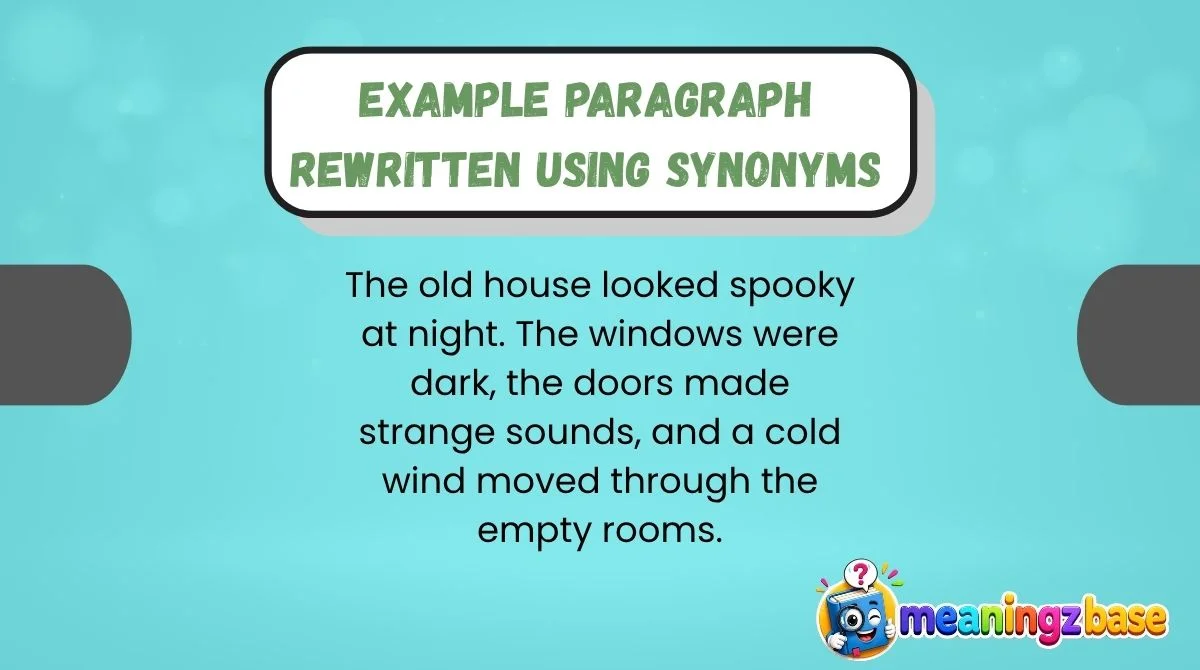
Original Sentence
The old house looked spooky at night. The windows were dark, the doors made strange sounds, and a cold wind moved through the empty rooms.
Rewrite Using Different Synonyms
The old house looked eerie at night. Its dark windows and creepy corridors created an unsettling atmosphere. The doors made unnerving sounds, while a cold wind moved through the empty rooms. In the distance, a ghostly shadow appeared behind one of the windows, giving the entire building a haunting appearance.
This version avoids repeating “spooky” while giving each detail a slightly different meaning. “Eerie” describes the overall mood, “creepy” adds discomfort, “unnerving” focuses on nervousness, and “ghostly” suggests something supernatural.
FAQs
What is the best synonym for spooky?
Eerie is one of the best synonyms for spooky because it describes something strange, mysterious, and slightly frightening. “Creepy” is also a close choice in casual English.
What is a stronger word for spooky?
Stronger alternatives include terrifying, horrifying, chilling, sinister, menacing, and frightening. The best choice depends on the level and type of fear.
What is a simple synonym for spooky?
Scary is the simplest common synonym. Other easy choices include creepy, strange, and weird, although each has a slightly different meaning.
What is a formal synonym for spooky?
Good formal alternatives include eerie, unsettling, ominous, disturbing, unnerving, and sinister. Choose the word that best describes the specific feeling.
What is a literary synonym for spooky?
Eerie, haunting, spectral, macabre, and ominous are strong literary choices. They can create a vivid atmosphere in stories and descriptive writing.
What is the difference between spooky and creepy?
“Spooky” often suggests a mysterious or supernatural feeling, while “creepy” usually focuses on discomfort or a feeling that something is wrong. The two words overlap, but their emotional focus can differ.
Can spooky be used in formal writing?
Yes, but it is usually better to choose a more precise word in formal writing. Words such as eerie, unsettling, ominous, or disturbing may communicate the intended meaning more clearly.
Conclusion
There are many useful synonyms for spooky, but the best word depends on the exact feeling you want to express.
Eerie works well for a strange and mysterious atmosphere, while creepy is natural in casual English.
Unsettling is useful for formal writing, haunting works well in literary descriptions, and sinister or menacing can suggest a serious threat.
For extreme fear, stronger choices such as terrifying or horrifying are more suitable.
The key is to choose words based on meaning, tone, audience, and context. You do not need the most complicated word to make your writing better.
A precise and natural synonym will always be more effective than an advanced word used in the wrong way.
Whether you are writing an essay, preparing for IELTS, creating a story, or simply improving your vocabulary, using the right alternative to “spooky” can make your writing clearer, richer, and more engaging.
SEO Meta Description:
Use up and down arrow keys to resize the meta box pane.
Move upMove downShow or hide panel
Move upMove downShow or hide panel

Evan Blake is a passionate language enthusiast who creates simple and informative content about word meanings, slang, phrases, and modern expressions.
He focuses on making complex or unfamiliar words easy to understand through clear explanations and practical examples.