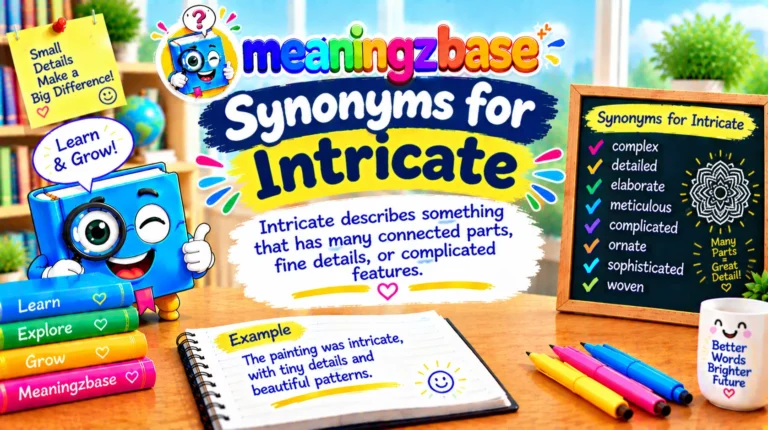
When you need to describe something with many small parts, complex details, or a hard-to-follow design, the word intricate is often a good choice.
But using the same word again and again can make your writing feel flat.
That is why many writers search for synonyms for intricate that fit different situations, tones, and audiences.
Choosing the right synonym can make a big difference.
A formal word may work well in an academic essay, while a simple alternative may sound more natural in everyday speech.
In professional writing, the right choice can make an idea clearer without making it sound overly complex.
In creative writing, a more vivid word can help readers picture a detailed object, scene, or process.
This guide explores useful alternatives to intricate for academic, professional, casual, and creative writing.
You will learn what each word means, how strong it sounds, and when it works best.
You will also find stronger and softer alternatives, IELTS-friendly vocabulary, words to avoid in certain contexts, and examples that show how to choose the best synonym.
What Does “Intricate” Mean?
Intricate describes something that has many connected parts, fine details, or complicated features. It often suggests that something is not simple and may require careful attention to understand, make, or complete.
For example:
- The artist created an intricate pattern on the wall.
- The machine has an intricate system of gears.
- She explained the intricate details of the plan.
The word can describe both physical and abstract things. You can have an intricate design, an intricate pattern, an intricate process, an intricate argument, or an intricate relationship.
Its tone is usually neutral to formal. It is common in professional, academic, and descriptive writing. It can also appear in everyday speech when people want to stress the fine details or complexity of something.
One important point is that intricate does not always mean simply “difficult.” It often focuses on the number and connection of small details. A task can be difficult without being intricate, while an intricate design may be complex but carefully organized.
15+ Best Synonyms for “Intricate”
1. Complex
Definition: Made up of many connected parts or ideas that are not easy to understand.
Tone: Formal / Academic / Neutral
Example: The researchers developed a complex model to explain the results.
Complex is one of the closest general alternatives to intricate. It works for systems, ideas, problems, processes, and designs.
2. Complicated
Definition: Difficult to understand, manage, or complete because it has many parts or steps.
Tone: Neutral / Casual
Example: The instructions looked complicated, so I read them twice.
Complicated is useful when the main focus is difficulty. It is often more common in everyday English than intricate.
3. Elaborate
Definition: Carefully developed with many details, features, or parts.
Tone: Formal / Literary
Example: They prepared an elaborate plan for the school event.
Use elaborate when something has been developed with care and contains many details. It can sometimes suggest richness rather than difficulty.
4. Detailed
Definition: Containing a large amount of specific information or many small features.
Tone: Neutral / Academic / Professional
Example: The report provides a detailed explanation of the new policy.
Detailed is a safe choice when clarity matters. It does not necessarily suggest that something is difficult.
5. Sophisticated
Definition: Highly developed, advanced, or carefully designed.
Tone: Formal / Academic / Professional
Example: The company uses a sophisticated security system.
Sophisticated is useful when complexity comes with skill, quality, or advanced development.
6. Complicatedly Designed
Definition: Created with many connected features or carefully arranged parts.
Tone: Formal / Descriptive
Example: The building is complicatedly designed, with several levels and hidden passages.
This phrase is more specific than intricate and works best when discussing physical structures, products, or systems.
7. Multifaceted
Definition: Having many different parts, sides, qualities, or aspects.
Tone: Formal / Academic
Example: Climate change is a multifaceted issue with social and economic effects.
Use multifaceted for subjects, problems, people, and situations that have many different dimensions.
8. Complexified
Definition: Made more complex by adding layers, features, or conditions.
Tone: Academic / Technical
Example: The new rules have complexified the process of applying for support.
This is less common than complex and is best used when you specifically mean that something has become more complex.
9. Labyrinthine
Definition: Extremely complicated and difficult to follow, like a maze.
Tone: Literary / Formal
Example: The company became trapped in a labyrinthine network of regulations.
Labyrinthine is much stronger than intricate. It suggests confusion and difficulty finding a clear path.
10. Convoluted
Definition: Unnecessarily complex, twisted, or difficult to follow.
Tone: Formal / Academic
Example: The lawyer gave a convoluted explanation of the contract.
Be careful with this word. Unlike intricate, convoluted often carries a negative meaning.
11. Ornate
Definition: Highly decorated with many artistic or decorative details.
Tone: Literary / Formal
Example: The palace has an ornate entrance covered with carved designs.
Use ornate mainly for decoration, architecture, clothing, furniture, or visual art.
12. Detailed
Definition: Full of small pieces of information or careful features.
Tone: Academic / Professional / Neutral
Example: The engineer prepared a detailed diagram of the machine.
Although detailed is simpler than intricate, it is often the best choice when your goal is clarity.
13. Nuanced
Definition: Showing small but important differences in meaning, feeling, or opinion.
Tone: Academic / Formal
Example: The author gives a nuanced view of the social issue.
Nuanced is especially useful for arguments, opinions, discussions, and analysis.
14. Sophisticated
Definition: Advanced or carefully developed rather than simple or basic.
Tone: Formal / Professional
Example: Modern hospitals rely on sophisticated medical equipment.
Use this word when complexity is connected to advancement, expertise, or high quality.
15. Intricately Woven
Definition: Closely connected or formed from many carefully linked parts.
Tone: Literary / Descriptive
Example: The novel contains an intricately woven story of family and friendship.
This phrase works well for stories, relationships, patterns, fabrics, and connected ideas.
16. Tangled
Definition: Mixed together in a way that makes something hard to understand or separate.
Tone: Informal / Literary
Example: The investigation uncovered a tangled web of financial problems.
Tangled is more vivid and often suggests disorder.
17. Sophisticatedly Structured
Definition: Organized in an advanced way with several connected elements.
Tone: Academic / Professional
Example: The course is sophisticatedly structured to develop advanced research skills.
This phrase is useful when discussing systems, programs, plans, or organizations.
18. Detailed and Complex
Definition: Containing both many specific features and several connected parts.
Tone: Academic / Professional
Example: The team created a detailed and complex strategy for the project.
This combination is useful when one synonym alone does not fully express the intended meaning.
Stronger Alternatives
Sometimes intricate is not strong enough. If something is extremely complex, difficult, or confusing, consider these alternatives:
- Convoluted — Use it when something is difficult to follow, especially because it is overly complicated.
- Labyrinthine — Best for systems, rules, stories, or processes that feel like a maze.
- Byzantine — Useful for extremely complicated systems, especially rules, organizations, or procedures.
- Complicated — A broad and simple choice for something difficult to understand or manage.
- Formidable — Use it when the complexity creates a serious challenge.
- Multilayered — Good for ideas, stories, problems, or systems with several levels.
- Highly complex — A clear academic and professional phrase when you need strong but direct language.
- Mind-boggling — A casual option for something extremely difficult to understand or imagine.
For example, “an intricate legal system” sounds complex but controlled. “A labyrinthine legal system” suggests that the system is so complicated that people may struggle to navigate it.
Softer or Polite Alternatives
Sometimes you want to describe complexity without making something sound difficult or negative. These alternatives can help:
- Detailed — Focuses on the amount of information rather than difficulty.
- Elaborate — Suggests care and development without necessarily sounding negative.
- Sophisticated — Adds a sense of quality or advancement.
- Refined — Suggests careful development and improvement.
- Layered — Shows that something has several levels or meanings.
- Multifaceted — Highlights different sides or aspects.
- Rich — Useful in creative writing when something contains many interesting qualities.
- Thorough — Best when the focus is on completeness and careful attention.
For example, instead of saying, “The instructions are complicated,” you could say, “The instructions are detailed.” The second version sounds less critical.
Academic & IELTS-Friendly Alternatives
If you are writing an IELTS essay, university assignment, research paper, or formal report, variety can make your vocabulary stronger. However, advanced vocabulary should always fit the meaning.
Here are useful options:
- Complex — Excellent for systems, issues, relationships, and processes.
- Multifaceted — Strong for problems that have several different aspects.
- Sophisticated — Useful for advanced methods, systems, technology, and analysis.
- Nuanced — Best for arguments, opinions, and subtle differences.
- Elaborate — Good for plans, systems, designs, and explanations.
- Multilayered — Useful for social issues, texts, stories, and arguments.
- Convoluted — Appropriate when complexity makes something difficult to follow.
- Detailed — A clear and safe choice for reports, explanations, and descriptions.
- Intricately structured — Useful for systems, organizations, texts, and processes.
- Highly complex — Direct and strong for academic analysis.
- Interconnected — Useful when many parts affect one another.
- Multidimensional — Good for subjects involving several perspectives or factors.
For IELTS, do not replace every use of intricate with a difficult word. Examiners value accurate vocabulary more than vocabulary that simply sounds advanced.
For example:
Weak choice:
“The government faces a labyrinthine problem.”
Better:
“The government faces a multifaceted problem involving economic, social, and environmental factors.”
The second sentence is clearer and more natural for academic writing.
Synonyms You Should Avoid
Not every word that suggests complexity is a true replacement for intricate. Some alternatives can change your meaning.
1. Difficult
Why to avoid: Difficult focuses on how hard something is, not on how many connected details it contains.
“The exam was difficult” does not mean “The exam was intricate.”
2. Confusing
Why to avoid: Confusing means something is hard to understand. It often suggests poor organization or unclear information.
An intricate design can be beautiful and well organized without being confusing.
3. Messy
Why to avoid: Messy usually suggests disorder, poor organization, or an untidy appearance.
An intricate pattern may contain many details while still being perfectly organized.
4. Ornate
Why to avoid: Ornate mainly describes decoration. It is not a general synonym for complexity.
An ornate building may have detailed decoration, but an intricate argument is not necessarily ornate.
5. Difficult-to-understand
Why to avoid: This phrase focuses only on comprehension. It does not express the fine detail or careful structure that intricate can suggest.
The key lesson is simple: choose a synonym based on the exact meaning you want, not just because the word looks more advanced.
How to Choose the Right Synonym in Writing
Choosing the right alternative depends on four main factors: context, tone, audience, and clarity.
Context
First, ask what you are describing.
For a machine, complex or sophisticated may work well.
For artwork, detailed, ornate, or elaborate may be better.
For an argument, nuanced, multifaceted, or complex may be more accurate.
For a confusing process, convoluted or labyrinthine may fit.
Tone
Think about how you want the sentence to feel.
If you want a neutral tone, use complex or detailed.
If you want a positive tone, consider sophisticated, refined, or elaborate.
If you want a negative tone, convoluted may be suitable.
If you want a literary tone, labyrinthine can create a stronger image.
Audience
A general audience usually benefits from simple vocabulary.
Instead of:
“The organization implemented a multifaceted operational framework.”
You might write:
“The organization created a complex plan with several parts.”
For academic readers, however, multifaceted may be useful when it precisely describes the subject.
Clarity
Never choose a synonym only because it sounds impressive.
If detailed communicates your meaning better than labyrinthine, use detailed.
Good vocabulary is not about using the biggest word. It is about using the right word.
Example Paragraph Rewritten Using Synonyms
Original Sentence
“The company created an intricate plan to improve its online services.”
This sentence is correct, but intricate can be replaced depending on the exact meaning.
Using “Complex”
“The company created a complex plan to improve its online services.”
This version suggests that the plan contains many connected parts.
Using “Detailed”
“The company created a detailed plan to improve its online services.”
This version focuses on the amount of information in the plan.
Using “Elaborate”
“The company created an elaborate plan to improve its online services.”
This suggests that the plan was carefully developed and contains many features.
Using “Sophisticated”
“The company created a sophisticated plan to improve its online services.”
This gives the plan a more advanced or expert feel.
Using “Multifaceted”
“The company created a multifaceted plan to improve its online services.”
This suggests that the plan addresses several different areas or challenges.
Using “Convoluted”
“The company created a convoluted plan to improve its online services.”
This changes the meaning because it suggests that the plan is unnecessarily difficult to understand.
This example shows why synonyms are not always interchangeable. The best replacement depends on the message you want to communicate.
FAQs
What is the best synonym for intricate?
Complex is usually the closest general synonym for intricate. However, detailed, elaborate, sophisticated, or multifaceted may be better depending on the context.
What is a simple synonym for intricate?
Detailed and complex are two simple and useful alternatives. They are easy to understand and work in many types of writing.
What is a stronger word than intricate?
Labyrinthine, convoluted, and highly complex can be stronger than intricate. They are useful when something is extremely difficult to follow or contains many connected parts.
Is complicated a synonym for intricate?
Yes, complicated can be a synonym for intricate in many situations. However, complicated focuses more on difficulty, while intricate often emphasizes fine detail and connected parts.
What is a good synonym for intricate in IELTS?
Complex, multifaceted, sophisticated, nuanced, and multidimensional can work well in IELTS writing when they accurately match the context.
What is the opposite of intricate?
Common opposites include simple, plain, basic, straightforward, and uncomplicated. The best choice depends on what you are describing.
Can intricate have a positive meaning?
Yes. Intricate can have a positive meaning when it describes careful craftsmanship, beautiful artwork, detailed design, or a well-developed system. It does not automatically mean something is bad or confusing.
Conclusion
Knowing different synonyms for intricate can make your writing clearer, more precise, and more interesting.
The closest general alternative is complex, but words such as detailed, elaborate, sophisticated, multifaceted, nuanced, convoluted, and labyrinthine each add a different shade of meaning.
The best choice depends on what you are describing and how you want your reader to understand it.
For academic and IELTS writing, focus on accuracy rather than using advanced words simply to sound impressive. In casual writing, simpler choices are often more natural.
In professional and creative writing, the right synonym can add both precision and style.
Instead of repeating intricate, choose the word that matches the level of complexity, tone, and purpose of your sentence.

Evan Blake is a passionate language enthusiast who creates simple and informative content about word meanings, slang, phrases, and modern expressions.
He focuses on making complex or unfamiliar words easy to understand through clear explanations and practical examples.