
Retention is a useful word, but using the same word again and again can make writing feel plain.
That is why many students, teachers, writers, employees, and English learners search for synonyms of retention.
The right synonym can make an idea clearer, more natural, and better suited to its context.
The word retention can describe keeping something, remembering information, holding employees, maintaining customers, or preserving something over time.
Because it has several meanings, there is no single synonym that works in every sentence.
For example, memory may work when talking about learning, while preservation may fit a discussion about protecting something.
Knowing different alternatives is especially helpful in academic writing, professional communication, reports, essays, and everyday English.
A student may need a stronger word for an essay, while a business writer may need a term related to customer or employee retention.
Casual writing may need a simpler choice.
This guide explains the most useful synonyms of retention, their meanings, tones, and examples.
It also shows which alternatives work in different situations so you can choose the right word with confidence.
What Does “Retention” Mean?
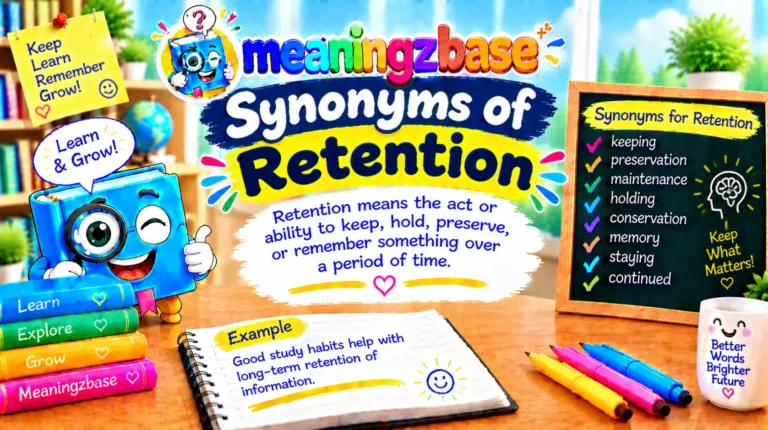
Retention means the act or ability to keep, hold, preserve, or remember something over a period of time.
The exact meaning depends on the context. When discussing learning, retention usually means the ability to remember information.
In business, it often means keeping customers or employees. In other situations, it can mean preserving or maintaining something instead of allowing it to disappear or be lost.
The word has a mostly formal and neutral tone. It is common in academic, business, medical, educational, and professional writing.
It can also appear in everyday English, although simpler words such as keeping or memory may sound more natural in casual conversation.
For example:
- Student retention means keeping students enrolled in a school or program.
- Information retention means keeping information for future use.
- Customer retention means keeping customers over time.
- Memory retention means the ability to remember learned information.
- Water retention means the body or soil holding water.
Because retention has several meanings, always check the context before replacing it with a synonym.
15+ Best Synonyms for “Retention”
1. Keeping
Definition: Keeping means continuing to have, hold, or maintain something instead of losing or giving it away.
Tone: Casual / Neutral
Example: The company focused on keeping its loyal customers.
2. Preservation
Definition: Preservation means protecting something so that it remains safe, useful, or unchanged over time.
Tone: Formal / Academic
Example: The preservation of historical records is important for future generations.
3. Maintenance
Definition: Maintenance means keeping something in a good, working, or existing condition.
Tone: Formal / Professional
Example: Regular maintenance helps with the retention of the building’s original condition.
4. Conservation
Definition: Conservation means protecting and carefully managing something so it is not wasted, damaged, or lost.
Tone: Formal / Academic
Example: Water conservation is necessary in areas with limited rainfall.
5. Storage
Definition: Storage means keeping information, materials, or objects in a place where they can be used later.
Tone: Neutral / Technical
Example: The system provides secure storage of important customer information.
6. Memory
Definition: Memory refers to the ability to keep and recall information, experiences, or events.
Tone: Neutral / Academic
Example: Regular practice can improve memory of new vocabulary.
7. Remembrance
Definition: Remembrance means keeping a person, event, or idea in one’s thoughts or memory.
Tone: Formal / Literary
Example: The monument was built in remembrance of those who served the country.
8. Recall
Definition: Recall is the ability to bring previously learned or experienced information back to the mind.
Tone: Academic / Professional
Example: Short quizzes can improve students’ recall of important facts.
9. Continuance
Definition: Continuance means the act of allowing something to continue or remain in place.
Tone: Formal
Example: The policy supports the continuance of the program for another year.
10. Sustenance
Definition: Sustenance means support that allows something to continue, survive, or remain active.
Tone: Formal / Literary
Example: Financial support provided the sustenance needed to keep the project running.
11. Persistence
Definition: Persistence means continuing to exist, remain, or continue despite difficulty or change.
Tone: Academic / Formal
Example: The persistence of the tradition shows its importance to the community.
12. Continuity
Definition: Continuity means maintaining something without a major break or interruption.
Tone: Formal / Academic
Example: The new manager worked to ensure continuity in the team’s operations.
13. Holding
Definition: Holding means keeping something in one’s possession or maintaining control over it.
Tone: Neutral / Casual
Example: The bank is responsible for holding the documents securely.
14. Preservation of Memory
Definition: This phrase describes keeping information, experiences, stories, or knowledge available for future recall.
Tone: Formal / Academic
Example: Written records help with the preservation of memory across generations.
15. Safekeeping
Definition: Safekeeping means keeping something protected from damage, loss, or theft.
Tone: Formal / Neutral
Example: The documents were placed in a secure location for safekeeping.
16. Conservation of Resources
Definition: This phrase means using resources carefully while preventing unnecessary loss or waste.
Tone: Academic / Professional
Example: Conservation of resources can reduce unnecessary spending.
17. Stability
Definition: Stability refers to the condition of remaining steady, secure, or unchanged over time.
Tone: Formal / Academic
Example: Employee stability can help a business maintain strong performance.
18. Sustaining
Definition: Sustaining means continuing to support, maintain, or keep something active.
Tone: Formal / Professional
Example: The organization is focused on sustaining long-term community programs.
Stronger Alternatives
Sometimes retention does not fully express the strength of an idea. A stronger alternative can show that something is being firmly protected, maintained, or remembered.
Preservation
Use preservation when something is being actively protected from damage, change, or loss.
Example: The preservation of ancient buildings requires careful planning.
Safeguarding
Use safeguarding when the focus is on protecting something from danger or harm.
Example: Safeguarding customer data is a major responsibility for the company.
Conservation
Use conservation when resources, nature, energy, or valuable materials must be protected.
Example: Energy conservation can reduce waste.
Continuity
Use continuity when the main idea is keeping something going without interruption.
Example: The company created a plan to ensure business continuity.
Persistence
Use persistence when something continues to exist or remain despite pressure or change.
Example: The persistence of the problem required further research.
Sustaining
Use sustaining when continued support is necessary to keep something active.
Example: Sustaining employee motivation can improve workplace performance.
Protection
Use protection when keeping something safe is more important than simply keeping it.
Example: Data protection is essential in modern businesses.
Softer or Polite Alternatives
In some writing, retention can sound technical. A simpler or softer alternative may make the sentence easier to understand.
Keeping
Keeping is simple and friendly.
Example: The goal is keeping our customers satisfied.
Maintaining
Maintaining is polite and professional without sounding too strong.
Example: Maintaining good relationships is important for the team.
Holding On To
This phrase is useful in casual writing when someone continues to have something.
Example: She had difficulty holding on to the information she learned.
Remembering
Use remembering when retention means keeping information in your mind.
Example: Reading the material twice helped with remembering key points.
Staying With
This phrase can work in informal contexts involving people, groups, or choices.
Example: Many customers are staying with the company because of its reliable service.
Preserving
Preserving is gentle but still suitable for formal situations involving protection.
Example: The museum is preserving important cultural materials.
Maintaining Interest
Use this phrase when discussing attention or engagement.
Example: Short activities can help with maintaining student interest.
Academic & IELTS-Friendly Alternatives
Academic writing benefits from precise vocabulary. The best alternative depends on what you mean by retention.
Preservation
Useful for history, culture, records, nature, and physical objects.
Example: The preservation of cultural traditions can strengthen community identity.
Conservation
Useful for natural resources, energy, wildlife, and environmental topics.
Example: Conservation of natural resources is important for sustainable development.
Continuity
Useful when discussing systems, services, traditions, organizations, or processes.
Example: Policy continuity can support long-term economic planning.
Maintenance
Useful for systems, standards, equipment, conditions, and performance.
Example: Regular maintenance is necessary to keep public facilities safe.
Persistence
Useful when describing an issue, behavior, condition, or trend that continues.
Example: The persistence of poverty remains a serious social concern.
Recall
Useful in education, psychology, learning, and research.
Example: Repetition can improve the recall of newly learned information.
Memory
Useful when discussing learning and the ability to remember information.
Example: Sleep can play an important role in memory and learning.
Sustenance
Useful in formal discussions about continued support or survival.
Example: Financial support provides sustenance for many community projects.
Stability
Useful when discussing conditions that remain steady over time.
Example: Economic stability can encourage long-term investment.
Safeguarding
Useful when discussing safety, personal information, rights, records, or resources.
Example: Safeguarding personal information should be a priority for online services.
Preservation of Knowledge
Useful for education, history, research, and cultural studies.
Example: Libraries play an important role in the preservation of knowledge.
Synonyms You Should Avoid
Not every word that seems similar to retention can replace it. Some alternatives change the meaning or sound unnatural.
1. Remembering
Remembering only fits when retention refers to information or memory. It should not normally replace customer retention or employee retention.
Incorrect: The company improved employee remembering.
Better: The company improved employee retention.
2. Storage
Storage means putting something somewhere for future use. It does not always mean successfully keeping or remembering it.
Example: Data storage and information retention can be related, but they are not identical ideas.
3. Protection
Protection focuses on preventing harm. Retention focuses on keeping or maintaining something.
Example: Customer protection is not the same as customer retention.
4. Possession
Possession means having or owning something. It may not express the idea of keeping something over time.
Example: Possession of a document is different from preservation of the document.
5. Resistance
Resistance means opposing something or refusing to accept a force, change, or action. It does not normally mean retention.
Example: Resistance to change is different from retention of an existing system.
Choosing the wrong synonym can make an otherwise correct sentence confusing. Always consider the exact meaning before replacing retention.
How to Choose the Right Synonym in Writing
Choosing a synonym is not simply about finding a different word. The replacement should carry the same meaning and fit the sentence naturally.
Context
First, identify what retention means in your sentence. Is it about memory, customers, employees, information, water, resources, or something else?
For example:
- Learning retention → memory, recall
- Customer retention → customer loyalty, continued business
- Employee retention → keeping employees, employee stability
- Information retention → preservation, storage
- Resource retention → conservation, preservation
The context usually tells you which synonym is safest.
Tone
Think about how formal your writing is.
For casual writing, keeping or remembering may sound natural. For academic writing, preservation, continuity, conservation, or maintenance may work better.
Do not use a complicated word simply because it sounds advanced. Clear English is usually stronger than unnecessary complexity.
Audience
Consider who will read your writing. A school audience may understand keeping more easily than sustenance. A research paper may require more precise academic vocabulary.
Professional readers also expect words that match the field. In business writing, customer retention is often more precise than a general word such as keeping.
Clarity
The most important rule is clarity. Your synonym should make the sentence easier to understand, not harder.
Compare:
Original: The program improved student retention.
Clear alternative: The program helped more students stay enrolled.
Both sentences communicate a similar idea, but the second uses simpler language.
When writing for a general audience, simple alternatives are often the best choice.
Example Paragraph Rewritten Using Synonyms
Original Paragraph:
The school introduced a new learning program to improve student retention. Teachers used regular practice and short tests to help students remember important information. The program also focused on maintaining student interest throughout the school year.
Rewritten Paragraph:
The school introduced a new learning program to improve student continuity and learning outcomes. Teachers used regular practice and short tests to strengthen students’ recall of important information. The program also focused on maintaining student interest throughout the school year.
Another version could use simpler vocabulary:
The school introduced a new learning program to help students stay enrolled and remember important lessons. Teachers used regular practice and short tests to improve memory. The program also helped keep students interested throughout the school year.
These examples show why context matters. The best synonym is not always the most advanced word. It is the word that communicates the intended meaning clearly.
FAQs
What is the best synonym for retention?
There is no single best synonym because retention has several meanings. Common alternatives include keeping, preservation, maintenance, memory, recall, and continuity.
What is a simple synonym for retention?
Keeping is one of the simplest alternatives. When retention refers to learning, remembering or memory may be more appropriate.
What is the synonym of retention in education?
In education, retention can refer to remembering learned information. Useful alternatives include memory, recall, remembering, and knowledge preservation. In some school contexts, retention can also mean keeping students enrolled.
What is the synonym of customer retention?
Useful alternatives include customer loyalty, keeping customers, continued customer engagement, and customer continuity. The exact choice depends on the sentence.
What is the synonym of employee retention?
Possible alternatives include keeping employees, employee stability, staff continuity, and maintaining the workforce. In business writing, employee retention is often the clearest term.
Is preservation a synonym for retention?
Yes, in some contexts. Preservation works when retention means protecting something from loss, damage, or change. It is not suitable for every use of retention.
What is the opposite of retention?
The opposite depends on the context. Possible opposites include loss, release, removal, departure, forgetting, and disposal.
For example, the opposite of information retention may be information loss, while the opposite of employee retention may be employee turnover or departure.
Conclusion
Retention is a flexible word with several meanings, so its best synonym depends on what you are trying to express.
Words such as keeping, preservation, maintenance, conservation, memory, recall, continuity, and stability can all be useful in the right context.
For academic and professional writing, focus on precision rather than using the most complicated word.
For everyday writing, simpler choices often sound more natural.
Always consider the meaning, tone, audience, and purpose of your sentence before choosing a replacement.
The right synonym should make your writing clearer, smoother, and more effective.

Evan Blake is a passionate language enthusiast who creates simple and informative content about word meanings, slang, phrases, and modern expressions.
He focuses on making complex or unfamiliar words easy to understand through clear explanations and practical examples.