
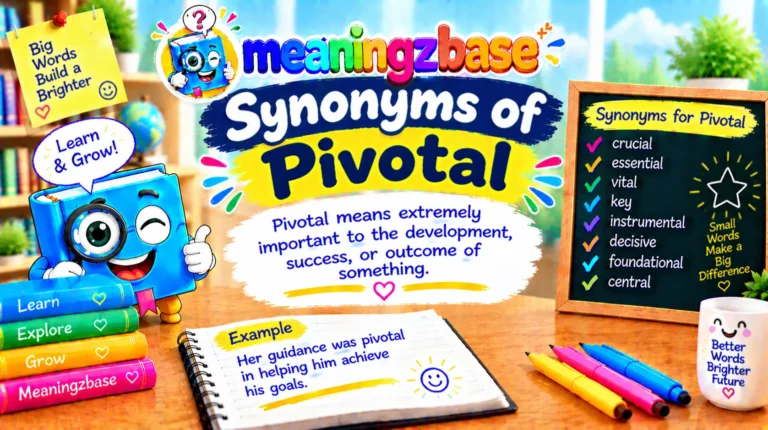
Finding the right word can make a sentence clearer, stronger, and more natural. “Pivotal” is a useful word, but using it again and again can make writing feel repetitive.
This is why many people search for synonyms for pivotal when they want a better way to describe something important, central, or highly influential.
Word variety matters in many types of writing. Students may need alternatives to “pivotal” in essays, research papers, and IELTS answers.
Professionals may use different choices in reports, presentations, emails, and business writing.
In casual English, a simpler word such as “key” or “important” may sound more natural.
However, synonyms are not always exact matches. Each alternative can carry a slightly different meaning, strength, or tone.
For example, “crucial” suggests that something is necessary, while “influential” focuses more on its power to affect people or events.
Learning these differences helps you choose the word that fits your sentence instead of simply replacing one word with another.
The list below gives you practical choices, clear examples, and useful guidance for academic, professional, and everyday English.
What Does “Pivotal” Mean?
Pivotal means extremely important to the development, success, or outcome of something. It describes a person, event, decision, idea, or moment that has a major effect on what happens next.
The word often suggests that something acts like a turning point. If one decision changes the direction of a project, that decision can be called pivotal.
For example:
Her support played a pivotal role in the success of the project.
Here, “pivotal” means her support was a major factor in the project’s success.
The word has a formal and professional tone. It is common in academic writing, business reports, news articles, speeches, and serious discussions. It can also be used in everyday English, although simpler choices such as “key” or “important” may sound more natural in casual conversation.
“Pivotal” usually works with nouns such as:
- pivotal role
- pivotal moment
- pivotal decision
- pivotal event
- pivotal point
- pivotal factor
- pivotal figure
- pivotal change
15+ Best Synonyms for “Pivotal”
Crucial
Definition: Extremely important because the result depends on it.
Tone: Formal / Academic
Example:
Good communication is crucial to the success of any team.
“Crucial” is one of the closest alternatives to “pivotal.” Use it when something is not just important but necessary for a successful result.
Critical
Definition: Very important to the success, safety, or outcome of something.
Tone: Formal / Academic
Example:
The final test was critical to the success of the new system.
“Critical” can suggest greater urgency than “pivotal.” It is especially useful when failure could cause a serious problem.
Key
Definition: Very important or central to a particular result.
Tone: Professional / Casual
Example:
Trust is a key part of a strong working relationship.
“Key” is one of the easiest replacements for “pivotal.” It is short, natural, and widely understood.
Essential
Definition: Absolutely needed for something to work or succeed.
Tone: Formal / Academic
Example:
Regular practice is essential for improving your writing skills.
Use “essential” when something is necessary rather than simply influential.
Vital
Definition: Extremely important or necessary.
Tone: Formal / Academic
Example:
Clean water is vital to public health.
“Vital” has strong force and often suggests that something is needed for continued success, health, or survival.
Central
Definition: At the heart of an idea, activity, plan, or situation.
Tone: Academic / Formal
Example:
Education is central to the country’s long-term development.
“Central” is a good choice when you want to show that something is at the core of an issue.
Significant
Definition: Important enough to have a noticeable effect or meaning.
Tone: Academic / Formal
Example:
The study found a significant change in customer behavior.
“Significant” is common in academic writing, but it does not always mean “extremely important.” It can also mean meaningful or noticeable.
Influential
Definition: Having the power to change opinions, actions, decisions, or results.
Tone: Formal / Academic
Example:
She was an influential figure in the development of modern education.
Use “influential” when the focus is on the ability to affect people or events.
Decisive
Definition: Having a strong effect on the final result or decision.
Tone: Formal / Academic
Example:
His final argument was decisive in winning the debate.
“Decisive” works especially well when something determines an outcome.
Determining
Definition: Having the power to decide or strongly shape an outcome.
Tone: Formal / Academic
Example:
Cost was a determining factor in the company’s final decision.
This word is useful when explaining what directly affected a result.
Momentous
Definition: Very important because it may create major or lasting change.
Tone: Literary / Formal
Example:
The country faced a momentous decision about its future.
“Momentous” is stronger and more dramatic than ordinary alternatives. It suits major historical or life-changing events.
Foundational
Definition: Forming a basic part of something that develops later.
Tone: Academic / Professional
Example:
Early reading skills are foundational to later academic success.
Use this word when something provides the base for future growth or development.
Instrumental
Definition: Very helpful or important in causing a particular result.
Tone: Formal / Academic
Example:
Her research was instrumental in improving the treatment process.
“Instrumental” focuses on the role something played in producing an outcome.
Transformative
Definition: Causing a major change in the way something works, develops, or is understood.
Tone: Formal / Academic
Example:
The new technology had a transformative effect on the industry.
This is a strong choice when the important thing does more than influence events and actually creates major change.
Consequential
Definition: Producing important effects or results.
Tone: Formal / Academic
Example:
The policy change had consequential effects on small businesses.
“Consequential” highlights the results that follow from an action, decision, or event.
Prominent
Definition: Important, well-known, or noticeable within a group or field.
Tone: Formal / Professional
Example:
He became a prominent voice in the technology sector.
“Prominent” is not a perfect synonym for “pivotal.” It works when the idea is about importance or visibility rather than direct influence.
Important
Definition: Having great value, meaning, or effect.
Tone: Casual / General
Example:
This meeting is important for the future of the project.
“Important” is the safest and clearest alternative. It is less powerful than “pivotal,” but it works in almost any context.
Major
Definition: Large in importance, size, effect, or influence.
Tone: General / Professional
Example:
The company made a major change to its business strategy.
“Major” is useful when you want to show that something has a large impact without sounding overly formal.
Turning-Point
Definition: A time or event that causes a major change in direction.
Tone: General / Literary
Example:
Winning the competition became a turning point in her career.
This phrase is especially useful when “pivotal moment” feels repetitive.
Stronger Alternatives
Sometimes “pivotal” is not strong enough for the idea you want to express. In such cases, a more powerful alternative can make your writing more precise.
Crucial is useful when success depends heavily on something.
Example: Accurate data is crucial to the study.
Critical is stronger when failure could create serious problems.
Example: Quick action was critical during the emergency.
Decisive works when something directly determines the final result.
Example: Her final vote was decisive.
Vital is effective when something is necessary for continued success or survival.
Example: Public trust is vital to the organization.
Transformative is ideal when something causes major change.
Example: The discovery had a transformative effect on medicine.
Momentous suits events with major historical or personal importance.
Example: The agreement marked a momentous change in relations.
Fundamental works when something is a basic part of a system or idea.
Example: Equality is a fundamental principle of the organization.
Choose a stronger word only when the situation supports it. Calling every small decision “critical” can make your writing sound exaggerated.
Softer or Polite Alternatives

Not every situation needs a powerful word. In polite, balanced, or less dramatic writing, softer alternatives can sound more natural.
Important is the safest general option.
Example: Your feedback is important to us.
Relevant works when something has a useful connection to the topic.
Example: The report includes several relevant points.
Helpful is suitable when something provides support without suggesting huge importance.
Example: Her advice was helpful during the planning stage.
Useful focuses on practical value.
Example: The guide provides useful information for new employees.
Valuable suggests worth or benefit without sounding extreme.
Example: His experience was valuable to the team.
Notable works when something deserves attention.
Example: The report shows a notable increase in sales.
Meaningful is useful when something has personal, social, or emotional value.
Example: The conversation led to a meaningful change in the team’s approach.
Relevant can also be a polite choice when you want to avoid overstating a point. It tells readers that something matters to the discussion without claiming that it controls the outcome.
Academic & IELTS-Friendly Alternatives
Academic and IELTS writing benefits from precise vocabulary. Instead of repeating “pivotal,” choose a word based on the exact relationship between the subject and the outcome.
- Crucial — useful for something that is extremely important.
Example: Effective planning is crucial to long-term success. - Significant — useful for an important or noticeable effect.
Example: The policy produced significant social changes. - Essential — best when something is necessary.
Example: Public awareness is essential for reducing waste. - Fundamental — useful for a basic principle or part of a system.
Example: Education plays a fundamental role in economic development. - Influential — best when something affects opinions or behavior.
Example: Social media has become an influential source of information. - Instrumental — useful for explaining how something helped produce a result.
Example: Technology was instrumental in improving access to education. - Central — ideal for something at the heart of an issue.
Example: Public transport is central to sustainable urban growth. - Decisive — useful when something determines an outcome.
Example: Government funding was decisive in completing the project. - Substantial — useful for a large or meaningful effect.
Example: The program made a substantial contribution to local employment. - Consequential — suitable when an action has important results.
Example: The decision had consequential effects on future investment. - Transformative — best for major changes in systems, behavior, or conditions.
Example: Digital learning has had a transformative effect on education. - Foundational — useful when something creates the base for later development.
Example: Basic literacy is foundational to academic achievement.
For IELTS, avoid using advanced words simply to sound impressive. A simple word used correctly is better than an advanced word used incorrectly. Accuracy, clear meaning, and natural sentence structure matter more than difficult vocabulary.
Synonyms You Should Avoid
Some words may look like synonyms for “pivotal,” but they do not always carry the same meaning.
Famous — A famous person may be well-known without being important to a particular outcome.
Incorrect idea: “The famous decision changed the project.”
“Famous” describes public recognition, not influence.
Popular — Popularity means that many people like or support something. It does not mean that something has a major effect.
A popular idea may still have little impact.
Prominent — This can mean important or well-known, but it does not always suggest that something changed an outcome.
Relevant — Something can be relevant without being central or highly influential. A minor fact may be relevant to a discussion.
Useful — Something can be useful without being necessary or decisive. Calling a helpful tool “pivotal” may overstate its role.
The main lesson is simple: do not treat synonyms as interchangeable words. Look at the exact meaning before replacing “pivotal.”
How to Choose the Right Synonym in Writing
Choosing the right synonym is easier when you consider four main points.
Context
First, ask what role the subject plays.
If something is necessary, use essential, crucial, or vital.
If it changes the final result, choose decisive or determining.
If it affects people or opinions, influential may be better.
If it creates major change, transformative is a strong option.
Tone
Think about how formal your writing needs to be.
For casual writing, use key, important, or major.
For professional writing, consider crucial, central, or significant.
For academic writing, instrumental, foundational, consequential, and fundamental can work well when their meanings fit.
Audience
Think about who will read your words.
A general audience may prefer simple vocabulary. A research audience may expect more precise academic terms. In business writing, clarity is usually more valuable than complex vocabulary.
For example:
- Casual: This is a key part of the plan.
- Professional: This is a crucial part of the strategy.
- Academic: This factor is fundamental to the development of the model.
All three sentences communicate importance, but the tone changes.
Clarity
Never replace “pivotal” just to avoid repetition. Make sure the new word adds the meaning you need.
Compare:
Her research was pivotal to the project.
Her research was influential to the project.
The second sentence may suggest that the research had an effect, but it is not necessarily saying that the research was central to the project’s success.
A better choice might be:
Her research was instrumental in completing the project.
The meaning is more specific because “instrumental” focuses on how the research helped produce the result.
Example Paragraph Rewritten Using Synonyms
Original Sentence
The manager made a pivotal decision that helped the company recover from its financial problems.
Rewrite Using “Crucial”
The manager made a crucial decision that helped the company recover from its financial problems.
This version stresses the high importance of the decision.
Rewrite Using “Decisive”
The manager made a decisive decision that helped the company recover from its financial problems.
This wording is less natural because “decisive decision” repeats a similar idea. A better version is:
The manager made a decision that proved decisive in helping the company recover from its financial problems.
Rewrite Using “Turning Point”
The manager’s decision became a turning point in the company’s recovery from financial problems.
This version presents the decision as an event that changed the direction of the company.
Rewrite Using “Instrumental”
The manager’s decision was instrumental in helping the company recover from its financial problems.
This version focuses on the decision’s role in producing the recovery.
Rewrite Using “Transformative”
The manager’s decision had a transformative effect on the company’s financial position.
This is stronger and suggests that the decision caused major change.
The best rewrite depends on the meaning you want. If the decision was simply very important, “crucial” works well. If it determined the result, “decisive” is better. If it changed the company’s direction, “turning point” may be the most natural choice.
FAQs
What is the best synonym for pivotal?
Crucial is one of the closest synonyms for “pivotal.” Other strong choices include “key,” “critical,” “essential,” “central,” and “decisive,” depending on the sentence.
What does pivotal mean in simple words?
“Pivotal” means very important to what happens next. It can describe a person, decision, event, or factor that strongly affects an outcome.
Is crucial a synonym for pivotal?
Yes. “Crucial” is a close synonym because both words describe something extremely important. However, “crucial” often suggests that something is necessary, while “pivotal” often suggests that something strongly changes or shapes an outcome.
What is a formal synonym for pivotal?
Formal alternatives include crucial, critical, significant, fundamental, instrumental, consequential, central, and decisive. The best choice depends on the intended meaning.
What is a simple synonym for pivotal?
Key and important are simple, natural alternatives. “Key” is especially useful in everyday and professional writing.
What is a good synonym for pivotal in IELTS?
For IELTS writing, useful alternatives include crucial, significant, essential, fundamental, influential, instrumental, central, and decisive. Choose based on meaning rather than using advanced vocabulary simply for variety.
Can pivotal mean important?
Yes. “Pivotal” means highly important, especially when something has a strong effect on an outcome or direction. It is usually stronger and more specific than the general word “important.”
Conclusion
Learning synonyms for pivotal can make your writing more precise, natural, and engaging.
The best alternative depends on the meaning you want to express.
Use crucial or critical for strong importance, essential or vital when something is necessary, central when it is at the heart of an issue, influential when it affects people or decisions, and decisive when it determines an outcome.
For major change, transformative may be a better choice, while key and important work well in simple everyday writing.
Good vocabulary is not about using the most difficult word. It is about choosing the word that says exactly what you mean.
By understanding the small differences between these alternatives, you can avoid repetition while keeping your writing clear and powerful in academic, professional, and casual settings.

Evan Blake is a passionate language enthusiast who creates simple and informative content about word meanings, slang, phrases, and modern expressions.
He focuses on making complex or unfamiliar words easy to understand through clear explanations and practical examples.