
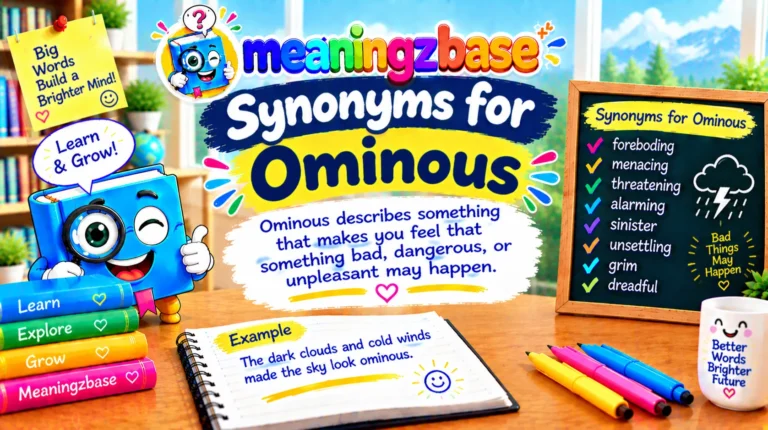
When you need to describe something that feels dark, threatening, or likely to lead to trouble, the word ominous is a strong choice.
But using the same word again and again can make your writing sound flat. That is why many writers, students, teachers, and English learners search for ominous synonyms.
Having a wider range of words helps you express small differences in meaning.
One synonym may suggest fear, while another may suggest danger, sadness, or a bad outcome. Choosing the right word can make your sentence clearer and more natural.
Ominous synonyms are useful in many types of writing.
In academic work, they can help describe warning signs or troubling trends. In professional writing, they can explain risks or serious concerns.
In casual writing, they can describe a strange feeling, dark weather, or an uneasy situation.
This guide explains the meaning of ominous, gives you more than 30 useful alternatives, and shows how to choose the best word for your context.
You will also find stronger options, softer alternatives, academic choices, confusing words to avoid, examples, and common questions about the word.
What Does “Ominous” Mean?
Ominous describes something that makes you feel that something bad, dangerous, or unpleasant may happen.
It often points to a warning sign rather than an actual bad event. For example, dark clouds may look ominous because they suggest a storm is coming.
The word usually has a serious or slightly dramatic tone. It can describe a sound, look, event, sign, message, situation, or feeling.
For example:
The sky became ominous before the storm.
Here, the sky is not itself dangerous. Its appearance suggests that danger or trouble may be near.
Ominous is commonly used when the future feels uncertain but the signs are not good. It is especially useful when you want to create a sense of fear, concern, or suspense.
15+ Best Synonyms for “Ominous”
1. Threatening
Definition: Suggesting possible harm, danger, or trouble.
Tone: Formal / Casual
Example: The dark clouds looked threatening as the wind grew stronger.
2. Menacing
Definition: Showing that someone or something may cause harm.
Tone: Formal / Literary
Example: A menacing silence filled the room after the argument.
3. Foreboding
Definition: Creating a strong feeling that something bad may happen.
Tone: Literary / Formal
Example: She had a strange sense of foreboding before opening the letter.
4. Sinister
Definition: Giving the impression that something harmful, evil, or dangerous is present.
Tone: Literary / Formal
Example: There was something sinister about the empty house.
5. Alarming
Definition: Causing worry, fear, or concern because something may be wrong.
Tone: Formal / Academic
Example: The sudden drop in sales was an alarming sign for the company.
6. Troubling
Definition: Causing worry because a situation appears unhealthy, unsafe, or wrong.
Tone: Formal / Academic
Example: The report revealed some troubling changes in the local economy.
7. Disturbing
Definition: Causing strong concern, discomfort, or fear.
Tone: Formal / Casual
Example: The investigation uncovered several disturbing facts.
8. Menacing
Definition: Appearing likely to cause harm or danger.
Tone: Formal / Literary
Example: The dog gave the stranger a menacing look.
9. Warning
Definition: Showing that danger, trouble, or a bad result may be near.
Tone: Formal / Casual
Example: The unusual noise was a warning that something was wrong.
10. Dark
Definition: Suggesting sadness, danger, fear, or an unpleasant future.
Tone: Casual / Literary
Example: The novel takes a dark turn near the end.
11. Threatening
Definition: Showing signs of possible danger or harm.
Tone: Formal / Casual
Example: The threatening weather forced the pilots to delay the flight.
12. Unsettling
Definition: Making you feel nervous, uncomfortable, or unsure.
Tone: Formal / Casual
Example: There was something unsettling about the man’s sudden silence.
13. Eerie
Definition: Strange and frightening in a quiet or unusual way.
Tone: Casual / Literary
Example: An eerie sound came from the forest at midnight.
14. Gloomy
Definition: Suggesting sadness, darkness, or little hope.
Tone: Casual / Literary
Example: The gloomy forecast gave the team little reason to celebrate.
15. Dire
Definition: Suggesting an extremely serious or dangerous situation.
Tone: Formal / Academic
Example: The country faced dire consequences if the crisis continued.
16. Grave
Definition: Very serious and often linked to danger or important consequences.
Tone: Formal / Academic
Example: The doctor warned that the situation was grave.
17. Worrying
Definition: Causing concern about what may happen.
Tone: Casual / Formal
Example: The latest figures show a worrying rise in costs.
18. Dreadful
Definition: Extremely unpleasant, serious, or frightening.
Tone: Formal / Literary
Example: The town received dreadful news after the storm.
19. Sinister-looking
Definition: Appearing strange, harmful, or dangerous.
Tone: Casual / Literary
Example: The old building had a sinister-looking entrance.
20. Threat-laden
Definition: Filled with signs or suggestions of danger.
Tone: Academic / Formal
Example: The speech contained several threat-laden statements.
Stronger Alternatives
Sometimes ominous is not strong enough. If the situation suggests serious danger or a very bad outcome, these words can create more impact.
Menacing — Use it when something appears ready to cause harm. It works well for people, animals, behavior, or situations.
Sinister — Choose this when there is a darker or more evil feeling. It is common in stories, films, and descriptions of suspicious behavior.
Dire — Use this for extremely serious conditions. It works especially well in formal and academic writing.
Grave — Choose it when the situation has serious consequences. It is useful in professional, medical, legal, and formal contexts.
Terrifying — Use this when the main idea is extreme fear rather than simply a warning of future trouble.
Dangerous — Choose this when actual risk is clear. Unlike ominous, it does not only suggest danger; it directly states that danger exists.
Doom-laden — This is a dramatic choice for writing where a sense of disaster or failure is strong.
Softer or Polite Alternatives
The word ominous can sound dramatic. In some situations, you may want a gentler word.
Concerning — A useful professional option when you want to express worry without sounding dramatic.
Worrying — Good for everyday and professional writing when something causes concern.
Troubling — A balanced choice for serious issues that need attention.
Unsettling — Best when something feels uncomfortable or strange but not clearly dangerous.
Uncertain — Use this when the future is unclear rather than clearly negative.
Unusual — A very soft option when something is different from normal but not necessarily bad.
Questionable — Useful when something seems doubtful, suspicious, or not quite right.
Cause for concern — A polite phrase often used in professional or academic writing.
For example, instead of:
The results were ominous.
You could write:
The results were concerning.
This sounds less dramatic and may be better for a workplace report.
Academic & IELTS-Friendly Alternatives
Students often need alternatives to ominous for essays, reports, IELTS writing, and formal discussions. The best choice depends on the exact meaning.
Concerning
Useful when evidence suggests that a problem may grow or become serious.
Example: The rising cost of housing is a concerning trend.
Alarming
Best when the information creates strong concern.
Example: The study found an alarming increase in pollution levels.
Troubling
Useful when evidence reveals a serious problem.
Example: The research highlights several troubling social trends.
Threatening
Best when something creates a clear risk.
Example: Climate change is threatening many coastal communities.
Serious
A simple and highly useful formal alternative.
Example: The country is facing a serious economic challenge.
Grave
Use it when consequences may be severe.
Example: The organization faces grave financial difficulties.
Adverse
Useful when describing harmful effects or negative conditions.
Example: The policy may have adverse effects on small businesses.
Detrimental
Best when something is likely to cause harm.
Example: Excessive screen time can have detrimental effects on sleep.
Hazardous
Use it when something presents a real physical or environmental risk.
Example: Workers were exposed to hazardous conditions.
Precarious
Useful when a situation is unstable and could become worse.
Example: The company is in a precarious financial position.
Unfavorable
A neutral formal choice for negative conditions or outcomes.
Example: The business faced unfavorable market conditions.
Disconcerting
Use it when something causes worry, confusion, or discomfort.
Example: The sudden change in policy was disconcerting for employees.
For IELTS writing, avoid using dramatic words simply to sound advanced. A clear word such as concerning, serious, or threatening is often better than an unusual word used incorrectly.
Synonyms You Should Avoid
Not every word connected to fear or danger is a true replacement for ominous. Some can change the meaning of your sentence.
Scary
Why to avoid it: Scary focuses on fear. Ominous focuses more on a warning that something bad may happen.
Example: An ominous sound suggests future trouble, while a scary sound mainly causes fear.
Evil
Why to avoid it: Evil describes something morally bad. Ominous does not always suggest evil.
Example: Dark clouds can be ominous, but they are not evil.
Sad
Why to avoid it: Sad describes unhappiness, not a warning of danger or future trouble.
Example: A sad song may make you emotional, but it is not necessarily ominous.
Dangerous
Why to avoid it: Dangerous means that something can cause harm. Ominous often means that something suggests future danger.
Example: A broken bridge may be dangerous. A darkening sky may be ominous.
Frightening
Why to avoid it: Frightening focuses on the emotion of fear. Ominous focuses on the sense that something bad may be coming.
Using the wrong synonym can make your sentence sound unnatural or change its intended meaning. Always consider what you actually want the reader to understand.
How to Choose the Right Synonym in Writing
Choosing an ominous synonym is not only about finding a word with a similar meaning. You should also consider the situation.
Context
First, ask what the sentence is describing.
If you are describing a person who looks ready to attack, menacing may be best.
If you are describing a possible future problem, concerning or worrying may work better.
If you are describing a strange feeling in a story, eerie, sinister, or foreboding may be more effective.
Tone
Think about how serious or dramatic you want to sound.
For a casual conversation:
That sounds worrying.
For a formal report:
The findings are concerning.
For a dramatic story:
A sinister silence fell over the village.
The basic idea may be similar, but the tone is very different.
Audience
Your audience also matters.
Young readers may understand scary, dark, or worrying more easily.
Academic readers may expect words such as concerning, adverse, detrimental, or precarious.
Professional readers usually benefit from direct language rather than dramatic vocabulary.
Clarity
Never choose a synonym just because it sounds impressive.
For example, foreboding may sound advanced, but it is not always the best choice for a business report. Concerning may communicate the idea more clearly.
Good writing is not about using the hardest word. It is about using the right word.
Example Paragraph Rewritten Using Synonyms
Original sentence:
The dark clouds looked ominous, and the fishermen quickly returned to shore.
This sentence is already clear, but we can change the synonym to create different effects.
Using threatening:
The threatening clouds warned the fishermen that severe weather might be approaching.
Using foreboding:
The foreboding sky made the fishermen uneasy, so they quickly returned to shore.
Using alarming:
The alarming change in the weather convinced the fishermen to return to shore.
Using ominous-looking:
The ominous-looking clouds grew darker as the fishermen headed back to shore.
Using unsettling:
The unsettling change in the sky made the fishermen decide to return to shore.
Each version changes the feeling slightly. Threatening emphasizes danger. Foreboding creates a stronger feeling about the future. Alarming focuses on concern, while unsettling gives a softer sense of discomfort.
This is why synonym choice matters. Words that appear similar may create very different images in the reader’s mind.
FAQs
What is the best synonym for ominous?
Threatening is one of the closest everyday synonyms. Other strong choices include menacing, foreboding, sinister, alarming, and troubling.
What is a stronger word than ominous?
Words such as menacing, sinister, dire, grave, and threatening can be stronger depending on the sentence. Dire is especially useful when the situation is extremely serious.
What is a simple synonym for ominous?
Simple alternatives include worrying, threatening, dark, concerning, and unsettling. The best choice depends on the context.
Is “threatening” the same as “ominous”?
They are close, but they are not always identical. Ominous often suggests that something bad may happen, while threatening more directly suggests danger or harm.
What is the opposite of ominous?
Possible opposites include hopeful, reassuring, promising, encouraging, positive, and favorable. The best opposite depends on the sentence.
Is “sinister” a synonym for ominous?
Yes, in some contexts. Both words can describe something that suggests danger or something bad. However, sinister often has a darker or more evil feeling than ominous.
What is a good IELTS synonym for ominous?
For IELTS writing, useful choices include concerning, alarming, threatening, serious, adverse, detrimental, and precarious. Choose the word that fits the exact meaning rather than simply choosing the most advanced option.
Conclusion
Knowing a wide range of ominous synonyms can make your English more precise, natural, and engaging.
Words such as threatening, menacing, foreboding, sinister, alarming, troubling, unsettling, dire, and grave share the general idea of danger or concern, but each carries a slightly different meaning and tone.
The strongest writing comes from choosing the word that matches your context, audience, and purpose.
For casual English, simple words are often best.
For academic and professional writing, precise terms such as concerning, adverse, detrimental, and precarious can work well.
For creative writing, words such as sinister, eerie, and foreboding can create mood and suspense.
Instead of searching for the longest or most impressive synonym, focus on the word that tells your reader exactly what you mean.

Evan Blake is a passionate language enthusiast who creates simple and informative content about word meanings, slang, phrases, and modern expressions.
He focuses on making complex or unfamiliar words easy to understand through clear explanations and practical examples.