
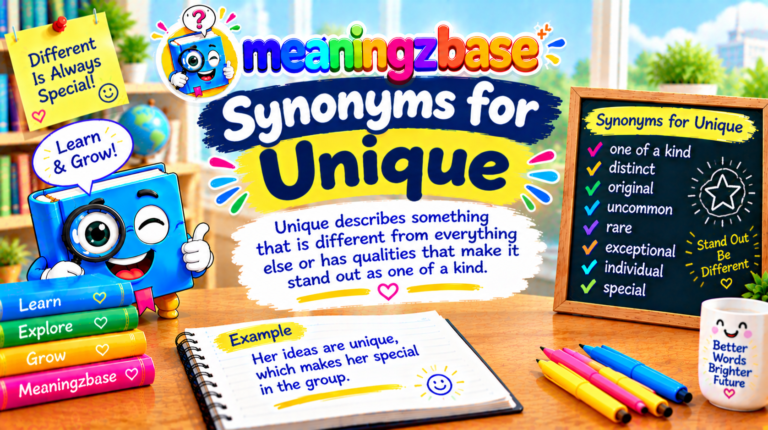
The word unique is common, useful, and powerful, but using it again and again can make writing feel flat.
That is why many people search for synonyms of unique when they want a better way to describe something special, rare, different, or unlike anything else.
The right alternative can make a sentence clearer and help the reader understand exactly what makes a person, idea, product, place, or experience stand out.
Word variety matters in every type of writing. In academic work, a precise synonym can make an argument sound more thoughtful.
In professional writing, it can make a product or brand description more engaging. In casual writing, a simple alternative can make your message feel more natural.
However, not every synonym for unique has the same meaning. Some suggest rarity, while others focus on originality, excellence, difference, or individuality.
Choosing the right word depends on what you really want to say. This guide explains the best alternatives to unique, when to use them, and which choices may create confusion.
What Does “Unique” Mean?
Unique describes something that is different from everything else or has qualities that make it stand out as one of a kind.
For example:
The artist has a unique style.
This means the artist’s style has qualities that make it noticeably different from other artists’ styles.
The word unique can have a strong meaning, but its tone is usually neutral. It works well in casual conversation, business writing, marketing, academic writing, and creative work.
It can describe many things, including:
- A person’s personality
- A product or service
- An idea
- A design
- A skill
- A place
- An experience
- A writing style
- A solution
- A situation
The meaning can also change slightly based on context. If you say a product is unique, you may mean it is unlike competing products. If you describe someone’s personality as unique, you may mean that person has unusual or highly individual qualities.
Because of this wide use, writers often need a more precise alternative.
15+ Best Synonyms for “Unique”
Distinctive
Definition: Clearly different from others because of noticeable or recognizable qualities.
Tone: Formal / Academic / Professional
Example: The building has a distinctive design that attracts visitors from around the city.
Distinctive is one of the safest replacements for unique. It works especially well when you want to explain that something stands out without claiming that nothing else is exactly like it.
One-of-a-kind
Definition: So special or different that it seems to have no exact equal.
Tone: Informal / Casual
Example: She created a one-of-a-kind gift for her best friend.
This phrase is natural and friendly. It is excellent for conversations, social media, product descriptions, and personal writing.
Original
Definition: New, fresh, or created independently rather than copied from something else.
Tone: Formal / Academic / Professional
Example: The student presented an original approach to the problem.
Original is useful when the main idea is creativity or independent thinking. It does not always mean completely unlike everything else.
Uncommon
Definition: Not often seen, found, or experienced.
Tone: Neutral / Formal
Example: The region has an uncommon type of plant that grows only in certain conditions.
Use uncommon when something is unusual but not necessarily completely unique.
Rare
Definition: Not frequently found, seen, or experienced.
Tone: Neutral / Formal / Casual
Example: It is rare to see such a clear sky in the city.
Rare focuses on limited occurrence rather than total originality.
Singular
Definition: Remarkably different, special, or exceptional compared with others.
Tone: Formal / Literary
Example: Her singular talent made her stand out among the other performers.
This is a more sophisticated alternative and works well in polished writing.
Exceptional
Definition: Much better, more unusual, or more impressive than what is normally expected.
Tone: Formal / Professional / Academic
Example: The company is known for providing exceptional customer service.
Be careful: exceptional often means unusually good, while unique simply means different.
Unparalleled
Definition: Having no equal because nothing else reaches the same level.
Tone: Formal / Academic / Professional
Example: The museum offers an unparalleled collection of ancient artwork.
This is a strong word. It is best when you want to emphasize superiority rather than simple difference.
Unprecedented
Definition: Never known or seen before.
Tone: Formal / Academic / Professional
Example: The discovery led to unprecedented changes in the field.
Use unprecedented when something is genuinely without a known previous example.
Inimitable
Definition: So distinctive that it cannot easily be copied or reproduced.
Tone: Formal / Literary
Example: The singer is admired for her inimitable voice.
This word is especially useful for describing style, personality, talent, or creative work.
Matchless
Definition: Having no equal or competitor.
Tone: Literary / Formal
Example: The writer’s matchless storytelling kept readers interested until the final page.
Matchless has a strong and slightly old-fashioned feel, so it works better in expressive writing than everyday speech.
Individual
Definition: Belonging to or reflecting the particular qualities of one person or thing.
Tone: Neutral / Formal / Academic
Example: Each student developed an individual method for completing the task.
This word works well when the focus is personal identity or independent style.
Idiosyncratic
Definition: Having unusual qualities that are strongly connected with a particular person or thing.
Tone: Academic / Literary
Example: His idiosyncratic writing style is easy to recognize.
This is an advanced word. It is useful when something is unusual in a personal or distinctive way.
Novel
Definition: New, fresh, or different from familiar approaches.
Tone: Academic / Formal / Professional
Example: Researchers developed a novel method for testing the material.
Novel is common in academic and scientific writing, especially when discussing new ideas, methods, or solutions.
Special
Definition: Different from ordinary things because of particular value or importance.
Tone: Casual / Neutral
Example: The small town has a special charm that visitors remember.
Special is warmer and softer than unique. It is useful when emotion or personal value matters.
Peculiar
Definition: Noticeably unusual or different from what is normal.
Tone: Formal / Literary / Casual
Example: The machine made a peculiar sound during the test.
Use this word carefully. Peculiar can sometimes suggest that something is strange or odd rather than positive.
Exclusive
Definition: Limited to a particular person, group, place, or purpose.
Tone: Formal / Professional / Marketing
Example: Members received exclusive access to the new collection.
Exclusive does not mean unique in every situation. It usually refers to limited access or availability.
Stronger Alternatives
Sometimes unique is not strong enough. If you want to emphasize that something has no equal, is extremely unusual, or stands far above others, these alternatives can work better.
Unparalleled
Use unparalleled when something has no equal in quality, success, or performance.
The hotel provides unparalleled views of the mountains.
Inimitable
Use inimitable for qualities that are difficult or impossible to copy.
Her inimitable sense of humor made her popular with the audience.
Peerless
Use peerless when something is presented as having no equal among its competitors.
The athlete showed peerless skill during the final.
Matchless
Use matchless for something that cannot be matched in quality or beauty.
The region is famous for its matchless natural beauty.
Incomparable
Use incomparable when a direct comparison does not seem fair because the subject stands apart.
The chef’s attention to detail was incomparable.
Unprecedented
Use unprecedented when there has been no known earlier example.
The project achieved unprecedented growth in its first year.
One-of-a-kind
Use one-of-a-kind when you want a strong but easy-to-understand expression.
The shop sells one-of-a-kind handmade furniture.
These stronger choices should not be used simply to make a sentence sound impressive. Choose them only when the meaning supports the stronger claim.
Softer or Polite Alternatives
Not every situation needs a powerful word. Sometimes you want to describe difference without sounding exaggerated. These softer options can make your writing more balanced.
Distinctive
A polite and positive way to say something stands out.
The restaurant has a distinctive atmosphere.
Special
Useful when the difference comes from emotional or personal value.
This place is special to our family.
Individual
Good for describing someone’s personal style or qualities.
Everyone has an individual way of learning.
Uncommon
A gentle way to say something is not often seen.
She has an uncommon ability to explain difficult ideas clearly.
Different
The simplest and safest choice when you only need to show contrast.
This approach is different from the traditional method.
Notable
Useful when something deserves attention without making an extreme claim.
The report includes several notable findings.
Distinguishing
Useful when describing a quality that helps separate one thing from another.
The company’s distinguishing feature is its simple design.
Remarkable
A positive choice when something deserves attention because it is impressive or unusual.
The young writer showed remarkable creativity.
These alternatives are useful when unique feels too strong, too promotional, or too absolute.
Academic & IELTS-Friendly Alternatives
In academic and IELTS writing, word choice should be accurate rather than overly complicated. Replacing unique with a more precise word can improve vocabulary variety, but only when the meaning remains correct.
Distinctive
Good for describing a clear feature that separates one thing from others.
The region has a distinctive cultural identity.
Novel
Best for new ideas, methods, theories, or approaches.
The study presents a novel solution to the problem.
Original
Useful when discussing independent ideas, research, designs, or opinions.
The researcher proposed an original explanation for the results.
Unprecedented
Use when something has no known previous example.
The country experienced unprecedented population growth.
Uncommon
Useful for things that occur less often than normal.
Such behavior is uncommon among young children.
Exceptional
Best when something is significantly above the normal level.
The school has achieved exceptional academic results.
Individual
Useful when discussing personal differences or separate characteristics.
Students have individual learning needs.
Idiosyncratic
A strong academic choice for highly personal or unusual features.
The author’s idiosyncratic style is visible throughout the novel.
Remarkable
Useful when something is unusually impressive or worthy of attention.
The region has experienced remarkable economic growth.
Distinguishing
Helpful when identifying a feature that separates one group, object, or system from another.
One distinguishing feature of the model is its low energy use.
Innovative
Best when something introduces a new and effective idea or method.
The company developed an innovative approach to waste management.
Singular
Useful in advanced formal or literary writing when describing something unusually important or distinctive.
The event had a singular impact on the development of modern art.
For IELTS, do not use advanced vocabulary simply to sound intelligent. A clear word used correctly is usually better than a complicated word used incorrectly.
Synonyms You Should Avoid
Some words may appear close to unique, but they can change the meaning of your sentence.
Strange
Strange means unusual or unfamiliar. It can carry a negative feeling.
The scientist has a unique method.
Changing this to strange method suggests the method may seem odd or suspicious. That is a different meaning.
New
New means recently created, discovered, purchased, or introduced. Something can be new without being unique.
A new phone does not necessarily mean a unique phone.
Exclusive
Exclusive often means restricted to a certain person or group.
An exclusive club may be common in its design. The word says more about access than originality.
Different
Different is much broader than unique. Two things can be different without either one being unusual or one of a kind.
This design is different does not necessarily mean this design has never been seen before.
Special
Special often carries an emotional or positive meaning. It does not always suggest that something is unlike everything else.
She gave me a special gift may simply mean the gift has personal importance.
These words are not bad alternatives. The problem comes when they are used as exact replacements without checking the intended meaning.
How to Choose the Right Synonym in Writing
Choosing a synonym is not just about finding a word with a similar meaning. The best choice depends on four main factors.
Context
First, ask what you mean by unique.
Do you mean:
- Different?
- Rare?
- New?
- Creative?
- Better than others?
- Impossible to copy?
- Personally meaningful?
For example, rare works when something does not happen often, while original works when something was created independently.
Tone
Think about how your writing should sound.
For casual writing, choose words such as:
- Special
- Different
- One-of-a-kind
- Rare
For formal writing, consider:
- Distinctive
- Exceptional
- Unprecedented
- Unparalleled
For literary writing, stronger choices may include:
- Inimitable
- Singular
- Matchless
- Peerless
Audience
Your reader matters. A general audience may understand one-of-a-kind immediately, while idiosyncratic may be less familiar.
In business writing, clarity should usually come before complexity.
In academic writing, advanced vocabulary can help, but only when it accurately expresses your point.
Clarity
Never choose a synonym just because it sounds impressive.
Compare:
The study uses a unique method.
This is broad.
The study uses a novel method.
This tells the reader that the method is new.
The study uses an innovative method.
This suggests that the method introduces a useful or creative improvement.
The third sentence is not simply a fancier version of the first. It gives more specific information.
Example Paragraph Rewritten Using Synonyms
Original sentence:
The city has a unique culture, unique architecture, and unique food that attract many tourists.
The sentence is understandable, but repeating unique three times makes it less engaging.
Rewrite using different synonyms:
The city has a distinctive culture, remarkable architecture, and an uncommon food tradition that attract many tourists.
Another version can focus more on originality:
The city offers an original cultural experience, one-of-a-kind architecture, and a rare mix of traditional foods that attract visitors from around the world.
A more formal version could be:
The city is known for its distinctive culture, exceptional architecture, and unusual culinary traditions, which make it an attractive destination for visitors.
Each version changes the emphasis slightly. Distinctive focuses on difference, remarkable highlights quality, uncommon suggests rarity, and original points toward freshness or creativity.
FAQs
What is the best synonym for unique?
Distinctive is one of the best general synonyms for unique because it clearly shows that something has noticeable qualities that separate it from others.
What is another word for unique in academic writing?
Useful academic alternatives include distinctive, novel, original, unprecedented, exceptional, and idiosyncratic. The best choice depends on the exact meaning.
What is a stronger word than unique?
Words such as unparalleled, peerless, matchless, incomparable, and inimitable can sound stronger than unique because they suggest that something has no equal.
What is a simple synonym for unique?
Different, special, rare, and uncommon are simple alternatives. However, each has a slightly different meaning.
What is a synonym for unique in IELTS?
Good IELTS-friendly options include distinctive, uncommon, original, novel, remarkable, exceptional, and unprecedented. Always choose based on context rather than vocabulary difficulty.
Can “rare” and “unique” be used interchangeably?
Not always. Rare means something is not commonly found or seen, while unique suggests that something is distinctly different or one of a kind.
Is “one-of-a-kind” the same as “unique”?
In many situations, yes. One-of-a-kind strongly suggests that there is no exact equivalent. It is more conversational than unique.
Conclusion
Finding the right synonym for unique can make your writing more precise, natural, and interesting.
The best choice depends on the idea you want to express.
Use distinctive when something clearly stands out, rare when it is not commonly found, original when it comes from independent thinking, novel for new academic ideas, and unparalleled when you want to stress that something has no equal.
Softer words such as special, different, and uncommon work well when you want a less dramatic tone.
Stronger choices such as inimitable, peerless, and matchless should be saved for situations that truly justify them.
Instead of replacing unique with any random synonym, consider your context, audience, tone, and intended meaning first.
The right word will not only prevent repetition but will also help your reader understand exactly what makes something stand out.

Evan Blake is a passionate language enthusiast who creates simple and informative content about word meanings, slang, phrases, and modern expressions.
He focuses on making complex or unfamiliar words easy to understand through clear explanations and practical examples.