
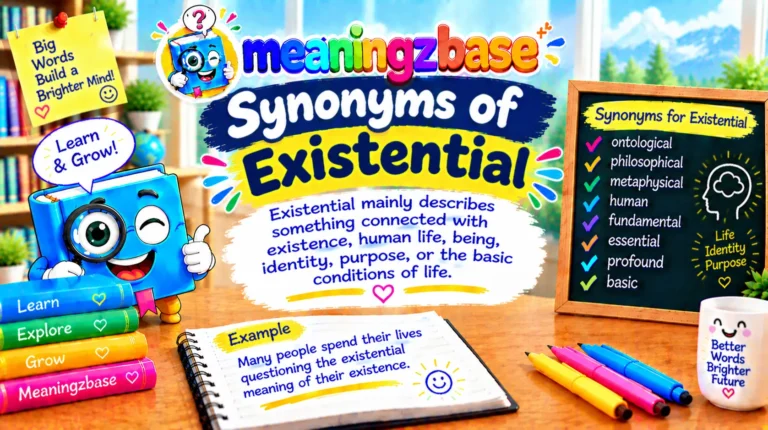
When you need a better word than existential, choosing the right synonym can be harder than it seems.
The word has a deep meaning linked to human life, existence, identity, purpose, freedom, and the nature of being.
A simple replacement may change the meaning or tone of your sentence.
This guide covers the best synonyms of existential, along with stronger options, softer alternatives, academic vocabulary, and words you should avoid in the wrong context.
It is designed to help students, writers, professionals, and English learners choose words with confidence.
People often search for alternatives to “existential” because they want to avoid repetition, make an essay sound more natural, or find a word that better matches their intended meaning.
Word variety is especially useful in academic writing, professional communication, creative writing, and everyday conversation.
The best choice depends on context. An academic essay may need a precise term such as ontological, while a casual conversation may work better with deep, fundamental, or life-related.
Understanding these differences helps you write with greater clarity and control.
What Does “Existential” Mean?
Existential mainly describes something connected with existence, human life, being, identity, purpose, or the basic conditions of life.
For example:
She faced an existential question about the purpose of her life.
Here, “existential” does not simply mean “important.” It points to a deep question about life, meaning, or existence.
The word can also describe a serious threat to continued existence:
Climate change presents an existential threat to many communities.
In this sentence, the meaning is closer to a threat to survival or continued existence.
“Existential” is common in several settings. Philosophers use it when discussing human existence, freedom, choice, meaning, and responsibility. Academics may use it to discuss fundamental questions about being or life. Journalists and professionals often use it when describing major threats to organizations, societies, or humanity.
Because the word has several uses, there is no single perfect synonym. The best replacement depends on what you mean.
15+ Best Synonyms for “Existential”
1. Fundamental
Definition: Related to something basic, essential, or central to a subject.
Tone: Formal / Academic
Example:
The debate raises fundamental questions about human freedom.
Fundamental works well when you mean something deeply basic or essential. It is one of the safest alternatives to “existential” in academic writing.
2. Philosophical
Definition: Related to deep questions about life, knowledge, reality, values, or existence.
Tone: Academic / Formal
Example:
The novel explores several philosophical questions about death and meaning.
Use philosophical when the subject involves ideas about life, reality, or human thought. It is not always an exact synonym, but it often fits discussions about existence.
3. Ontological
Definition: Related to the nature of being, existence, or what it means for something to exist.
Tone: Academic / Formal
Example:
The study examines the ontological nature of personal identity.
This is a highly precise academic alternative. It is best for philosophy, theory, and scholarly writing rather than everyday English.
4. Essential
Definition: Extremely important or necessary to the existence, success, or function of something.
Tone: Formal / Academic
Example:
Trust is essential to a healthy relationship.
Essential can replace “existential” when the intended meaning is “necessary” or “basic.” However, it does not always carry the philosophical meaning of existence.
5. Foundational
Definition: Forming the basic support or starting point of an idea, system, or belief.
Tone: Formal / Academic
Example:
The course examines foundational questions about human nature.
This word is useful when discussing ideas that form the base of a larger system.
6. Profound
Definition: Very deep, serious, or meaningful.
Tone: Formal / Literary
Example:
The experience caused her to ask profound questions about life.
Profound is a good choice when you want to highlight depth rather than existence itself.
7. Deep
Definition: Serious, meaningful, or difficult to understand fully.
Tone: Informal / Casual
Example:
His experience led to some deep questions about his future.
Deep is a natural choice in everyday English. It is less precise than “existential,” but it sounds more conversational.
8. Life-related
Definition: Connected with human life, living, or personal experience.
Tone: Casual / Neutral
Example:
The book explores several life-related concerns.
This phrase is useful when the original word sounds too academic. It is simple, but it should not be used when precise philosophical meaning matters.
9. Human
Definition: Connected with people, human nature, or the human experience.
Tone: Neutral / Academic
Example:
The poem examines human concerns such as love, loss, and mortality.
Human can work when “existential” refers to the experience of being human.
10. Metaphysical
Definition: Related to questions about reality, existence, being, or what lies beyond physical experience.
Tone: Academic / Literary
Example:
The essay explores metaphysical ideas about reality and consciousness.
This is useful in philosophy but can be too broad when discussing ordinary life problems.
11. Existentialist
Definition: Connected with existentialist philosophy or its ideas about freedom, choice, responsibility, and meaning.
Tone: Academic / Literary
Example:
The film contains several existentialist themes about freedom and personal choice.
Use existentialist when you specifically mean the philosophical tradition or its followers and ideas. It is not interchangeable with “existential” in every sentence.
12. Meaningful
Definition: Having important value, purpose, or significance.
Tone: Neutral / Casual
Example:
She began searching for a more meaningful direction in life.
This works when “existential” refers to questions about purpose or meaning.
13. Significant
Definition: Important enough to have a major effect or meaning.
Tone: Formal / Academic
Example:
The discovery created a significant challenge for the organization.
Significant is useful for general importance, but it is weaker than “existential” when survival or existence is at stake.
14. Core
Definition: Central or most important part of something.
Tone: Neutral / Casual
Example:
The discussion focuses on core questions about identity.
Core is short and natural. It works particularly well when the idea is central rather than specifically philosophical.
15. Basic
Definition: Relating to the simplest or most important part of something.
Tone: Casual / Neutral
Example:
The course asks basic questions about what makes us human.
Basic is easy to understand, but it may sound too simple for serious academic writing.
16. Universal
Definition: Applying broadly to all people or human experience.
Tone: Formal / Academic / Literary
Example:
The novel deals with universal concerns such as death and love.
Use this when the idea concerns experiences shared across cultures or generations.
17. Life-changing
Definition: Having a major and lasting effect on someone’s life.
Tone: Casual / Neutral
Example:
Moving abroad became a life-changing experience for him.
This is useful when “existential” refers to a major personal experience rather than philosophy.
18. Survival-related
Definition: Connected with staying alive or continuing to exist.
Tone: Formal / Neutral
Example:
The company faces survival-related challenges after years of losses.
This is a strong alternative when “existential threat” specifically means a threat to survival.
Stronger Alternatives
Sometimes “existential” is not strong enough for the idea you want to express. These alternatives can add force:
- Life-or-death — Use this when the situation directly involves survival.
The rescue team faced a life-or-death decision. - Critical — Best when something is extremely important to an outcome.
The company must solve this critical problem quickly. - Severe — Use this for serious harm, danger, or difficulty.
The region is facing a severe water shortage. - Fundamental — Strong when the issue affects a basic principle or condition.
The proposal creates a fundamental change in policy. - Devastating — Use this when the consequences could cause major damage.
The loss had a devastating effect on the community. - Threatening — Useful when something creates danger or risk.
The new policy could have threatening consequences for small firms. - Catastrophic — Best for extremely destructive situations.
A catastrophic failure could shut down the entire system.
Do not use the strongest word simply to sound impressive. A precise word is better than an exaggerated one.
Softer or Polite Alternatives
“Existential” can sometimes make a problem sound heavier than it really is. These gentler alternatives can create a more balanced tone:
- Important — A simple choice for a serious matter.
- Significant — Good for professional and academic writing.
- Meaningful — Best for personal values, purpose, and life choices.
- Challenging — Useful when you want to avoid dramatic language.
- Serious — Clear and natural without sounding extreme.
- Fundamental — Strong but measured when discussing basic issues.
- Personal — Useful when the issue relates to someone’s identity or life.
- Deep — A friendly option for thoughtful questions or feelings.
For example, instead of saying:
The decision created an existential crisis.
You could write:
The decision created a serious personal challenge.
The second sentence sounds less dramatic and may be more appropriate in professional communication.
Academic & IELTS-Friendly Alternatives
For academic writing and IELTS essays, vocabulary should be precise rather than unnecessarily complex. The following words can help you express ideas related to “existential”:
- Fundamental — Useful for basic questions, principles, or problems.
- Philosophical — Suitable for ideas about life, reality, values, and meaning.
- Ontological — Best for advanced discussions about being and existence.
- Metaphysical — Useful for theories about reality and existence beyond physical matters.
- Foundational — Good for ideas that form the base of a system or argument.
- Universal — Appropriate for issues shared across human societies.
- Essential — Useful when something is necessary or central.
- Profound — Good for deep questions or major effects.
- Human-centered — Useful when focusing on human experience and needs.
- Fundamental to human experience — A clear phrase for academic discussion of life and existence.
- Related to human existence — A highly clear alternative when precision matters more than style.
- Concerned with the nature of existence — Useful when explaining a philosophical idea directly.
For IELTS, avoid using ontological or metaphysical just because they sound advanced. If you use a complex word incorrectly, it can make your writing less clear. Words such as fundamental, significant, profound, and essential are often safer.
Synonyms You Should Avoid
Some words look like synonyms of “existential,” but they can change the meaning.
1. Important
“Important” only means that something matters. It does not automatically relate to existence, identity, or the meaning of life.
Weak replacement:
Climate change is an important threat.
Better when survival is meant:
Climate change is an existential threat.
2. Emotional
“Emotional” describes feelings. An existential issue can create strong emotions, but the two words do not mean the same thing.
Incorrect:
He faced an emotional question about the meaning of existence.
Better:
He faced an existential question about the meaning of existence.
3. Spiritual
“Spiritual” relates to spirituality, faith, inner life, or beliefs beyond the physical world. An existential question does not always involve spirituality.
4. Psychological
“Psychological” relates to the mind, thoughts, behavior, and mental processes. An existential issue may affect the mind, but it is not necessarily psychological.
5. Philosophical
Although “philosophical” is often a useful alternative, it is broader than “existential.” Philosophy covers many areas that have nothing to do with existence.
For example, a discussion about logic can be philosophical without being existential.
How to Choose the Right Synonym in Writing
Choosing a synonym is not simply about finding a word with a similar dictionary meaning. You should consider four key points.
Context
First, ask what “existential” means in your sentence.
Does it refer to:
- Human existence?
- The meaning of life?
- Personal identity?
- A serious threat?
- Survival?
- A philosophical question?
- A deep personal struggle?
If you mean survival, life-or-death or survival-related may work better. If you mean questions about existence, ontological may be more precise.
Tone
Think about how your writing should sound.
For casual writing, choose words such as deep, important, or meaningful.
For professional writing, significant, fundamental, or essential may be better.
For academic writing, ontological, metaphysical, or foundational can work when the subject truly requires them.
Audience
Your readers matter. A general audience may understand fundamental question more easily than ontological question.
Do not use difficult vocabulary when a simple word communicates the idea better.
Clarity
Always choose clarity before variety.
If “existential” is already the clearest word, keep it. Replacing it just to avoid repetition can make your writing less accurate.
Compare:
The crisis poses an existential threat to the nation.
with:
The crisis poses a philosophical threat to the nation.
The second sentence sounds strange because philosophical changes the meaning. A synonym should preserve the central idea, not merely look similar.
Example Paragraph Rewritten Using Synonyms
Original sentence:
Many young people experience existential questions when they begin thinking about their future, identity, and purpose in life.
Rewrite 1 — Academic:
Many young people face fundamental questions when they begin examining their future, identity, and sense of purpose.
Rewrite 2 — Simple:
Many young people ask deep questions when they start thinking about who they are and what they want from life.
Rewrite 3 — Formal:
Many young people confront profound questions about identity, purpose, and their place in the world.
Rewrite 4 — Philosophical:
Many young people explore philosophical questions about identity, freedom, purpose, and human existence.
These versions have similar ideas, but each creates a different tone. The first suits an academic essay, the second works well for general readers, the third sounds more polished, and the fourth fits a discussion of philosophy.
FAQs
What is the best synonym for existential?
There is no single perfect synonym. Fundamental, philosophical, ontological, profound, and meaningful can work depending on the sentence.
What is another word for existential crisis?
Possible alternatives include deep personal crisis, crisis of identity, crisis of meaning, profound personal struggle, and period of uncertainty. The best option depends on what kind of crisis you mean.
What is a simple synonym for existential?
For simple English, try deep, fundamental, life-related, or meaningful. However, these words do not match every use of “existential.”
What is the academic synonym for existential?
Ontological is one of the closest academic terms when discussing the nature of existence or being. Metaphysical and philosophical may also work in specific contexts.
What is the opposite of existential?
There is no single opposite in every context. Depending on the meaning, possible contrasts include nonessential, minor, superficial, or unrelated to existence.
Is philosophical the same as existential?
No. Philosophical is broader. Existential ideas focus especially on existence, freedom, identity, meaning, choice, and the human condition.
What is a synonym for existential threat?
Depending on the situation, you can use serious threat, critical threat, survival threat, life-threatening danger, or threat to continued existence. Life-or-death can also work in some contexts.
The best synonym for existential depends on the meaning you want to keep.
Use fundamental for basic issues, philosophical for broad questions about life and thought, ontological for the nature of existence, meaningful for purpose and personal value, and survival-related when continued existence is at risk.
Good writing is not about replacing every repeated word. It is about choosing the word that expresses your exact idea, suits your audience, and sounds natural in context.

Evan Blake is a passionate language enthusiast who creates simple and informative content about word meanings, slang, phrases, and modern expressions.
He focuses on making complex or unfamiliar words easy to understand through clear explanations and practical examples.