
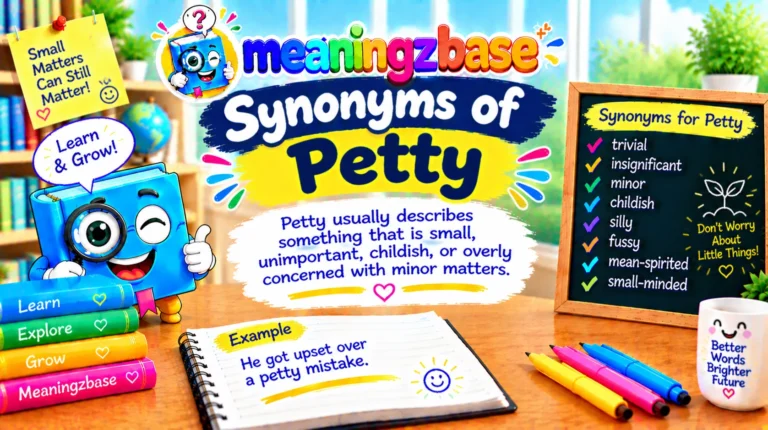
The word petty is common, but using it too often can make your writing sound repetitive.
Whether you are writing an essay, email, story, social post, or workplace message, choosing the right synonym can make your meaning much clearer.
A good alternative can also show exactly how serious, rude, childish, or unimportant a situation is.
People often search for synonyms of petty because they want a better word for a person, action, argument, complaint, or behavior.
However, not every synonym has the same meaning. Some words suggest childish behavior, while others describe something small, trivial, or overly focused on minor details.
Knowing these differences is useful in academic, professional, and casual writing. In academic work, you may need a more precise or advanced word.
In professional writing, you may want a polite alternative that does not sound insulting. In casual conversation, a stronger or more direct word may be perfectly natural.
This guide covers the most useful synonyms for petty, stronger alternatives, softer choices, academic vocabulary, confusing words to avoid, and practical examples.
By the end, you will know which word fits your sentence best.
What Does “Petty” Mean?
Petty usually describes something that is small, unimportant, childish, or overly concerned with minor matters.
The exact meaning depends on the situation. When describing a person, petty often suggests that someone is upset, angry, or difficult over something that does not deserve much attention.
For example:
He refused to speak to his friend over a petty disagreement.
Here, petty means the disagreement was too small or unimportant to cause such a serious reaction.
The word can also describe actions:
She made a petty complaint about the seating arrangement.
In this case, the complaint seems unnecessarily focused on a minor issue.
Petty can have a negative tone. It may suggest immaturity, spite, narrow-mindedness, or unnecessary attention to small problems. It is common in everyday speech, social media, personal writing, and informal conversation.
However, the word does not always mean exactly the same thing as small or minor. A small problem can be neutral, while a petty problem often carries criticism.
15+ Best Synonyms for “Petty”
1. Trivial
Definition: Something that has little importance, value, or effect.
Tone: Formal / Academic
Example: The committee spent too much time discussing a trivial issue.
Trivial is one of the best choices when you mean that something is unimportant rather than childish or spiteful.
2. Minor
Definition: Something small in importance, size, or seriousness.
Tone: Formal / Academic
Example: The report contained a few minor errors.
Minor is more neutral than petty. It works well in professional and academic writing.
3. Insignificant
Definition: Not important enough to have a meaningful effect.
Tone: Formal / Academic
Example: The difference between the two results was statistically insignificant.
Use insignificant when you want to stress a lack of importance.
4. Small-minded
Definition: Having a narrow way of thinking and caring too much about unimportant matters.
Tone: Informal / Critical
Example: His small-minded attitude made it hard to solve the problem.
This is a strong choice for describing a person’s attitude or thinking.
5. Childish
Definition: Behaving in an immature way, especially over something unimportant.
Tone: Informal / Casual
Example: Arguing over who gets the last seat seems childish.
Childish is useful when petty refers to immature behavior.
6. Immature
Definition: Not showing the level of emotional judgment expected from a mature person.
Tone: Formal / Informal
Example: Ignoring her messages because of one small mistake was immature.
Immature focuses more on a lack of emotional maturity than on the size of the issue.
7. Mean-spirited
Definition: Deliberately unkind or hurtful, often for a small reason.
Tone: Informal / Critical
Example: His mean-spirited comment ruined an otherwise pleasant evening.
Use this when the behavior has a clear element of cruelty or unkindness.
8. Spiteful
Definition: Wanting to hurt, annoy, or upset someone because of anger or resentment.
Tone: Formal / Informal
Example: She made a spiteful remark after the argument.
Spiteful is stronger than petty when someone intentionally wants another person to suffer.
9. Narrow-minded
Definition: Unwilling to consider different ideas, opinions, or ways of thinking.
Tone: Formal / Informal
Example: His narrow-minded view prevented the team from considering new solutions.
This word is related to petty in some contexts, but it focuses on limited thinking.
10. Fussy
Definition: Paying too much attention to small details or minor problems.
Tone: Informal / Casual
Example: He is fussy about how the books are arranged.
Fussy is often softer than petty and can describe someone who is overly particular.
11. Nitpicky
Definition: Giving too much attention to tiny mistakes or details.
Tone: Informal / Casual
Example: Her nitpicky comments slowed down the editing process.
This is especially useful when someone keeps pointing out very small faults.
12. Picky
Definition: Choosing very carefully and rejecting things that do not meet personal preferences.
Tone: Informal / Casual
Example: He is picky about the food he eats.
Picky is not always negative and is often much softer than petty.
13. Frivolous
Definition: Lacking seriousness or importance.
Tone: Formal / Academic
Example: The court dismissed the claim as frivolous.
Frivolous works well in formal contexts, especially when something lacks a serious purpose.
14. Inconsequential
Definition: Having little or no important effect.
Tone: Formal / Academic
Example: The change was inconsequential to the final outcome.
This is a strong academic alternative when the issue has little practical impact.
15. Superficial
Definition: Concerned mainly with the surface rather than deeper or more important matters.
Tone: Formal / Academic
Example: Their discussion remained superficial and avoided the main issue.
Superficial should not replace petty in every sentence because it suggests a lack of depth rather than childish behavior.
16. Fussy-minded
Definition: Excessively concerned with small details or minor preferences.
Tone: Informal
Example: His fussy-minded approach made a simple task take much longer.
This expression is useful in informal writing, although more natural alternatives such as fussy or nitpicky are usually better.
17. Puerile
Definition: Silly, immature, or childish, especially in a way that deserves criticism.
Tone: Formal / Literary
Example: The debate was weakened by several puerile insults.
Puerile is a strong advanced alternative when the behavior is clearly childish.
18. Petulant
Definition: Easily annoyed and likely to complain or behave badly over small matters.
Tone: Formal / Literary
Example: The petulant customer continued to complain about every minor detail.
Petulant is especially useful for describing an irritable, complaining attitude.
Stronger Alternatives
Sometimes petty does not feel strong enough. If someone’s behavior is intentionally cruel, childish, or hostile, a stronger word may communicate the idea better.
- Spiteful — Use it when someone wants to hurt or annoy another person.
- Vindictive — Use it when someone wants revenge or deliberately tries to punish another person.
- Mean-spirited — Use it for behavior that is unnecessarily unkind.
- Malicious — Use it when harmful intent is clear.
- Childish — Use it when the main problem is immature behavior.
- Petulant — Use it for repeated complaining or irritation over small matters.
- Puerile — Use it when behavior is extremely immature or silly.
- Contemptuous — Use it when someone shows strong disrespect toward another person.
For example, saying “He was vindictive” is much stronger than saying “He was petty.” Vindictive behavior usually involves a desire for revenge, while petty behavior may simply involve unnecessary concern over something small.
Softer or Polite Alternatives
Calling someone petty can sound insulting. In professional or sensitive situations, a softer word may be better.
- Minor — Best for small problems or concerns.
- Small — Simple and neutral in many situations.
- Limited — Useful when describing scope or effect.
- Unimportant — Direct but less personal.
- Trivial — Formal, though it can still sound dismissive.
- Overly particular — Polite way to describe someone who focuses heavily on details.
- Fussy — Often lighter and less harsh.
- Concerned with details — Very neutral and useful in professional communication.
For example, instead of saying:
Your concern is petty.
You could say:
Your concern seems focused on a minor detail.
The second version sounds more professional because it criticizes the issue without directly attacking the person.
Academic & IELTS-Friendly Alternatives
In academic writing and IELTS essays, petty is often too informal or too emotionally charged. More precise vocabulary can make your argument clearer.
1. Trivial
Use it when something has very little importance.
Example: Governments should avoid spending public funds on trivial matters.
2. Insignificant
Use it when something has little importance or effect.
Example: The difference between the two groups was insignificant.
3. Inconsequential
Use it when something does not meaningfully affect an outcome.
Example: These minor differences are inconsequential to the overall findings.
4. Frivolous
Use it when something lacks seriousness or a sensible purpose.
Example: Excessive attention to frivolous concerns can distract from major social issues.
5. Minor
Use it for small problems, errors, or concerns.
Example: The study identified several minor limitations.
6. Immature
Use it when discussing behavior that lacks emotional or social maturity.
Example: Such behavior may indicate an immature approach to conflict.
7. Superficial
Use it when something lacks depth.
Example: A superficial analysis cannot fully explain the causes of the problem.
8. Narrow-minded
Use it when someone refuses to consider different views.
Example: A narrow-minded approach can prevent meaningful discussion.
9. Excessively particular
Use it when someone focuses too strongly on small details.
Example: Being excessively particular about minor formatting issues can waste valuable time.
10. Puerile
Use it when behavior is noticeably childish or immature.
Example: Puerile arguments rarely contribute to productive debate.
11. Insular
Use it when someone’s thinking is limited and not open to outside ideas.
Example: An insular perspective may prevent organizations from adapting to change.
12. Petulant
Use it when describing an irritated or complaining attitude.
Example: The employee’s petulant response did not help resolve the disagreement.
For IELTS, always choose the word that matches your exact meaning. Using a difficult word simply to sound advanced can make your writing less clear.
Synonyms You Should Avoid
Some words look similar to petty, but they do not always mean the same thing.
1. Small
Small can describe physical size, quantity, or importance. It does not automatically suggest childish or spiteful behavior.
Wrong idea: He is small because he argues over everything.
Better: He is petty because he argues over everything.
2. Cheap
Cheap usually relates to low cost or poor quality. It can also describe behavior, but the meaning changes.
Calling someone cheap may suggest that they do not like spending money.
3. Selfish
Selfish means caring mainly about your own needs or interests. A person can be selfish without being petty.
4. Rude
Rude means lacking politeness or respect. Petty behavior may be rude, but the two words are not interchangeable.
5. Jealous
Jealous describes fear, insecurity, or resentment connected to another person’s attention, success, or relationship. A jealous person may act petty, but jealous explains a different cause.
Choosing the wrong synonym can change the meaning of your sentence. Always consider what you are actually trying to describe.
How to Choose the Right Synonym in Writing
Choosing a synonym is not simply about finding another word with the same dictionary meaning. You need to think about the situation.
Context
First, identify what petty describes.
Is it a person, argument, complaint, action, concern, or mistake?
For example, minor works well for a mistake, while spiteful may work better for an action intended to hurt someone.
Tone
Think about how strong you want your statement to sound.
- Neutral: minor
- Mildly negative: trivial
- Critical: small-minded
- Strong: spiteful
- Very strong: malicious
The wrong tone can make a simple sentence sound unnecessarily aggressive.
Audience
Your audience also matters.
A social media post can use words such as nitpicky, childish, or fussy. A business report may be better with minor, insignificant, or inconsequential.
Clarity
The best synonym is the one your reader understands immediately.
Do not replace a simple word with a complicated one just because it sounds impressive. If minor communicates your idea perfectly, there is no need to use a rare word.
Good writing is not about using the biggest vocabulary. It is about using the right vocabulary.
Example Paragraph Rewritten Using Synonyms
Original Sentence
Tom was petty because he became angry when his coworker received praise for a small project.
Rewrite 1: Neutral
Tom seemed immature because he became angry when his coworker received praise for a small project.
Rewrite 2: Stronger
Tom appeared small-minded because he became angry when his coworker received praise for a small project.
Rewrite 3: More Formal
Tom’s reaction seemed disproportionate to the minor situation, as he became angry when his coworker received praise for a small project.
Rewrite 4: More Critical
Tom’s mean-spirited reaction was clear when he became angry over his coworker’s praise.
Rewrite 5: Academic Style
Tom displayed an immature response to a relatively insignificant event when his coworker received recognition for the project.
Notice that each version changes the focus slightly. Immature focuses on behavior, small-minded focuses on attitude, mean-spirited focuses on unkindness, and insignificant focuses on the importance of the event.
FAQs
What is the best synonym for petty?
The best synonym depends on the context. Trivial, minor, childish, small-minded, spiteful, and nitpicky are useful choices, but each has a slightly different meaning.
What is a polite word for petty?
Minor, overly particular, fussy, and focused on small details are softer alternatives. They can help you express criticism without sounding too harsh.
What is a stronger word than petty?
Spiteful, vindictive, malicious, and mean-spirited can be stronger than petty. Choose one only when the person’s behavior is genuinely more serious.
Is trivial a synonym for petty?
Yes, in some contexts. Both can describe something unimportant. However, trivial usually focuses on the lack of importance, while petty can also suggest childishness or spite.
What is the opposite of petty?
Depending on the context, possible opposites include generous, mature, magnanimous, important, significant, and broad-minded. The correct opposite depends on the meaning of petty in the sentence.
Is petty a formal word?
Petty is a standard English word and can appear in formal writing, but it often carries a strong judgment. In academic writing, words such as minor, trivial, or insignificant may be more precise.
What is a good IELTS synonym for petty?
For IELTS, useful alternatives include trivial, minor, insignificant, inconsequential, frivolous, immature, and superficial. The best choice depends on the sentence and intended meaning.
Conclusion
The best synonyms of petty depend on what you want to say. If you mean something unimportant, choose minor, trivial, insignificant, or inconsequential.
If you are describing immature behavior, childish, immature, or puerile may work better.
When someone deliberately tries to hurt another person, stronger words such as spiteful, vindictive, or malicious can give your sentence more force.
For polite and professional writing, softer choices such as minor, overly particular, and focused on small details can help you communicate criticism without sounding unnecessarily harsh.
In academic and IELTS writing, precision matters more than using complicated vocabulary.
The key is to match the synonym to the context, tone, audience, and exact meaning. A strong vocabulary is not about replacing every common word with a difficult one.
It is about choosing the word that expresses your idea most clearly and naturally.

Evan Blake is a passionate language enthusiast who creates simple and informative content about word meanings, slang, phrases, and modern expressions.
He focuses on making complex or unfamiliar words easy to understand through clear explanations and practical examples.