
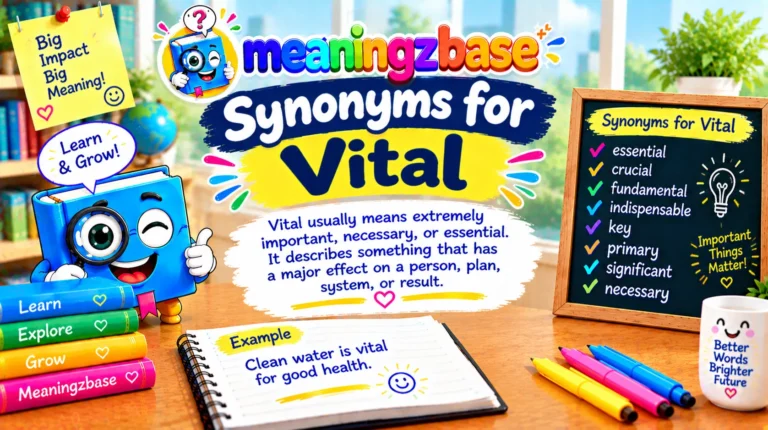
Finding the right vital synonym can make your writing clearer, stronger, and more natural.
The word vital is useful, but using it again and again can make your sentences sound flat.
This is why students, writers, professionals, and English learners often search for words that can replace vital without changing the main idea.
Word variety matters because the best synonym depends on the sentence.
A word that works well in an academic essay may sound too formal in a text message.
In the same way, a strong word may be perfect for a serious report but too intense for a casual conversation.
Knowing several alternatives to vital can help you write with greater control. You can choose words that show importance, urgency, value, or necessity with more precision.
These alternatives are useful in academic writing, IELTS essays, business emails, reports, articles, presentations, and everyday English.
This guide explains the best synonyms for vital, including their tone, meaning, and practical examples.
It also shows which alternatives are stronger, softer, more academic, or better avoided in certain situations.
What Does “Vital” Mean?
Vital usually means extremely important, necessary, or essential. It describes something that has a major effect on a person, plan, system, or result.
For example:
Clean water is vital for human health.
Here, vital means that clean water is extremely important and necessary for health.
The word can also mean related to life or living things, although this use is less common in everyday writing. For example, vital organs are organs that the body needs to stay alive.
In most modern writing, vital has a strong and serious tone. It is stronger than words such as useful or helpful. It often suggests that something should not be ignored.
Common uses include:
- Academic: “Education plays a vital role in social development.”
- Professional: “Clear communication is vital to the success of the project.”
- Casual: “It’s vital that we get there on time.”
- Health: “Sleep is vital for good health.”
- Business: “Customer feedback is vital to improving the service.”
Because vital already carries a strong meaning, its replacement should match the level of importance intended by the sentence.
15+ Best Synonyms for “Vital”
Essential
Definition: Absolutely necessary or required for something to work, exist, or succeed.
Tone: Formal / Academic
Example: “Trust is essential for a strong relationship.”
Essential is one of the closest and safest replacements for vital. It works in both academic and professional writing.
Crucial
Definition: Extremely important to a result or decision.
Tone: Formal / Academic
Example: “Good planning is crucial to the success of the event.”
Use crucial when one factor can strongly affect the final outcome.
Important
Definition: Having great value, influence, or effect.
Tone: Neutral / Casual
Example: “It is important to listen to your customers.”
Important is simple and clear. It is less powerful than vital, but it fits almost any audience.
Necessary
Definition: Needed in order to achieve a goal or complete an action.
Tone: Formal / Neutral
Example: “Regular practice is necessary to improve your skills.”
Choose necessary when something is needed rather than simply valuable.
Indispensable
Definition: So useful or necessary that it cannot easily be replaced.
Tone: Formal / Academic
Example: “Reliable data is indispensable for accurate research.”
This is a strong alternative and works especially well in formal writing.
Fundamental
Definition: Basic and highly important to the nature or success of something.
Tone: Academic / Formal
Example: “Reading is fundamental to language development.”
Fundamental is useful when discussing basic principles, skills, or ideas.
Critical
Definition: Extremely important, especially because failure could cause serious problems.
Tone: Formal / Professional
Example: “Quick action is critical during an emergency.”
Critical can suggest greater urgency than vital.
Key
Definition: Very important to a particular situation, result, or purpose.
Tone: Neutral / Professional
Example: “Communication is a key part of effective leadership.”
Key is short, natural, and common in business and everyday writing.
Major
Definition: Very important or having a large effect.
Tone: Neutral / Formal
Example: “Cost is a major concern for many families.”
Use major when you want to show that something has a large role or impact.
Significant
Definition: Important enough to have a noticeable effect or meaning.
Tone: Academic / Formal
Example: “The study found a significant change in consumer behavior.”
Significant is common in academic writing, but it does not always mean “absolutely necessary.”
Central
Definition: Most closely connected to the main idea, purpose, or activity.
Tone: Academic / Formal
Example: “Education is central to the development of a healthy society.”
This word works well when something is at the heart of an issue.
Pivotal
Definition: Extremely important because it can change or determine an outcome.
Tone: Formal / Academic
Example: “Her decision played a pivotal role in the company’s growth.”
Use pivotal when an event, person, or decision has a turning-point effect.
Imperative
Definition: Extremely important and requiring action.
Tone: Formal / Academic
Example: “It is imperative that governments address the issue quickly.”
This is a powerful word and is best suited to serious writing.
Paramount
Definition: More important than anything else in a particular situation.
Tone: Formal / Literary
Example: “Public safety must remain paramount during the crisis.”
Paramount is stronger and more formal than important.
Pressing
Definition: Needing attention or action very soon.
Tone: Formal / Professional
Example: “Climate change is one of the most pressing issues facing the world.”
Use pressing when the main idea is urgency rather than simple importance.
Valuable
Definition: Very useful, helpful, or worthwhile.
Tone: Neutral / Professional
Example: “Her experience was valuable to the research team.”
Valuable is softer than vital. Something can be valuable without being necessary.
Meaningful
Definition: Important because it has real value, purpose, or emotional effect.
Tone: Neutral / Literary
Example: “The feedback provided meaningful insight into the problem.”
Use this word when importance comes from value or meaning rather than necessity.
Worthwhile
Definition: Worth the time, effort, or money spent on it.
Tone: Casual / Neutral
Example: “Learning another language is a worthwhile investment.”
It is a good alternative when the idea is beneficial rather than absolutely necessary.
Stronger Alternatives
Sometimes vital is not strong enough. If you need to show urgency, extreme importance, or a serious consequence, consider these alternatives.
Critical — Use it when failure could create serious harm or problems.
“It is critical to protect customer information.”
Crucial — Best when something directly affects success or failure.
“The final interview was crucial to getting the job.”
Imperative — Use it when immediate action is necessary.
“It is imperative that the company follows the new safety rules.”
Pivotal — Best for a decision, event, or person that changes an outcome.
“The discovery was pivotal to the development of the treatment.”
Paramount — Use it when one concern is more important than all others.
“The safety of the passengers is paramount.”
Indispensable — Best when something cannot reasonably be replaced.
“Her technical knowledge was indispensable to the team.”
Urgent — Use it when action is needed quickly.
“The hospital faces an urgent need for additional staff.”
The strongest word is not always the best word. Avoid choosing an extreme term when the situation only calls for ordinary importance.
Softer or Polite Alternatives

Not every sentence needs a strong word. In friendly, polite, or less forceful writing, softer alternatives can sound more natural.
Helpful — Shows that something provides assistance.
“Your advice was helpful during the planning process.”
Useful — Shows practical value without suggesting necessity.
“This guide provides useful information for new students.”
Valuable — Suggests that something has worth or benefit.
“Your feedback would be valuable to our team.”
Beneficial — Highlights a positive effect.
“Regular exercise can be beneficial for overall well-being.”
Relevant — Shows that something is connected to the subject.
“Please include only relevant details in your answer.”
Worthwhile — Suggests that something is worth the effort.
“The training session was worthwhile.”
Meaningful — Suggests personal, social, or practical value.
“The discussion led to meaningful improvements.”
Helpful to — A gentle way to show usefulness.
“It would be helpful to review the report before the meeting.”
These choices are useful when you want to avoid sounding demanding or overly dramatic.
Academic & IELTS-Friendly Alternatives
Academic writing requires precision. Simply replacing vital with a complicated word does not automatically make an essay better. The best choice is the one that fits the exact meaning.
Essential
“Access to education is essential for long-term social development.”
A strong choice when something is necessary.
Crucial
“Government support is crucial to reducing unemployment.”
Useful for showing a major effect on an outcome.
Significant
“Technology has had a significant impact on modern education.”
Best when something has a noticeable or important effect.
Fundamental
“Critical thinking is fundamental to effective learning.”
Good for basic principles or core skills.
Key
“Public awareness is a key factor in reducing waste.”
Simple, clear, and widely accepted in academic writing.
Central
“Economic stability is central to sustainable development.”
Useful when something is at the heart of an issue.
Pivotal
“The invention played a pivotal role in industrial development.”
Good for major turning points.
Indispensable
“Accurate information is indispensable to sound decision-making.”
Strong formal choice for research and professional analysis.
Paramount
“Patient safety should remain paramount in medical practice.”
Very formal and powerful. Use it carefully.
Imperative
“It is imperative that policymakers consider the long-term effects.”
Good for recommendations that require action.
Fundamental to
“Equal access to education is fundamental to social progress.”
A natural academic structure.
Of great importance
“Public transport is of great importance to large urban communities.”
Useful when you want a formal phrase without using a highly advanced single word.
For IELTS writing, focus on meaning before complexity. A clear word such as important can be better than an advanced word used incorrectly.
Synonyms You Should Avoid
Some words may look like synonyms for vital, but they do not always carry the same meaning.
Alive
Vital can relate to life, but alive normally means living or not dead.
“The patient is alive.”
You cannot normally replace vital with alive in a sentence such as “Education is vital.”
Lively
Lively means energetic, active, or full of excitement.
“The children had a lively discussion.”
It does not mean extremely important.
Strong
Strong can describe power, ability, evidence, feelings, or physical force. It does not always express necessity.
“There is strong evidence.”
This is different from saying something is vital.
Valuable
Valuable is sometimes a good replacement, but it usually means useful or worthwhile rather than necessary.
“His advice was valuable.”
Something can be valuable without being vital.
Serious
Serious describes importance, danger, or a situation that needs attention. However, it does not directly mean necessary.
“The company faces a serious problem.”
The problem may be serious, but serious and vital are not interchangeable in every sentence.
The main lesson is simple: never choose a synonym only because a thesaurus lists it. Check the exact meaning and tone first.
How to Choose the Right Synonym in Writing
Choosing the best synonym is not about finding the fanciest word. It is about finding the word that communicates your exact meaning.
Context
Look at what the sentence is trying to say.
If something is required, use essential or necessary.
If something can determine success, use crucial.
If something needs immediate attention, use pressing or urgent.
If something has a major effect, significant may be better.
For example:
“Clean water is essential for survival.”
Here, essential is better than significant because clean water is required for survival.
Tone
Think about how formal the writing should sound.
For an academic essay, words such as fundamental, crucial, and significant may work well.
For a casual message, important or key may sound more natural.
For a formal report, critical, imperative, or paramount may fit, depending on the meaning.
Audience
Your readers should understand the word without effort.
A complex synonym is not automatically better. If your audience includes beginners, important may be clearer than paramount.
Good writing puts clarity first.
Clarity
Ask yourself one question:
What exactly do I mean by vital?
Do you mean:
- necessary?
- extremely important?
- useful?
- urgent?
- influential?
- valuable?
- central?
- impossible to replace?
Once you identify the exact meaning, choosing a synonym becomes much easier.
Example Paragraph Rewritten Using Synonyms
Original Sentence
“Good communication is vital for a successful workplace. It helps employees understand their duties, solve problems, and work together.”
Rewrite Using Different Synonyms
“Good communication is essential for a successful workplace. It is crucial for helping employees understand their duties, solve problems, and work together.”
Another Version
“Good communication is a key part of a successful workplace. It plays a significant role in helping employees understand their duties, solve problems, and cooperate effectively.”
More Formal Version
“Effective communication is fundamental to workplace success. It is indispensable for ensuring that employees understand their responsibilities, address problems, and collaborate efficiently.”
Each version keeps the central idea but changes the strength and tone. The first rewrite sounds natural and direct. The second is balanced and professional. The final version is more formal and suitable for academic or business writing.
FAQs
What is the best synonym for vital?
Essential is usually the closest synonym for vital. Both words can mean that something is necessary and extremely important.
What is a stronger word than vital?
Words such as critical, imperative, paramount, and crucial can be stronger than vital, depending on the context.
What is a simple synonym for vital?
Important is the simplest and most widely understood alternative. Necessary is another clear choice when something is required.
What is a good synonym for vital in academic writing?
Essential, crucial, fundamental, significant, central, and pivotal can work well in academic writing. The best option depends on the exact meaning.
What is a synonym for vital in IELTS writing?
For IELTS, useful choices include essential, crucial, significant, fundamental, key, central, and important. Accuracy is more important than using difficult vocabulary.
Is crucial the same as vital?
They are very close, but there can be a small difference. Crucial often suggests that something strongly affects an outcome, while vital often stresses extreme importance or necessity.
Can I use important instead of vital?
Yes. Important can replace vital in many sentences, but it is usually weaker. If you need to show that something is absolutely necessary, essential may be a better choice.
Conclusion
The best vital synonyms depend on what you want your sentence to express. Essential and necessary are excellent when something is required.
Crucial and critical work well when the result depends heavily on something. Significant highlights an important effect, while fundamental points to a basic principle.
Pivotal suits turning points, and paramount shows the highest level of importance.
For casual writing, simple choices such as important, key, helpful, and valuable often sound more natural.
For academic and IELTS writing, words such as essential, crucial, significant, fundamental, and central can add variety without making your writing difficult to understand.
The key is not to replace vital every time you see it. Instead, choose the synonym that matches the context, tone, audience, and exact meaning.
That approach will make your English clearer, more precise, and more natural.

Evan Blake is a passionate language enthusiast who creates simple and informative content about word meanings, slang, phrases, and modern expressions.
He focuses on making complex or unfamiliar words easy to understand through clear explanations and practical examples.