
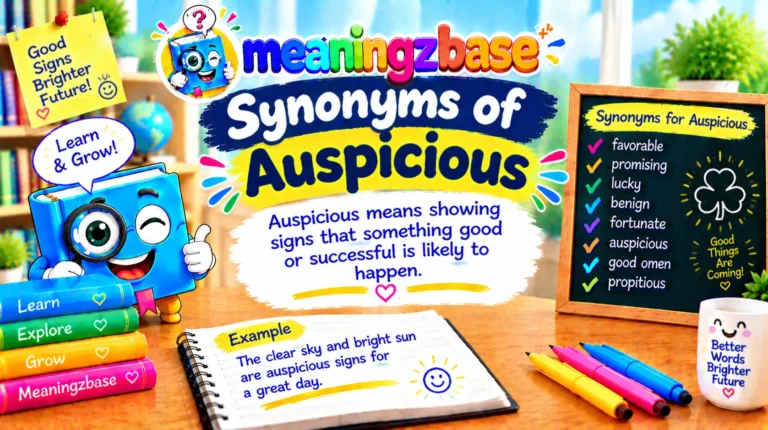
When people search for synonyms of auspicious, they are often looking for a better way to describe something that seems promising, fortunate, or likely to bring good results.
The word auspicious is useful, but it can sound formal in everyday English. Knowing similar words helps you choose language that fits your exact meaning.
Word variety also makes writing clearer and more engaging. Instead of using auspicious again and again, you can select a synonym that shows the right level of hope, success, luck, or promise.
This is especially useful in academic essays, professional writing, reports, speeches, and casual conversations.
For students, strong vocabulary can improve writing quality and help avoid repetition.
In professional settings, the right word can make a message sound confident without becoming overly formal.
In casual English, simpler choices such as promising or favorable may feel more natural.
This guide explains the meaning of auspicious, provides useful alternatives, and shows how to use each one correctly.
What Does “Auspicious” Mean?
Auspicious means showing signs that something good or successful is likely to happen. It can describe a situation, event, beginning, sign, opportunity, or occasion that suggests a positive future.
For example:
The company’s strong first quarter was an auspicious start to the year.
The word has a positive and somewhat formal tone. It is common in formal writing, news reports, speeches, academic work, and discussions about important events.
Auspicious is often used when something appears favorable at the beginning of a process. For example, an auspicious beginning suggests that what follows may turn out well.
The word can also describe an event that is considered lucky or favorable:
The couple chose an auspicious date for their wedding.
In simple English, auspicious can often be understood as promising, favorable, fortunate, or encouraging.
15+ Best Synonyms for “Auspicious”
1. Promising
Definition: Showing good signs that something may become successful or turn out well.
Tone: Casual / Professional
Example: The young athlete had a promising start to the season.
Promising is one of the best everyday replacements for auspicious. It works well when you want to focus on future success.
2. Favorable
Definition: Creating good conditions or making a positive result more likely.
Tone: Formal / Academic
Example: The company entered the market under favorable conditions.
Favorable is especially useful when discussing conditions, circumstances, decisions, or outcomes.
3. Fortunate
Definition: Bringing or involving good luck or a positive outcome.
Tone: Formal / Casual
Example: It was fortunate that the team found a solution so quickly.
Use fortunate when luck plays an important role.
4. Propitious
Definition: Giving strong signs that success or a good result is likely.
Tone: Formal / Literary
Example: The clear skies created a propitious setting for the outdoor event.
Propitious is very close in meaning to auspicious. It is useful in formal writing but less common in everyday speech.
5. Encouraging
Definition: Giving hope or showing that a situation may improve or succeed.
Tone: Casual / Professional
Example: The early test results were encouraging.
This is a natural choice when you want to highlight positive signs rather than luck.
6. Hopeful
Definition: Suggesting that a good result may happen.
Tone: Casual / Literary
Example: The team’s first meeting gave them a hopeful start.
Hopeful focuses more on expectation and optimism than on good fortune.
7. Positive
Definition: Having a good effect or suggesting a good outcome.
Tone: Casual / Professional
Example: The project received positive feedback from customers.
Positive is simple and flexible, making it suitable for almost any audience.
8. Advantageous
Definition: Providing a benefit or creating a useful situation.
Tone: Formal / Academic
Example: The new policy created an advantageous position for small businesses.
Use this word when the focus is on a practical benefit rather than luck.
9. Beneficial
Definition: Producing a helpful or useful result.
Tone: Academic / Professional
Example: The training program had a beneficial effect on employee performance.
Beneficial works well in academic and professional writing.
10. Lucky
Definition: Bringing good fortune or happening by good chance.
Tone: Casual
Example: Choosing that location turned out to be a lucky decision.
Lucky is much more conversational than auspicious.
11. Fortuitous
Definition: Happening by chance in a way that produces a useful or positive result.
Tone: Formal / Academic
Example: Their fortuitous meeting led to a successful business partnership.
Be careful: fortuitous emphasizes a fortunate chance event, while auspicious emphasizes signs of future success.
12. Timely
Definition: Happening at a useful or suitable moment.
Tone: Professional / Academic
Example: The timely investment helped the company expand.
Timely does not always mean lucky, so use it when the timing itself is important.
13. Serendipitous
Definition: Happening unexpectedly and leading to a pleasant or useful result.
Tone: Literary / Academic
Example: A serendipitous conversation introduced her to a new career opportunity.
This word is best when a positive result comes through unexpected chance.
14. Advantageous
Definition: Likely to provide a useful benefit or improve someone’s position.
Tone: Formal / Academic
Example: The agreement was advantageous for both companies.
Although it overlaps with favorable, it places more emphasis on practical benefit.
15. Salubrious
Definition: Favorable to health or well-being.
Tone: Formal / Literary
Example: The town’s clean air created a salubrious environment.
This is not a general synonym for auspicious. Use it only when discussing health or well-being.
16. Auspiciously Positioned
Definition: Placed or arranged in a way that appears favorable for success.
Tone: Formal / Professional
Example: The business is auspiciously positioned to benefit from the growing market.
This phrase works well in business writing when discussing future opportunities.
17. Promotive
Definition: Helping to encourage growth, progress, or success.
Tone: Academic / Formal
Example: The new system created conditions promotive of innovation.
This is uncommon in everyday English but can work in specialized formal writing.
18. Successful
Definition: Producing or likely to produce the desired result.
Tone: Casual / Professional
Example: The campaign had a successful beginning.
Successful is more direct than auspicious. It describes actual or expected achievement rather than merely favorable signs.
Stronger Alternatives
Sometimes auspicious is not strong enough. If you want to express a more powerful sense of success, hope, or good fortune, consider these options:
- Highly promising — Use this when strong evidence suggests future success.
- Exceptionally favorable — Best for formal reports and serious analysis.
- Highly advantageous — Use it when a situation offers major practical benefits.
- Very encouraging — Good when early results create strong confidence.
- Fortunate — Useful when good luck is central to the situation.
- Highly beneficial — Suitable for academic or professional discussions.
- Remarkably positive — Useful when results are better than expected.
- Triumphant — Use this when success has already been achieved, not merely predicted.
For example, instead of saying:
The results were auspicious.
You could write:
The results were highly encouraging and suggested strong future growth.
This version gives readers more information about why the results were positive.
Softer or Polite Alternatives

A strong word can sometimes sound too certain. If you want a gentler expression, use:
- Promising — Positive but not overly confident.
- Encouraging — Shows hope without claiming success.
- Hopeful — Focuses on possibility.
- Positive — Simple and neutral.
- Favorable — Professional and measured.
- Constructive — Suggests useful progress.
- Potentially beneficial — Careful and appropriate for formal writing.
- A good sign — Very natural in everyday English.
For example:
The early figures are encouraging.
sounds less certain than:
The early figures guarantee success.
The softer option is often better because early evidence does not always predict the final result.
Academic & IELTS-Friendly Alternatives
For IELTS essays, academic assignments, and formal writing, avoid using difficult vocabulary simply to sound advanced. Choose words that fit your meaning.
1. Favorable
Useful for describing conditions, circumstances, or outcomes.
Example: Favorable economic conditions can encourage investment.
2. Beneficial
Best when something produces a positive effect.
Example: Regular reading can have beneficial effects on language development.
3. Advantageous
Use it when something gives a person, group, or organization an advantage.
Example: Public transportation can be advantageous for large cities.
4. Promising
Useful when early signs suggest future success.
Example: The initial findings are promising.
5. Encouraging
Good for describing results that create confidence or hope.
Example: The survey produced encouraging results.
6. Positive
A safe and clear academic choice when the context is broad.
Example: The policy had a positive impact on employment.
7. Favorably
Use this adverb when explaining how something is viewed or received.
Example: The proposal was favorably received by local residents.
8. Constructive
Useful when something helps create improvement or progress.
Example: Constructive feedback can improve students’ writing skills.
9. Productive
Use this when something creates useful results.
Example: The discussion was productive and led to several practical solutions.
10. Fruitful
A slightly more advanced choice for successful efforts, discussions, or activities.
Example: The research partnership proved fruitful.
11. Conducive
Use it when conditions help something happen or develop.
Example: A quiet environment is conducive to effective study.
12. Favorably Positioned
Useful in formal business or analytical writing when discussing future opportunities.
Example: The company is favorably positioned for long-term growth.
For IELTS, favorable, beneficial, advantageous, promising, encouraging, and conducive are generally more useful than rare words that may sound unnatural.
Synonyms You Should Avoid
Not every positive word is a true synonym of auspicious. Some words overlap only in specific situations.
1. Happy
Happy describes an emotional state. It does not normally mean that an event suggests future success.
Incorrect:
The new project was happy.
Better:
The new project was promising.
2. Successful
Successful usually means that something has already achieved its goal. Auspicious can describe a beginning that suggests future success.
Compare:
The project was successful.
with:
The project had an auspicious beginning.
3. Lucky
Lucky emphasizes chance or good fortune. Auspicious can suggest favorable signs without focusing on chance.
4. Profitable
Profitable specifically relates to financial gain. Something can be auspicious without making money.
5. Beautiful
Beautiful describes appearance or aesthetic appeal. It does not normally communicate the idea of favorable future results.
Choosing a synonym based only on a shared positive feeling can change your sentence’s meaning. Always consider the exact idea you want to communicate.
How to Choose the Right Synonym in Writing
Choosing the right synonym is not simply about finding another word with a similar meaning. The best choice depends on four main factors.
Context
First, ask what you are describing.
If you are talking about future success, promising may be best.
The new business has a promising future.
If you are talking about good conditions, choose favorable.
The company operates in favorable market conditions.
If you are talking about practical benefits, advantageous may fit better.
The location is advantageous for international trade.
Tone
Think about how formal your writing needs to be.
For casual conversation:
That looks like a lucky start.
For professional writing:
This represents a promising beginning.
For academic writing:
The initial findings provide encouraging evidence.
For literary writing:
The event seemed to herald a fortunate future.
The meaning is related, but the style changes.
Audience
Your reader matters. Simple words are often better than rare words.
A school audience may understand promising more quickly than propitious. A specialist audience may be comfortable with more advanced vocabulary.
Clear writing is usually stronger than complicated writing.
Clarity
Never replace auspicious just to avoid repetition if the new word makes the sentence less clear.
Ask yourself:
Does this synonym express the same idea?
If not, keep auspicious or rewrite the sentence completely.
Example Paragraph Rewritten Using Synonyms
Original sentence:
The company’s new partnership was an auspicious beginning, as it brought new customers, improved its reputation, and created opportunities for future growth.
Rewrite using different synonyms:
The company’s new partnership was a promising beginning. It attracted new customers, strengthened its reputation, and created favorable conditions for future growth.
Another version:
The new partnership gave the company an encouraging start. It helped attract customers, build a stronger reputation, and create advantageous opportunities for expansion.
A more academic version:
The partnership provided a beneficial foundation for the company’s future development, while creating favorable conditions for continued growth.
Each version keeps the main idea but changes the tone and emphasis. Promising highlights future success, encouraging highlights positive signs, and beneficial focuses on useful results.
FAQs
What is the best synonym for auspicious?
Promising is one of the best general synonyms for auspicious. It is natural, clear, and widely understood.
What is a simple synonym for auspicious?
Favorable, promising, positive, and lucky can be simple alternatives, depending on the context.
Is favorable the same as auspicious?
They are closely related but not identical. Favorable means helpful or positive, while auspicious often suggests that something is a good sign for future success.
Is auspicious a positive word?
Yes. Auspicious has a positive meaning and is used when something appears likely to lead to a good result or is considered fortunate.
What is the opposite of auspicious?
Common opposites include inauspicious, unfavorable, unpromising, unfortunate, and ominous, depending on the sentence.
Is auspicious good for IELTS?
Yes. Auspicious can be useful in IELTS when it fits the context naturally. However, words such as favorable, promising, and beneficial are often easier to use accurately.
What is the difference between auspicious and promising?
Both can describe signs of future success. Auspicious often has a more formal or traditional feel and can also suggest good fortune. Promising is more common in everyday and professional English.
Conclusion
Learning synonyms of auspicious gives you more control over your writing.
Although auspicious means favorable, fortunate, or promising for future success, its best replacement depends on your exact meaning.
Use promising for signs of future success, favorable for good conditions, fortunate for luck, beneficial for positive effects, and advantageous for practical benefits.
In academic and IELTS writing, clear words are usually more effective than rare ones.
The goal is not to use the most complicated synonym, but to choose the word that communicates your idea accurately, naturally, and clearly.

Evan Blake is a passionate language enthusiast who creates simple and informative content about word meanings, slang, phrases, and modern expressions.
He focuses on making complex or unfamiliar words easy to understand through clear explanations and practical examples.