
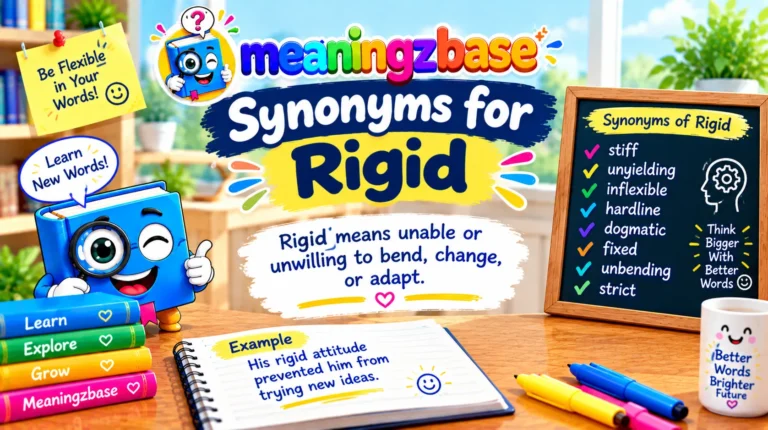
Finding the right synonym for rigid can make your writing clearer, more precise, and more natural.
The word rigid is common, but its meaning can change with context. It may describe something that cannot bend, a rule that cannot be changed, a person who refuses to adapt, or a system that leaves little room for choice.
Using the same word again and again can make writing feel flat, especially when you are working on an essay, report, article, email, or professional document.
Learning different synonyms for rigid gives you more control over your message.
In academic writing, you may need a precise word such as inflexible or uncompromising.
In professional writing, strict or fixed may sound more suitable. In casual speech, stubborn may be a better choice when describing a person.
This guide explains the best alternatives to rigid, their meanings, tones, and uses.
It covers academic, professional, literary, and everyday vocabulary so you can choose the word that fits your exact meaning.
What Does “Rigid” Mean?
Rigid means unable or unwilling to bend, change, or adapt.
The word has both physical and abstract meanings. Physically, a rigid object is stiff and does not bend easily. For example, a metal frame can be rigid. In a social or personal context, rigid can describe someone who refuses to change their opinions or behavior.
The word can also describe rules, systems, schedules, plans, or methods that allow very little freedom.
Example:
“The company has a rigid set of working hours.”
Here, rigid suggests that the working hours are fixed and difficult to change.
The tone of rigid is often neutral to negative. It can suggest strength or stability when describing a physical object, but it may suggest a lack of flexibility when describing people, rules, or systems.
15+ Best Synonyms for “Rigid”
Inflexible
Definition: Unable or unwilling to change, adjust, or accept different ideas.
Tone: Formal / Academic
Example:
“The school’s inflexible policy made it difficult for students to solve unusual problems.”
Inflexible is one of the closest alternatives to rigid when discussing rules, policies, plans, or attitudes.
Stiff
Definition: Firm and difficult to bend or move; it can also describe behavior that lacks ease.
Tone: Casual / General
Example:
“The stiff material kept the shape of the bag.”
Use stiff mainly for physical objects, although it can also describe social behavior.
Strict
Definition: Requiring rules to be followed closely with little freedom.
Tone: Formal / General
Example:
“The university has strict rules about attendance.”
Strict is useful when rigid refers to rules, standards, discipline, or requirements.
Unyielding
Definition: Refusing to bend, weaken, or change.
Tone: Formal / Literary
Example:
“Her unyielding position made further negotiations difficult.”
This word is stronger than ordinary inflexible and often describes a determined attitude.
Uncompromising
Definition: Unwilling to change a position or accept an alternative.
Tone: Formal / Academic
Example:
“The manager took an uncompromising approach to workplace safety.”
Use it when someone refuses to make concessions.
Firm
Definition: Strong, steady, or unlikely to change.
Tone: Formal / General
Example:
“The director remained firm about the new deadline.”
Unlike rigid, firm is often positive because it can suggest confidence and stability.
Fixed
Definition: Set in one position, state, or arrangement and not easily changed.
Tone: General / Professional
Example:
“We have a fixed schedule for the weekly meetings.”
Fixed is especially useful for schedules, prices, positions, arrangements, and plans.
Strictly Controlled
Definition: Managed according to firm rules with little freedom.
Tone: Formal / Professional
Example:
“The laboratory operates under strictly controlled conditions.”
This phrase works well when describing systems, processes, or environments.
Inflexible-Minded
Definition: Unwilling to consider different ideas or approaches.
Tone: General / Critical
Example:
“An inflexible-minded leader may struggle to respond to change.”
This expression focuses on a person’s thinking rather than a physical object.
Stubborn
Definition: Unwilling to change an opinion, decision, or behavior.
Tone: Informal / General
Example:
“He was too stubborn to admit that the original plan had failed.”
Stubborn is mainly used for people and is more personal than rigid.
Obstinate
Definition: Very determined to maintain an opinion or action despite advice or evidence.
Tone: Formal / Negative
Example:
“The obstinate employee refused to consider the proposed solution.”
This is a stronger and more formal way to describe stubborn behavior.
Dogmatic
Definition: Treating one’s beliefs as unquestionably correct and refusing to consider other views.
Tone: Academic / Formal
Example:
“The professor warned students against taking a dogmatic approach to the debate.”
Use dogmatic when the issue involves beliefs, opinions, or theories.
Unbending
Definition: Not willing to change an opinion, rule, or position.
Tone: Literary / Formal
Example:
“The chairman remained unbending during the negotiations.”
It is close to unyielding and often has a serious tone.
Intransigent
Definition: Refusing to change a position or agree to a compromise.
Tone: Academic / Formal
Example:
“The two sides remained intransigent during the final stage of talks.”
This is a strong word often used in political, legal, and professional writing.
Unalterable
Definition: Impossible or very difficult to change.
Tone: Formal / Academic
Example:
“The agreement contains several unalterable conditions.”
Use this when something is presented as permanently fixed.
Firmly Fixed
Definition: Securely established and not intended to change.
Tone: Professional / General
Example:
“The company has a firmly fixed policy on data security.”
This phrase can be useful when you want to emphasize stability without the negative feeling of rigid.
Hard-Line
Definition: Taking a strict position and refusing to make concessions.
Tone: Informal / Journalistic
Example:
“The minister adopted a hard-line position during the negotiations.”
It is commonly used in news and political writing.
Stronger Alternatives
Sometimes rigid is not strong enough. If you want to show that something is extremely difficult to change, these alternatives can add force.
- Unyielding — Use it when a person, position, or rule refuses to bend.
- Uncompromising — Best when someone will not make concessions.
- Intransigent — Suitable for serious disputes where neither side will change.
- Unbending — Useful for a firm attitude or position.
- Obstinate — Best when describing stubborn personal behavior.
- Dogmatic — Use when someone refuses to question their beliefs.
- Hard-line — Effective in political, business, or news contexts.
- Unalterable — Best when something cannot realistically be changed.
For example, “a rigid policy” is strong, but “an unalterable policy” suggests that change is practically impossible.
Softer or Polite Alternatives
The word rigid can sometimes sound critical. If you want to express the same basic idea more politely, choose a softer alternative.
- Firm — Suggests strength without strongly criticizing someone.
- Structured — Useful for organized systems or plans.
- Fixed — Neutral when something has been decided in advance.
- Consistent — Suggests stability rather than stubbornness.
- Well-defined — Good for rules, roles, or processes.
- Standardized — Useful for systems that follow the same method.
- Disciplined — Can suggest order and control in a positive way.
- Set — A simple, natural choice for plans, times, or arrangements.
For example, instead of saying, “The company has a rigid process,” you could say, “The company follows a well-defined process.” The second sentence sounds less negative.
Academic & IELTS-Friendly Alternatives
Strong vocabulary is useful in academic essays and IELTS writing, but advanced words should be used only when they fit the meaning. Do not choose a difficult synonym simply to sound intelligent.
Here are useful options:
- Inflexible — Best for systems, policies, attitudes, and methods.
- Uncompromising — Best for positions, attitudes, and decisions.
- Unyielding — Useful for strong resistance to change.
- Intransigent — Suitable for serious disagreements or negotiations.
- Strict — Useful for rules, regulations, and requirements.
- Fixed — Good for schedules, arrangements, and conditions.
- Standardized — Useful when one common method is required.
- Prescriptive — Describes rules that tell people exactly what they should do.
- Dogmatic — Useful for strongly held beliefs that do not allow debate.
- Unalterable — Suitable for conditions that cannot be changed.
- Constrained — Useful when freedom or choice is limited.
- Restrictive — Good when rules or conditions limit people’s actions.
For IELTS, accuracy matters more than using rare vocabulary. For example, restrictive may be better than intransigent when discussing government rules because restrictive focuses on limited freedom rather than refusal to compromise.
Synonyms You Should Avoid
Not every word that sounds similar to rigid has the same meaning. Using the wrong synonym can change your sentence.
Solid
Solid can mean strong or firm, but it does not normally mean unwilling to change. Calling a person “solid” does not mean that the person is rigid.
Hard
Hard can describe physical strength or difficulty, but it is too broad to replace rigid in many contexts.
Strong
Strong often has a positive meaning. A strong argument is not necessarily a rigid argument.
Tough
Tough can mean strong, difficult, or resilient. It does not automatically suggest inflexibility.
Persistent
Persistent means continuing despite difficulty. It can be positive, while rigid often suggests an inability to adapt.
For example, “She was persistent in defending her idea” does not necessarily mean she was unwilling to consider other ideas. If that is your intended meaning, inflexible or uncompromising may be clearer.
How to Choose the Right Synonym in Writing
Choosing the best synonym is not simply about finding a word with the same dictionary meaning. You need to consider the situation.
Context
First, ask what rigid means in your sentence.
If you are talking about a physical object, use words such as stiff or firm.
If you are talking about rules, strict, inflexible, or restrictive may work better.
If you are describing a person, stubborn, unyielding, or uncompromising may be more precise.
Tone
Think about how you want the sentence to sound.
A negative tone may require stubborn, obstinate, or dogmatic. A neutral tone may call for fixed or structured. A positive tone may make firm or disciplined a better choice.
Audience
Consider who will read your writing.
For children or casual readers, simple words such as stiff, strict, and fixed are clear.
For academic readers, terms such as inflexible, restrictive, and intransigent may be appropriate when used correctly.
Clarity
Never replace a simple word with a complicated one if the meaning becomes less clear.
For example:
“The school has strict attendance rules.”
This is clearer than:
“The school has an intransigent attendance framework.”
The second sentence sounds advanced, but it does not communicate the idea as naturally.
Example Paragraph Rewritten Using Synonyms
Original sentence:
“The company uses a rigid work schedule. Employees must arrive at the same time every day, and managers rarely allow changes.”
Rewrite using different synonyms:
“The company follows a fixed work schedule. Employees must arrive at the same time each day, and managers follow strict rules about schedule changes. This inflexible system can make it difficult for workers to deal with unexpected situations. A more flexible approach could give employees greater freedom while still maintaining clear standards.”
This version avoids repeating rigid while keeping the main idea clear. Notice that each replacement has a slightly different role. Fixed describes the schedule, strict describes the rules, and inflexible describes the overall system.
FAQs
What is the best synonym for rigid?
The best synonym depends on the context. Inflexible is one of the closest general alternatives, while strict, stubborn, fixed, and unyielding may be better in specific situations.
What is a simple synonym for rigid?
Stiff, strict, fixed, and firm are simple alternatives. The correct choice depends on whether you are describing an object, rule, person, or plan.
What is a strong synonym for rigid?
Unyielding, uncompromising, and intransigent are strong alternatives. They suggest that someone or something is very difficult to change.
What is the opposite of rigid?
Common opposites include flexible, adaptable, open-minded, adjustable, and relaxed. The best opposite depends on the context.
What is a synonym for rigid in academic writing?
Inflexible, restrictive, prescriptive, uncompromising, and intransigent can work in academic writing when their meanings fit the sentence.
What is a synonym for rigid when describing a person?
Good choices include stubborn, inflexible, unyielding, obstinate, dogmatic, and uncompromising. Each word gives a slightly different impression.
Is strict the same as rigid?
Not exactly. Strict focuses on rules or requirements that must be followed. Rigid focuses more broadly on a lack of flexibility or willingness to change. The two words can overlap, but they are not always interchangeable.
Conclusion
The best synonym for rigid depends on what you are trying to say.
Inflexible is a strong general choice, while strict works well for rules, stubborn for people, fixed for plans, and stiff for physical objects.
More advanced choices such as unyielding, uncompromising, dogmatic, and intransigent can add precision to academic and professional writing.
The key is not to use the most complicated word available. Choose the word that matches your meaning, tone, audience, and context.
Good vocabulary is not about making writing difficult; it is about making every word count.

Evan Blake is a passionate language enthusiast who creates simple and informative content about word meanings, slang, phrases, and modern expressions.
He focuses on making complex or unfamiliar words easy to understand through clear explanations and practical examples.