
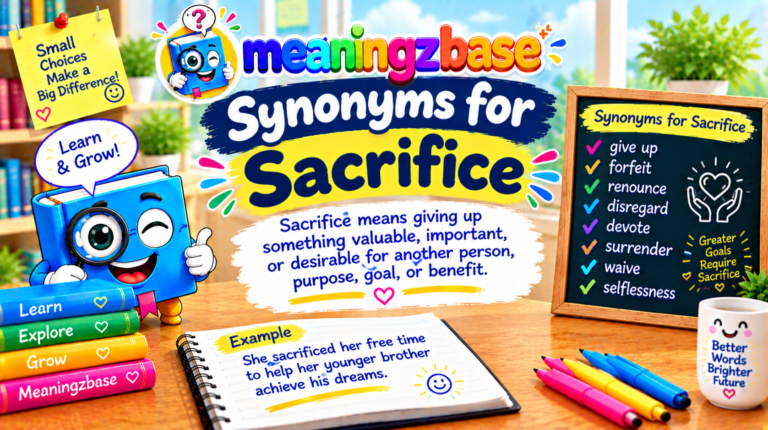
The word sacrifice is useful, but using it again and again can make your writing feel flat.
Finding the right synonym for sacrifice can help you express ideas with greater detail, emotion, and accuracy.
Whether you are writing an essay, a work email, a speech, a story, or a simple message, the best alternative depends on what kind of sacrifice you mean.
People often search for synonyms for sacrifice because the word can have several meanings.
It may describe giving up something valuable, accepting a loss for a greater purpose, putting another person’s needs first, or suffering for a goal.
Each meaning can call for a different word.
Word variety is especially important in academic writing, professional communication, and casual conversation.
In academic work, precise vocabulary can make an argument clearer.
In professional writing, the right word can sound more polished. In casual speech, a simpler alternative may feel more natural.
This guide explores useful synonyms for sacrifice, from common choices to stronger, softer, and more academic alternatives.
It also explains which words can be misleading and how to choose the best option for your sentence.
What Does “Sacrifice” Mean?
Sacrifice means giving up something valuable, important, or desirable for another person, purpose, goal, or benefit.
For example:
She made a sacrifice to support her family.
Here, sacrifice suggests that she gave up something she valued because someone else or something more important mattered to her.
The word can describe a small personal choice or a major loss. Someone might sacrifice free time to study for an exam, while another person might sacrifice money to help a friend.
The tone of sacrifice is usually serious and meaningful. It often suggests that something valuable was given up. In emotional, religious, historical, and literary writing, the word can carry a very strong sense of devotion or loss.
It is commonly used when talking about:
- Giving up personal comfort
- Putting someone else’s needs first
- Losing something for a goal
- Accepting hardship for a purpose
- Giving up an advantage
- Showing devotion or commitment
- Making difficult choices
The correct synonym depends on which of these ideas you want to express.
15+ Best Synonyms for “Sacrifice”
1. Giving up
Definition: To stop having, using, or enjoying something because of another need or goal.
Tone: Casual / Neutral
Example: He is giving up his free time to help the project succeed.
Giving up is one of the simplest alternatives to sacrifice. It works well when you want clear, everyday English without a dramatic tone.
2. Self-denial
Definition: Choosing not to enjoy or have something that you want or need.
Tone: Formal / Literary
Example: Her self-denial allowed her to save enough money for her family.
Self-denial focuses on controlling your own wants. It is useful when someone willingly avoids pleasure, comfort, or personal benefits.
3. Renunciation
Definition: The formal act of giving up a right, claim, belief, or possession.
Tone: Formal / Academic
Example: His renunciation of the position surprised everyone.
Renunciation is stronger and more formal than simply saying “giving up.” It often appears in legal, political, religious, or serious academic contexts.
4. Abandonment
Definition: The act of leaving or giving up something completely.
Tone: Formal / Neutral
Example: The abandonment of personal plans was difficult for her.
Abandonment can suggest that something was left behind permanently. However, it may sound negative, so it should not replace sacrifice in every situation.
5. Concession
Definition: Something given up or accepted to reach an agreement or settle a disagreement.
Tone: Formal / Academic
Example: The company made a concession to avoid a long dispute.
A concession is useful when the sacrifice happens during negotiation. It does not normally describe emotional or personal sacrifice.
6. Compromise
Definition: An agreement in which each side gives up something to reach a solution.
Tone: Neutral / Professional
Example: Both teams made a compromise to finish the project on time.
Compromise is especially useful for relationships, negotiations, business, and disagreements.
7. Forfeiture
Definition: The loss of something because of a rule, action, or failure.
Tone: Formal / Academic
Example: Missing the deadline resulted in the forfeiture of his reward.
Unlike sacrifice, forfeiture does not always mean that a person willingly gives something up. The loss may be forced.
8. Loss
Definition: The experience of no longer having something valuable or important.
Tone: Neutral / Emotional
Example: The loss of his free time was a necessary part of his training.
Loss is broader than sacrifice. It works when you want to emphasize what disappeared rather than the decision to give it up.
9. Surrender
Definition: Giving up control, possession, or resistance.
Tone: Formal / Strong
Example: She refused to surrender her career for someone else’s expectations.
Surrender often suggests giving up control or resistance. It can sound much stronger than sacrifice.
10. Devotion
Definition: Strong love, loyalty, or commitment to a person, cause, or purpose.
Tone: Formal / Literary
Example: His devotion to his children led him to work long hours.
Devotion highlights the reason behind the sacrifice rather than the loss itself.
11. Service
Definition: Giving your time, effort, or skills to help others or a cause.
Tone: Formal / Professional
Example: Her years of service required many personal sacrifices.
Service is a good choice when sacrifice involves helping a community, organization, country, or group.
12. Dedication
Definition: A strong commitment to a person, task, or goal.
Tone: Neutral / Professional
Example: His dedication to his studies required him to give up many social activities.
Dedication has a positive tone. It focuses on commitment rather than suffering or loss.
13. Selflessness
Definition: Caring more about others than about your own interests.
Tone: Formal / Literary
Example: Her selflessness inspired everyone around her.
Use selflessness when the key idea is putting other people first.
14. Submission
Definition: Accepting another person’s authority or giving up resistance.
Tone: Formal / Strong
Example: His submission to the demands of the organization came at a personal cost.
Submission is not a direct synonym in most situations. It works only when sacrifice involves yielding to authority or pressure.
15. Trade-off
Definition: A situation in which you accept less of one thing to gain more of another.
Tone: Casual / Professional
Example: Working longer hours is a trade-off for earning more money.
Trade-off is common in business, economics, technology, and everyday decision-making.
16. Cost
Definition: Something valuable that must be given, lost, or accepted to achieve something else.
Tone: Neutral / Academic
Example: The cost of success was less time with his family.
Cost is useful when discussing the negative side of achieving a goal.
17. Price
Definition: The personal or practical loss required to achieve something.
Tone: Literary / Emotional
Example: Freedom came at a heavy price.
Price is often metaphorical. It can make writing more powerful without directly using the word sacrifice.
18. Self-abnegation
Definition: The act of denying your own needs, interests, or desires.
Tone: Formal / Literary
Example: His life was marked by self-abnegation and service to others.
This is a sophisticated word and is best used when writing for an advanced audience.
Stronger Alternatives
Sometimes sacrifice does not feel strong enough. If the situation involves major suffering, serious loss, or extreme commitment, a more powerful expression may work better.
1. Self-denial
Use this when someone repeatedly rejects personal comfort or pleasure for a goal or another person.
Example: Years of self-denial helped her achieve her dream.
2. Self-abnegation
Use this for extreme or deep rejection of personal needs.
Example: His self-abnegation became central to his way of life.
3. Surrender
Use this when someone gives up control, power, or resistance.
Example: She would not surrender her principles.
4. Forfeiture
Use this when something valuable is lost as a result of a decision, rule, or failure.
Example: The breach led to the forfeiture of his rights.
5. Renunciation
Use this when someone deliberately rejects or gives up a claim, position, belief, or possession.
Example: His renunciation of power changed the course of the organization.
6. Self-sacrifice
Use this when someone puts another person or a greater purpose ahead of their own safety, comfort, or interests.
Example: Her self-sacrifice helped protect the people she loved.
7. Great personal cost
Use this phrase when you want to emphasize serious consequences without using overly dramatic vocabulary.
Example: He achieved his goal at great personal cost.
Softer or Polite Alternatives
The word sacrifice can sometimes sound dramatic. In professional or everyday situations, a softer alternative may communicate the idea more naturally.
1. Adjustment
Use this when someone changes their routine or plans.
Example: The new schedule required a few adjustments.
2. Compromise
Use this when both sides give up something to find a middle ground.
Example: We reached a compromise that worked for everyone.
3. Trade-off
Use this for a balanced choice involving advantages and disadvantages.
Example: Remote work involves a trade-off between flexibility and social contact.
4. Concession
Use this in formal discussions or negotiations.
Example: The manager made a small concession to keep the client satisfied.
5. Change
Use this when the situation does not require a serious or emotional word.
Example: Moving to a new city required some changes to her lifestyle.
6. Accommodation
Use this when someone changes something to meet another person’s needs.
Example: The school made an accommodation for working students.
7. Giving up
Use this in simple, friendly, everyday language.
Example: Giving up one evening a week was not a major problem for him.
Academic & IELTS-Friendly Alternatives
For academic writing and IELTS essays, vocabulary should be precise rather than simply complicated. The following alternatives can help you avoid repeating sacrifice when the meaning fits.
1. Compromise
Useful for discussing decisions in which both sides accept a disadvantage.
Example: Economic growth may require a compromise between development and environmental protection.
2. Trade-off
Useful for comparing benefits and disadvantages.
Example: There is often a trade-off between convenience and privacy.
3. Concession
Useful for negotiations, policies, and agreements.
Example: The government made several concessions during the negotiations.
4. Renunciation
Useful for formal acts of giving up rights, positions, or claims.
Example: His renunciation of the title was unexpected.
5. Forfeiture
Useful when something is lost because of a condition, rule, or failure.
Example: Failure to meet the requirements may result in the forfeiture of the benefit.
6. Self-denial
Useful when people reject personal wants for a greater purpose.
Example: Financial stability often requires a degree of self-denial.
7. Personal cost
Useful for describing the negative effects of achieving a goal.
Example: Career success can sometimes come at a significant personal cost.
8. Opportunity cost
Useful in economics and analytical writing.
Example: The opportunity cost of working full-time may be less time available for education.
9. Dedication
Useful when the focus is positive commitment.
Example: Her dedication to education helped her overcome many obstacles.
10. Selflessness
Useful when the main idea is concern for other people.
Example: Volunteering often reflects a strong sense of selflessness.
11. Deprivation
Useful when someone lacks something necessary or desirable.
Example: Long-term deprivation of basic resources can affect children’s development.
12. Concessionary adjustment
Useful in highly formal contexts involving policy or negotiation, although simpler wording is often clearer.
Example: The agreement required several concessionary adjustments from both parties.
For IELTS, do not replace sacrifice with a difficult word just to sound advanced. A simple and accurate word is usually better than an impressive but incorrect one.
Synonyms You Should Avoid
Not every word that seems similar to sacrifice has the same meaning. Some alternatives can change your sentence in an important way.
1. Abandonment
Why to avoid it: Abandonment often suggests leaving something completely or irresponsibly. Sacrifice usually suggests a meaningful choice.
Incorrect: She sacrificed her child.
Better: She gave up her career to care for her child.
2. Submission
Why to avoid it: Submission suggests yielding to another person’s authority or control. Sacrifice does not necessarily involve pressure.
Example: He sacrificed his free time to study.
Here, submission would change the meaning completely.
3. Forfeiture
Why to avoid it: Forfeiture often means losing something because of a rule or condition, not willingly giving it up.
Example: He forfeited his prize by breaking the rules.
This is different from willingly sacrificing a reward.
4. Loss
Why to avoid it: Loss focuses on the result rather than the decision or purpose behind it.
Example: The loss of income affected the family.
If the person deliberately gave up income to help someone, sacrifice may be more accurate.
5. Compromise
Why to avoid it: A compromise normally involves two or more sides making concessions.
Example: Both partners compromised on where to live.
Calling this simply a sacrifice may fail to show the shared nature of the decision.
How to Choose the Right Synonym in Writing
Choosing the right synonym is not just about finding another word with a similar meaning. You need to consider the situation.
Context
First, ask what kind of sacrifice you are describing.
Are you talking about money, time, comfort, control, rights, relationships, or personal goals?
For example:
- Giving up money → financial sacrifice / personal cost
- Giving up time → giving up / commitment
- Giving up a right → renunciation
- Losing something because of a rule → forfeiture
- Meeting halfway → compromise
- Choosing others over yourself → selflessness
- Giving time to a cause → service
Tone
Think about how serious you want the sentence to sound.
Sacrifice can be emotional and serious. Giving up is much more casual. Renunciation sounds formal. Self-abnegation sounds literary and intense.
Choose the word that matches the emotional weight of your message.
Audience
Your audience also matters.
A school essay may benefit from trade-off, opportunity cost, or personal cost. A casual conversation may sound better with giving up.
In professional writing, compromise, concession, and adjustment are often more suitable.
Clarity
Never choose a synonym just because it sounds sophisticated.
If your reader may misunderstand a complicated word, use a simpler alternative. Clear writing is usually stronger writing.
For example:
The policy required significant self-abnegation.
This sounds formal but may be unclear.
A clearer version is:
The policy required people to give up many personal comforts.
Example Paragraph Rewritten Using Synonyms
Original Sentence
Many people sacrifice their free time to build successful careers.
Rewrite 1: Casual
Many people give up their free time to build successful careers.
Rewrite 2: Professional
Many people make personal trade-offs to build successful careers.
Rewrite 3: Academic
Career development often involves a trade-off between professional progress and personal time.
Rewrite 4: Stronger
Many people accept significant personal costs in pursuit of career success.
Rewrite 5: More Emotional
Many people put their personal lives aside to achieve their career goals.
These sentences share a similar idea, but each one creates a slightly different effect. Give up sounds simple, trade-off sounds analytical, personal cost emphasizes the negative result, and put aside gives the sentence a softer emotional tone.
FAQs
What is the best synonym for sacrifice?
There is no single best synonym. Giving up, self-denial, compromise, trade-off, renunciation, and selflessness can all work, depending on the meaning.
What is a simple synonym for sacrifice?
Giving up is one of the simplest alternatives. It is easy to understand and works well in casual and everyday writing.
What is a strong synonym for sacrifice?
Self-sacrifice, self-abnegation, renunciation, and surrender can express stronger ideas, but each has a different meaning and should be used carefully.
What is a synonym for sacrifice in academic writing?
Useful academic alternatives include trade-off, concession, opportunity cost, personal cost, renunciation, forfeiture, and self-denial.
What is a synonym for sacrifice in IELTS?
For IELTS, trade-off, compromise, personal cost, concession, self-denial, and opportunity cost can be useful when they accurately match the context.
What is a synonym for sacrificing time?
Good alternatives include giving up time, devoting time, committing time, or spending time. The best choice depends on whether you want to emphasize loss or commitment.
What is the opposite of sacrifice?
The opposite depends on the context. Possible ideas include gain, reward, self-interest, indulgence, or retaining something. There is no single opposite that works in every sentence.
Conclusion
The best synonym for sacrifice depends on what you want your reader to understand. If you mean simply giving something up, giving up is clear and natural.
If you mean putting others first, selflessness or devotion may be better. For negotiations, choose compromise or concession.
For academic writing, trade-off, opportunity cost, and personal cost can add precision.
When the situation involves serious personal loss, stronger choices such as self-sacrifice, renunciation, or self-denial may be appropriate.
Good vocabulary is not about using the biggest or most difficult word. It is about choosing the word that expresses your exact meaning.
By using the right synonym for sacrifice, you can make essays, professional writing, conversations, and creative work clearer, more natural, and more engaging.

Evan Blake is a passionate language enthusiast who creates simple and informative content about word meanings, slang, phrases, and modern expressions.
He focuses on making complex or unfamiliar words easy to understand through clear explanations and practical examples.