Finding the right dictionary synonyms can make writing clearer, more natural, and more interesting.
Many people search for synonyms because they want a better word for an essay, email, report, article, school assignment, or everyday conversation.
Using the same word again and again can make writing feel flat, while the right alternative can make a sentence more exact and engaging.
Word variety is useful in almost every type of writing. Students may need better vocabulary for academic work or IELTS answers.
Professionals may want polished words for reports, presentations, and emails. In casual writing, a simple alternative can make a message sound more natural and friendly.
However, synonyms are not always exact matches. Two words may have similar meanings but different levels of formality, emotion, or strength.
That is why a good synonym choice depends on the sentence, audience, and purpose.
This guide explains useful alternatives related to synonyms, including stronger choices, softer options, academic vocabulary, and words that can cause confusion.
The goal is simple: help you choose the right word without making your writing difficult to understand.
What Does “Synonyms” Mean?
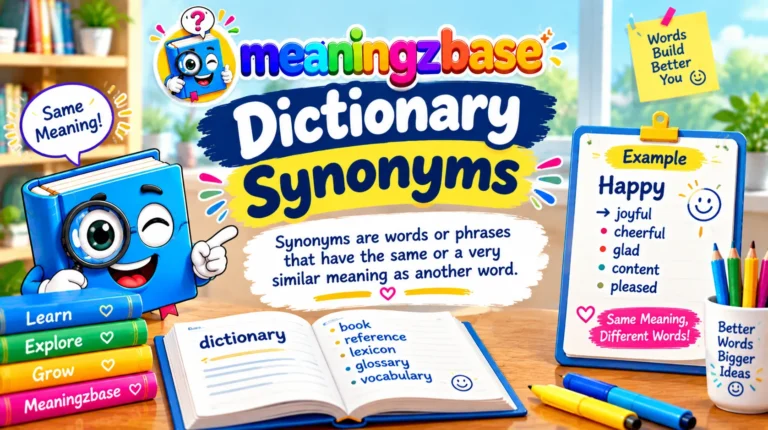
Synonyms are words or phrases that have the same or a very similar meaning as another word.
For example:
- Happy → glad, cheerful, pleased
- Big → large, huge, enormous
- Begin → start, commence, initiate
The word synonyms is commonly used when talking about vocabulary, dictionaries, writing, language learning, and word choice.
Its tone is neutral and standard. It works well in school, professional, academic, and everyday contexts.
It is important to remember that synonyms are often similar rather than perfectly identical. For example, large and huge both describe something big, but huge gives a stronger sense of size. Likewise, start and commence have similar meanings, but commence sounds much more formal.
When looking for dictionary synonyms, always consider the exact meaning you need. A word may look like a good replacement but sound unnatural in a particular sentence.
15+ Best Synonyms for “Synonyms”
Equivalent Words
Definition: Words that have the same or nearly the same meaning as another word.
Tone: Academic / Formal
Example: The dictionary provides several equivalent words for the term.
This is one of the clearest alternatives to synonyms. It works especially well when you want to explain the idea in simple language.
Similar Words
Definition: Words that share a meaning or idea but may not be exactly interchangeable.
Tone: Casual / Neutral
Example: The teacher asked students to find similar words for “quick.”
This phrase is easy to understand and useful for beginner learners.
Alternative Words
Definition: Different words that can be used instead of the original word in a certain context.
Tone: Formal / Neutral
Example: The writer used alternative words to avoid repeating the same phrase.
This is a useful choice when the main goal is variety rather than exact meaning.
Word Alternatives
Definition: Other words that may replace a particular word or expression.
Tone: Neutral / Casual
Example: The website lists word alternatives for common verbs.
This phrase is especially natural when discussing writing improvement.
Substitutes
Definition: Words used in place of another word, often to avoid repetition or change style.
Tone: Formal / Neutral
Example: These substitutes make the paragraph less repetitive.
Substitutes can suggest that one word is taking the place of another, but the meanings may not always be identical.
Equivalents
Definition: Words or expressions that have the same or almost the same meaning.
Tone: Formal / Academic
Example: The student found several equivalents for the difficult term.
This word is useful in academic and language-focused discussions.
Replacements
Definition: Words or phrases used instead of an original expression.
Tone: Neutral / Formal
Example: The editor suggested several replacements for repeated words.
Replacements focuses on the act of changing one word for another.
Expressions
Definition: Words, phrases, or ways of stating an idea.
Tone: Neutral / Academic
Example: The writer used different expressions to describe the same event.
This is broader than synonyms, because an expression may be a phrase rather than a single word.
Terms
Definition: Words or phrases used to name or describe a particular idea, subject, or concept.
Tone: Academic / Formal
Example: Several terms can describe the same process.
Terms works best when discussing specialist or subject-specific vocabulary.
Similar Expressions
Definition: Different words or phrases that communicate a related idea.
Tone: Neutral / Academic
Example: The lesson introduced similar expressions for describing change.
This option is helpful when the alternatives are phrases rather than exact one-word synonyms.
Near-Equivalents
Definition: Words with very close meanings that are not always interchangeable.
Tone: Academic / Formal
Example: The two terms are near-equivalents, but they differ in tone.
This is a precise choice when you want to show that two words are similar but not identical.
Related Words
Definition: Words connected by meaning, topic, or use.
Tone: Casual / Academic
Example: The vocabulary exercise asks students to identify related words.
Be careful: related words are not necessarily synonyms. They may simply belong to the same topic.
Alternative Expressions
Definition: Different ways to communicate the same or a closely related idea.
Tone: Formal / Neutral
Example: The writer used alternative expressions to make the article more engaging.
This phrase is useful for writing advice and language learning.
Parallel Terms
Definition: Words or terms that have comparable meanings or roles in a particular context.
Tone: Academic / Formal
Example: The researchers compared parallel terms used in different studies.
This is more specialized and should not replace synonyms in simple writing.
Lexical Equivalents
Definition: Words that correspond closely in meaning within a language or between languages.
Tone: Academic
Example: The study examines lexical equivalents in two languages.
This term is most suitable for linguistics and advanced language discussions.
Semantic Alternatives
Definition: Words that offer different ways to express a similar meaning.
Tone: Academic
Example: The author selected semantic alternatives to reduce repetition.
This is a technical phrase and is better suited to academic writing than everyday conversation.
Word Choices
Definition: The particular words a writer or speaker decides to use.
Tone: Neutral / Casual
Example: Careful word choices can make an essay much clearer.
This is not a strict synonym for synonyms, but it is often useful when discussing vocabulary and writing.
Different Ways to Say Something
Definition: Other words or phrases that communicate a similar idea.
Tone: Casual
Example: The teacher showed us different ways to say the same thing.
This is one of the easiest alternatives for beginner English learners.
Stronger Alternatives
Sometimes you need vocabulary that sounds more precise or powerful than the simple word synonyms. These options work best when discussing advanced vocabulary or detailed language analysis.
Lexical equivalents — Use this in linguistics, language research, or technical discussions where precision matters.
Semantic alternatives — Choose this when focusing on differences in meaning rather than simple word replacement.
Near-equivalents — Use this when two words are very close in meaning but have small differences.
Functional equivalents — This can describe words or expressions that perform a similar role in a specific context.
Alternative formulations — Use this when discussing different ways to construct or express an idea, especially in formal writing.
Lexical alternatives — A strong academic option for discussing different vocabulary choices.
Conceptual equivalents — Useful when comparing terms that represent a similar concept rather than being direct dictionary matches.
These stronger terms should not be used simply to sound intelligent. If similar words communicates your idea clearly, it may be the better choice.
Softer or Polite Alternatives
In everyday communication, technical language can sound unnecessarily difficult. Softer alternatives can make your writing friendly and easy to understand.
Similar words — A simple and natural choice for most readers.
Other words — Very basic and useful for children or beginner English learners.
Different words — A clear option when exact similarity is not important.
Word alternatives — Friendly and useful when discussing writing.
Other ways to say it — Natural in conversations and informal lessons.
Different expressions — Good when alternatives can include phrases as well as single words.
Related terms — Useful when the words are connected but not exact matches.
Other options — A broad and polite choice when discussing possible vocabulary choices.
For example, instead of saying, “The text contains several lexical equivalents,” a teacher speaking to a beginner might say, “The text contains several similar words.” The second sentence is easier to understand.
Academic & IELTS-Friendly Alternatives
Strong vocabulary can help make academic writing more precise, but advanced words should always be used correctly. Difficult vocabulary does not automatically make an essay better.
Here are useful options:
Equivalent terms — Good for comparing words with very similar meanings.
Lexical alternatives — Useful in academic discussions about vocabulary.
Semantic equivalents — Appropriate when meaning is the main focus.
Near-equivalent expressions — Useful when two expressions are almost, but not completely, interchangeable.
Alternative formulations — Helpful when discussing different ways to express an idea.
Comparable terms — Good when two terms have similar functions or meanings.
Related expressions — Useful when discussing vocabulary with connected meanings.
Alternative lexical items — A more technical linguistic expression.
Parallel expressions — Suitable when two expressions serve similar purposes.
Equivalent expressions — Useful when comparing phrases or longer language units.
Terminological alternatives — Best for specialized subjects where different terms may describe a concept.
Vocabulary alternatives — Clear enough for general academic writing while remaining easy to understand.
For IELTS, avoid forcing these terms into an essay simply because they sound advanced. IELTS writing rewards accurate, clear, and appropriate language. A natural word is usually better than an impressive word used incorrectly.
For example:
Weak: “The essay utilizes numerous semantic alternatives in every sentence.”
Better: “The essay uses different words to avoid unnecessary repetition.”
The second sentence is easier to read and communicates the point directly.
Synonyms You Should Avoid
Not every word connected to synonyms can replace it. Some alternatives may change the meaning or create confusion.
Related Words
Related words are not always synonyms. For example, doctor, hospital, and medicine are related, but they do not have the same meaning.
Use this phrase only when you mean words connected by a topic or idea.
Expressions
An expression can be a phrase, sentence, or common way of communicating an idea. It is therefore broader than synonym.
For example, give up and quit may be similar in some contexts, but give up is a phrase while quit is one word.
Terms
A term may simply be a word used in a specific field. It does not need to have the same meaning as another word.
Use terms when talking about vocabulary used to describe a subject or concept.
Replacements
A replacement is something used instead of something else, but it does not necessarily have the same meaning.
For example, replacing one sentence with another may change its message completely.
Alternatives
Alternatives can refer to many things, not just words. An alternative can be a plan, product, method, choice, or idea.
Use this word when the context clearly shows that you are discussing vocabulary.
The key lesson is simple: similar meaning does not always mean interchangeable meaning.
How to Choose the Right Synonym in Writing
Choosing a synonym is more than opening a thesaurus and picking the first result. A good writer checks four main points.
Context
First, examine the sentence.
A word may have several meanings, and each meaning can require different alternatives.
For example:
- Bright can mean intelligent.
- Bright can mean full of light.
- Bright can describe a strong color.
The right synonym depends on which meaning is intended.
Tone
Think about how the sentence should sound.
A formal report may use commence, while a casual message would normally use start.
A formal sentence:
“The meeting will commence at nine.”
A casual sentence:
“The meeting will start at nine.”
Both are correct, but they create different impressions.
Audience
Consider who will read your writing.
If you are writing for young students, simple vocabulary is often best. If you are writing for researchers, specialist vocabulary may be appropriate.
Good writing is not about using the hardest words. It is about using words your readers can understand.
Clarity
Always choose clarity before variety.
Changing every repeated word can make writing confusing. Sometimes repeating an important term is better than replacing it with an inaccurate synonym.
For example, if a report discusses a specific scientific concept, changing its name repeatedly may make the reader unsure whether you are referring to the same concept.
Use synonyms when they improve the writing—not simply because repetition exists.
Example Paragraph Rewritten Using Synonyms
Original Sentence
The student used the word “important” many times in the essay. The teacher advised the student to use different words to make the essay more interesting.
Rewritten Version
The student used the word “important” many times in the essay. The teacher advised the student to explore alternative words and similar expressions to make the writing more engaging.
Another Version
The student repeated the word “important” throughout the essay. The teacher suggested using equivalent terms and alternative expressions where appropriate to create greater variety.
Why the Rewrites Work
The original sentence is clear, but it repeats the same idea. The rewrites introduce vocabulary variety without changing the main message.
The second version is more academic because it uses equivalent terms and alternative expressions. However, the first rewrite may be better for general readers because it remains simple.
This shows an important rule: the best synonym is not always the most advanced one. The best synonym is the one that fits the meaning, tone, audience, and sentence.
FAQs
What are dictionary synonyms?
Dictionary synonyms are words listed as having the same or a similar meaning to another word. They help writers find different ways to express an idea.
What is another word for synonyms?
Useful alternatives include similar words, equivalent words, alternative words, equivalents, substitutes, related expressions, and lexical alternatives.
Are synonyms always exactly the same?
No. Most synonyms have similar meanings, but they may differ in strength, tone, usage, or context. Always check how the alternative works in the complete sentence.
Why should I use synonyms in writing?
Synonyms can reduce unnecessary repetition, improve word variety, and help you express an idea more precisely. However, they should not be used when they make the sentence less clear.
What are the best synonyms for academic writing?
Useful academic choices include equivalent terms, lexical alternatives, semantic equivalents, comparable terms, alternative formulations, and equivalent expressions.
Are synonyms useful for IELTS?
Yes. Correct use of varied vocabulary can help make IELTS writing more flexible and precise. However, accuracy and natural usage are more important than using complicated words.
How can I find the right synonym?
Start with the meaning of the original word. Then consider the context, tone, audience, and level of formality. Finally, read the complete sentence with the replacement to make sure it sounds natural.
Conclusion
Good dictionary synonyms give writers more choices, but effective vocabulary is not about replacing every word with a bigger or harder one.
The real goal is to choose language that matches the meaning, tone, audience, and purpose of the sentence.
Simple options such as similar words and alternative words work well in everyday writing, while terms such as lexical alternatives and semantic equivalents are better suited to academic or linguistic contexts.
Remember that words with similar meanings can still have different uses. By checking context and choosing clarity first, you can use synonyms naturally and make your writing more varied, accurate, and effective.

Evan Blake is a passionate language enthusiast who creates simple and informative content about word meanings, slang, phrases, and modern expressions.
He focuses on making complex or unfamiliar words easy to understand through clear explanations and practical examples.