Learning new words becomes much easier when students can see how words connect.
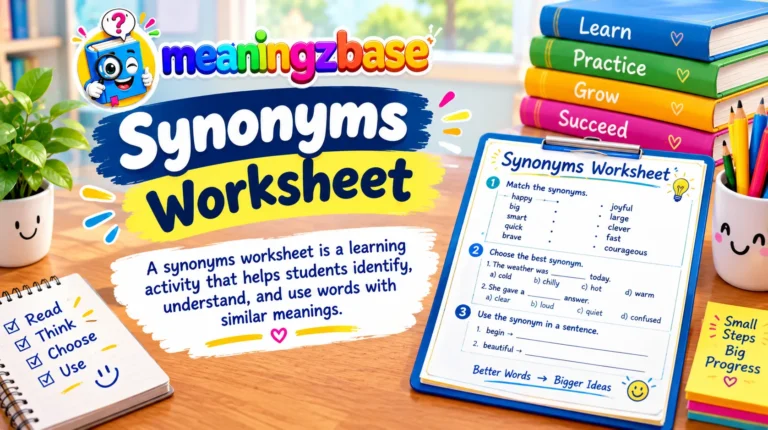
A synonyms worksheet is a simple and useful way to help learners understand words that have the same or nearly the same meaning.
It can be used in classrooms, at home, during homework, or for extra English practice.
People search for synonyms worksheets for many reasons. Teachers may need quick vocabulary activities for their students.
Parents may want extra practice for children. Students may use worksheets to prepare for tests, improve writing, or build stronger English skills.
Writers and language learners can also use synonym exercises to avoid repeating the same word again and again.
Word variety is important because good writing does not always use one word repeatedly.
For example, instead of saying “The movie was good” several times, a writer may use great, enjoyable, excellent, or entertaining, depending on the meaning.
Synonyms are useful in academic writing, professional communication, and casual conversation.
However, synonyms are not always perfect replacements. Their meaning, strength, and tone can be slightly different.
A good synonyms worksheet teaches more than a list of words. It helps learners understand which word fits the sentence, situation, audience, and tone. That makes vocabulary practice more useful and practical.
What Does “Synonyms Worksheet” Mean?
A synonyms worksheet is a learning activity that helps students identify, understand, and use words with similar meanings.
For example:
- happy → glad
- small → tiny
- quick → fast
- begin → start
- smart → clever
The word synonym refers to a word that has the same or a similar meaning as another word. The word worksheet means a page or digital activity that gives learners questions or exercises to complete.
A synonyms worksheet may include matching activities, fill-in-the-blank questions, multiple-choice questions, word banks, sentence-writing tasks, or short reading exercises.
The tone of a synonym depends on the word being used. Some synonyms are common and casual, while others sound more formal or academic. For example, help is common in everyday English, while assist sounds more formal.
Synonyms are commonly used when students want to:
- build vocabulary
- improve writing
- avoid repeated words
- understand reading passages
- prepare for English tests
- make sentences more interesting
- learn stronger or softer ways to express ideas
A useful worksheet should therefore teach students to think about meaning instead of simply memorizing word lists.
15+ Best Synonyms for “Synonyms Worksheet”
Because “synonyms worksheet” is a phrase rather than a single vocabulary word, there is no exact list of perfect one-word synonyms. However, several related terms can describe this type of learning material. The following alternatives can be useful depending on the context.
Vocabulary Worksheet
Definition: A worksheet designed to teach, review, or practice new vocabulary words.
Tone: Academic / Educational
Example: The teacher gave the class a vocabulary worksheet before the reading lesson.
Synonym Practice Sheet
Definition: A practice page that focuses specifically on words with similar meanings.
Tone: Academic / Casual
Example: Students completed a synonym practice sheet during English class.
Vocabulary Practice Worksheet
Definition: A learning page used to help students practice vocabulary through different activities.
Tone: Academic / Educational
Example: I printed a vocabulary practice worksheet for my students.
Word Practice Sheet
Definition: A simple activity sheet used to practice words and their meanings.
Tone: Casual / Educational
Example: The children used a word practice sheet to review their new vocabulary.
Synonym Exercise
Definition: An activity that asks learners to identify or use words with similar meanings.
Tone: Academic
Example: The synonym exercise helped students understand several new words.
Vocabulary Exercise
Definition: An activity designed to strengthen a learner’s knowledge and use of vocabulary.
Tone: Academic / Formal
Example: The vocabulary exercise included ten new words from the reading passage.
Word Study Worksheet
Definition: A worksheet that helps learners study word meanings, forms, relationships, or usage.
Tone: Academic
Example: The teacher prepared a word study worksheet for the weekly lesson.
Word Meaning Worksheet
Definition: A worksheet that focuses on understanding what different words mean.
Tone: Educational / Casual
Example: The word meaning worksheet helped younger students learn difficult terms.
Synonym Activity Sheet
Definition: A page containing activities that help students practice synonyms.
Tone: Casual / Educational
Example: Each student received a synonym activity sheet.
Word Relationship Worksheet
Definition: A worksheet that explores how words are connected in meaning or usage.
Tone: Academic
Example: The word relationship worksheet included synonyms and antonyms.
Vocabulary Review Sheet
Definition: A page used to review words students have already learned.
Tone: Academic / Casual
Example: We used the vocabulary review sheet before the final test.
Synonym Learning Activity
Definition: A structured activity that teaches learners how similar words can be used.
Tone: Educational / Academic
Example: The synonym learning activity made the vocabulary lesson more engaging.
English Vocabulary Worksheet
Definition: A worksheet focused on English words, meanings, and usage.
Tone: Academic / Educational
Example: The students completed an English vocabulary worksheet for homework.
Word Skills Worksheet
Definition: A learning page designed to develop general skills related to vocabulary and word use.
Tone: Academic
Example: The word skills worksheet included synonym and context questions.
Vocabulary Skills Practice
Definition: Practice that helps learners improve their ability to understand and use words.
Tone: Academic
Example: Regular vocabulary skills practice can improve students’ writing.
Synonym Review Activity
Definition: An activity used to review previously learned synonyms.
Tone: Educational / Casual
Example: The synonym review activity took only fifteen minutes.
Word Choice Worksheet
Definition: A worksheet that helps learners choose the most suitable word for a sentence or situation.
Tone: Academic / Formal
Example: The word choice worksheet taught students how to select precise vocabulary.
Stronger Alternatives
Not every synonym has the same level of strength. When you want to describe something with greater force, stronger vocabulary can make the message clearer.
Here are several useful stronger alternatives for common words:
- Good → Excellent: Use when something is much better than average.
She did an excellent job on the project. - Big → Huge: Use for something much larger than normal.
A huge tree stood beside the house. - Small → Tiny: Use when something is extremely small.
A tiny bird sat on the branch. - Angry → Furious: Use when someone is extremely angry.
He was furious after hearing the news. - Tired → Exhausted: Use when someone has almost no energy left.
After the long race, the runners were exhausted. - Scared → Terrified: Use when someone feels very strong fear.
The child was terrified during the storm. - Happy → Delighted: Use when someone feels very pleased or joyful.
She was delighted with her test result.
Stronger words should be used carefully. If the situation is only mildly positive or negative, an extremely strong word may make the sentence sound unnatural.
Softer or Polite Alternatives
Sometimes a direct word can sound too strong. Softer alternatives can make communication more polite and friendly.
- Wrong → Incorrect: Useful in school or professional settings when correcting information.
- Bad → Unhelpful: A gentler way to describe something that does not work well.
- Cheap → Affordable: Better when discussing prices in a positive or neutral way.
- Lazy → Unmotivated: Softer when describing a person’s lack of effort.
- Stupid → Unwise: A more respectful way to describe a poor decision.
- Lie → Give incorrect information: Useful when a less direct expression is needed.
- Problem → Challenge: Often used when discussing a difficult situation in a positive or professional way.
- Old → Experienced: Can be more respectful when referring to a person with many years of knowledge.
Choosing softer words does not mean hiding the truth. It means presenting an idea in a way that matches the situation and respects the audience.
Academic & IELTS-Friendly Alternatives
Synonyms can help students improve academic writing, but advanced words should never be used only to sound intelligent. The word must fit the sentence naturally.
Here are useful vocabulary choices:
- Help → Assist
Teachers assist students with difficult tasks. - Show → Demonstrate
The results demonstrate a clear difference. - Get → Obtain
Students can obtain useful information from the survey. - Use → Utilize
Researchers utilize several methods to collect data.
Note: “use” is often clearer and should not be replaced unnecessarily. - Give → Provide
The program provides students with additional support. - Think → Consider
Students should consider both sides of the argument. - Need → Require
The project requires careful planning. - Help improve → Enhance
Reading regularly can enhance vocabulary skills. - Show that → Indicate
The results indicate that regular practice is helpful. - Main → Primary
The primary goal is to improve reading skills. - Important → Significant
Vocabulary plays a significant role in language learning. - Change → Alter
The new method may alter the way students practice vocabulary.
For IELTS and academic writing, accuracy matters more than using difficult words. A simple word used correctly is usually better than an advanced word used incorrectly.
Synonyms You Should Avoid
Some words may appear to be synonyms but cannot replace each other in every sentence. This is one of the most important lessons a synonyms worksheet can teach.
Big and Large
These words are often interchangeable, but not always.
You can say:
She lives in a big house.
You can also say:
She lives in a large house.
However, big can sometimes describe importance or intensity, while large is more closely connected to physical size.
Fast and Quick
Both words relate to speed, but their use can differ.
He is a fast runner.
She gave me a quick answer.
“Fast” often describes speed, while “quick” can describe something that happens in a short amount of time.
Job and Work
These words are related but do not always mean the same thing.
I have a new job.
I have a lot of work today.
Using one in place of the other can change the meaning.
House and Home
A house is usually a physical building. A home is a place where someone lives and may carry a feeling of comfort or belonging.
They bought a new house.
I love coming home after school.
Say and Tell
These verbs are commonly confused.
She said that she was tired.
She told me that she was tired.
The grammar pattern is different, so replacing one with the other without changing the sentence can create an error.
The key lesson is simple: similar meaning does not always mean identical usage.
How to Choose the Right Synonym in Writing
Choosing a synonym is not simply about finding another word in a list. The best synonym is the word that communicates your exact idea.
Context
First, look at the complete sentence.
For example, bright can describe light, intelligence, or color:
- a bright light
- a bright student
- a bright yellow shirt
The correct synonym depends on the meaning.
Tone
Think about how the sentence should sound.
For casual writing, help may be natural:
Can you help me?
For formal writing, assist may work better:
The staff will assist visitors.
Do not make every sentence formal. Natural language is usually better than unnecessarily difficult language.
Audience
Consider who will read your writing.
A young student may understand happy more easily than delighted. An academic reader may be comfortable with significant.
Good vocabulary matches the reader.
Clarity
The most important rule is clarity. Never choose a synonym simply because it looks more advanced.
For example:
The teacher utilized a pencil.
This sounds strange because used is simpler and more natural.
A better sentence is:
The teacher used a pencil.
Strong writing is not about using the longest word. It is about using the right word.
Example Paragraph Rewritten Using Synonyms
Original Sentence
The student was happy because she got a good result on her test. She was happy to tell her parents, and they were happy for her.
The word happy appears three times. The sentence is understandable, but it can be improved with suitable synonyms.
Rewritten Using Synonyms
The student was delighted because she achieved an excellent result on her test. She was pleased to tell her parents, and they were proud of her.
The rewritten paragraph has more variety, but each replacement also adds a slightly different meaning.
- Delighted shows strong happiness.
- Excellent describes a very high-quality result.
- Pleased is a softer form of happiness.
- Proud describes the parents’ positive feeling about her achievement.
This is why synonym practice is valuable. Students learn not only to replace words but also to choose words that express a more exact idea.
FAQs
What is a synonyms worksheet?
A synonyms worksheet is an educational activity that helps students learn words with the same or similar meanings. It may include matching, multiple-choice, fill-in-the-blank, or sentence-writing exercises.
Why are synonyms important for students?
Synonyms help students build vocabulary, avoid repeated words, understand reading materials, and make their writing more varied and precise.
How can I use a synonyms worksheet?
You can use one in class, for homework, during tutoring, or for independent practice. Students can complete the activities and then use the new words in their own sentences.
What is an example of a synonym?
An example is happy and glad. Both words describe a positive feeling, although they may not fit every sentence in exactly the same way.
Are all synonyms interchangeable?
No. Synonyms often have similar meanings but may differ in tone, strength, grammar, or context. For example, house and home are related but are not always interchangeable.
How do synonyms improve writing?
Synonyms can reduce unnecessary repetition and help writers express ideas more precisely. They can also make writing more natural and interesting when the replacements are chosen carefully.
Can a synonyms worksheet help with IELTS?
Yes. Synonym practice can help IELTS learners develop vocabulary and improve word choice. However, learners should focus on accurate and natural vocabulary instead of using advanced words simply to sound formal.
Conclusion
A synonyms worksheet is a simple tool, but it can support a wide range of language skills.
It teaches learners to notice relationships between words, understand differences in meaning, and choose vocabulary that fits the sentence.
The best synonym is not always the most difficult word. It is the word that communicates the intended meaning clearly and naturally.
Students who practice synonyms regularly can gradually build a stronger vocabulary and become more confident writers.
Whether you are a teacher preparing a classroom activity, a parent supporting a child, or a student working on English vocabulary, synonym exercises can make word learning more active and useful.
With regular practice, learners can move beyond memorizing definitions and begin using new words correctly in real sentences.

Evan Blake is a passionate language enthusiast who creates simple and informative content about word meanings, slang, phrases, and modern expressions.
He focuses on making complex or unfamiliar words easy to understand through clear explanations and practical examples.