
When you need a better word than “tangible,” choosing the right synonym can make your writing clearer and more natural.
The word tangible is useful, but it does not fit every sentence.
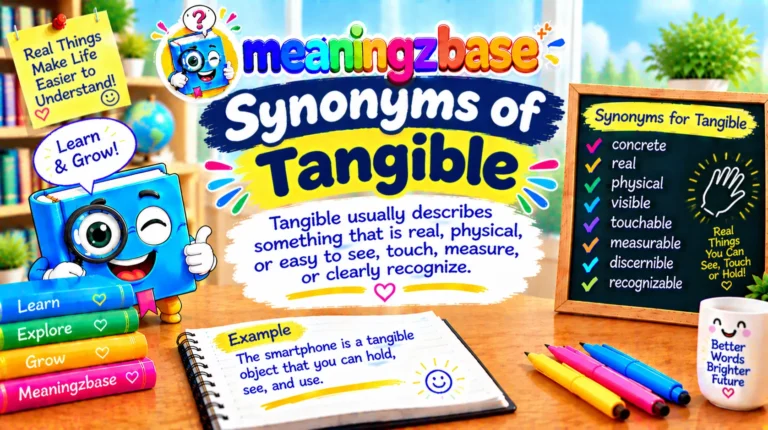
Depending on what you want to say, words such as concrete, physical, real, material, visible, palpable, substantial, or measurable may work better.
People often search for synonyms of tangible because they want to improve an essay, report, email, article, speech, or everyday conversation.
Word variety also helps your writing sound less repetitive. Instead of using tangible again and again, you can choose a replacement that matches your exact meaning.
These alternatives are useful in many settings. Students may need them for academic writing or IELTS essays.
Professionals may use them in reports, business documents, and presentations. In casual writing, a simpler word such as real or physical may sound more natural.
The key is not to replace tangible with any random synonym. Each word has a slightly different meaning, tone, or level of strength.
This guide explains the best options so you can choose the right word with confidence.
What Does “Tangible” Mean?
Tangible usually describes something that is real, physical, or easy to see, touch, measure, or clearly recognize.
For example:
The company achieved tangible results after the new plan was introduced.
Here, tangible does not mean that you can touch the results. It means the results are clear and measurable.
The word can describe physical things:
The museum contains many tangible objects from the past.
It can also describe things that are not physical but have clear effects:
The training produced tangible benefits for employees.
The tone of tangible is usually formal or professional. It is common in business, academic writing, reports, news articles, and formal discussions.
In simple conversation, words such as real, clear, physical, or actual may sound more natural.
15+ Best Synonyms for “Tangible”
Concrete
Definition: Something that is clear, specific, and real rather than vague or based only on ideas.
Tone: Formal / Academic
Example: The project produced concrete evidence of improvement.
Concrete is one of the strongest general alternatives to tangible. It works especially well when talking about evidence, results, plans, or benefits.
Physical
Definition: Something that exists in a material form and can usually be seen or touched.
Tone: Neutral / Casual
Example: The store sells physical copies of the book.
Use physical when you mean the opposite of digital, mental, or abstract.
Material
Definition: Something that exists as a physical object or has a real and important effect.
Tone: Formal / Academic
Example: The new law had a material effect on the company’s costs.
Material can refer to physical matter, but it can also mean something important or significant in formal writing.
Real
Definition: Something that truly exists or is genuine rather than imagined or false.
Tone: Casual / Neutral
Example: The new policy has made a real difference in the community.
Real is simple and flexible. It is often a better choice when writing for a general audience.
Actual
Definition: Something that truly exists or happened, rather than something expected or imagined.
Tone: Neutral / Formal
Example: The actual results were better than the team expected.
Use actual when you want to contrast reality with an idea, prediction, or assumption.
Touchable
Definition: Something that can be physically touched.
Tone: Casual
Example: The product gives customers a touchable example of the new design.
Touchable is close to the physical meaning of tangible, but it is less common in formal writing.
Palpable
Definition: Something that is so clear or strong that it can almost be felt.
Tone: Formal / Literary
Example: There was a palpable sense of excitement in the room.
Palpable is useful when describing feelings, tension, excitement, fear, or other strong experiences. It is not always suitable for physical objects.
Perceptible
Definition: Something that can be noticed, detected, or recognized.
Tone: Formal / Academic
Example: There was a perceptible change in the patient’s behavior.
This word is useful when something is noticeable but may not be directly touched.
Substantial
Definition: Something that is large, important, strong, or significant in amount or effect.
Tone: Formal / Academic
Example: The company made substantial progress during the year.
Substantial can replace tangible when the focus is on meaningful size, value, or impact rather than physical form.
Observable
Definition: Something that can be seen, noticed, or identified through observation.
Tone: Academic / Formal
Example: The study found observable changes in student performance.
This is a good choice for research, science, education, and analytical writing.
Evident
Definition: Something that is clear and easy to recognize.
Tone: Formal / Academic
Example: The benefits of the program were evident within a few months.
Evident works well when tangible means “clearly noticeable.”
Visible
Definition: Something that can be seen or clearly noticed.
Tone: Neutral / Casual
Example: The campaign created visible improvements in the local area.
Use visible when the main idea is something that can be seen.
Solid
Definition: Something reliable, strong, definite, or based on good evidence.
Tone: Neutral / Informal
Example: The team has a solid plan for the next stage.
Solid can express the idea of something real and dependable, but it does not always mean physically tangible.
Corporeal
Definition: Something that has a physical body or material existence.
Tone: Literary / Formal
Example: The story explores the difference between spiritual and corporeal life.
This is a more advanced word. It is mainly useful in literature, philosophy, and formal discussion.
Embodied
Definition: Something that gives a clear physical or visible form to an idea, quality, or concept.
Tone: Formal / Literary
Example: The building embodied the architect’s vision.
Embodied is useful when an abstract idea becomes clear through a person, object, action, or design.
Measurable
Definition: Something that can be measured or expressed with clear results.
Tone: Academic / Professional
Example: The new strategy delivered measurable improvements in sales.
Use measurable when you are talking about results, progress, change, or performance.
Definite
Definition: Something clear, certain, or specific rather than uncertain or vague.
Tone: Neutral / Formal
Example: The company needs definite proof before making a decision.
Definite is useful when tangible means clear or certain, but it should not be used when physical form is the main idea.
Stronger Alternatives
Sometimes tangible is not strong enough. If you want to show that something is especially clear, powerful, important, or significant, consider these alternatives.
Substantial
Use substantial when something is large or important in amount, value, or effect.
Example: The project delivered substantial financial benefits.
Significant
Use significant when something has an important effect or meaning.
Example: The research found significant changes in student behavior.
Striking
Use striking when something is unusually clear, noticeable, or impressive.
Example: The report showed a striking improvement in customer satisfaction.
Powerful
Use powerful when something has a strong effect on people or situations.
Example: The campaign sent a powerful message to young voters.
Compelling
Use compelling when evidence or information is strong enough to make people believe or accept something.
Example: The researchers presented compelling evidence.
Definitive
Use definitive when something provides a final or very strong answer.
Example: The test did not provide definitive proof of the theory.
Concrete
Use concrete when you want to stress that an idea, plan, result, or piece of evidence is clear and specific.
Example: The manager asked for concrete solutions.
Softer or Polite Alternatives
In some situations, a strong word may sound too forceful. Softer alternatives can make your writing more balanced and polite.
Clear
Use clear when you simply want to show that something is easy to understand or notice.
Example: The report provides clear evidence of progress.
Noticeable
Use noticeable when a change or effect can be seen without making it sound dramatic.
Example: There was a noticeable improvement in attendance.
Observable
Use observable when something can be noticed through careful attention.
Example: The experiment produced observable changes.
Apparent
Use apparent when something seems clear from the available facts.
Example: The benefits of the new system became apparent over time.
Meaningful
Use meaningful when something has value or importance without sounding overly strong.
Example: The program created meaningful opportunities for students.
Evident
Use evident when something is clear but you want a formal tone.
Example: Her progress was evident by the end of the course.
Practical
Use practical when you mean something useful and connected to real-world needs.
Example: The workshop gave employees practical skills.
Academic & IELTS-Friendly Alternatives
Academic writing requires accurate word choice. In IELTS essays, research papers, and university assignments, you should avoid replacing tangible with a complicated word simply to sound advanced. The best word is the one that fits your meaning.
Here are useful academic alternatives:
Concrete
Best for clear evidence, plans, examples, and results.
Example: Governments need to take concrete steps to reduce pollution.
Measurable
Best for results, progress, changes, and outcomes.
Example: The policy produced measurable improvements in public health services.
Substantial
Best for large or important effects.
Example: Higher education can provide substantial economic benefits.
Significant
Best for important changes or effects.
Example: The study found significant differences between the two groups.
Observable
Best for changes that can be seen or identified.
Example: The researchers recorded observable changes in behavior.
Evident
Best for something that becomes clear from facts or results.
Example: The impact of technology is evident in modern classrooms.
Quantifiable
Best for something that can be expressed with numbers.
Example: The company achieved quantifiable gains in productivity.
Demonstrable
Best for something that can be clearly shown or proven.
Example: The program has demonstrable benefits for local communities.
Verifiable
Best for facts, claims, or information that can be checked.
Example: Researchers should use verifiable sources when making important claims.
Material
Best for formal discussions of important effects or changes.
Example: The decision had a material impact on the organization’s finances.
Practical
Best for ideas or benefits connected to real-world use.
Example: Students gained practical experience during the placement.
Empirical
Best for evidence based on observation, testing, or real-world data.
Example: The argument should be supported by empirical evidence.
For IELTS, words such as concrete, measurable, significant, substantial, observable, demonstrable, and verifiable can improve vocabulary variety when they are used correctly.
Synonyms You Should Avoid
Not every word that means “real” or “clear” is a true synonym of tangible. Some alternatives can change the meaning of your sentence.
Genuine
Genuine means real or authentic, but it usually describes honesty, feelings, products, or identity.
Why avoid it: It does not normally describe something simply because it is physical.
Incorrect: “A genuine table” when you mean a physical table.
Visible
Visible means something can be seen.
Why avoid it: A tangible thing does not always need to be visible. An object may be tangible but hidden.
Touching
Touching can describe an emotional experience or the physical act of making contact.
Why avoid it: It can create a completely different meaning.
Concrete
Although concrete is often an excellent synonym, it is not suitable in every situation.
Why avoid it: It can also refer specifically to the building material.
Palpable
Palpable often describes something strongly felt or sensed.
Why avoid it: It may sound unnatural when used for ordinary physical objects.
The main lesson is simple: a synonym must match the meaning, not just the dictionary definition.
How to Choose the Right Synonym in Writing
Choosing the best synonym for tangible depends on four main factors.
Context
First, ask what you actually mean.
If you mean something physical, choose physical, material, or corporeal.
If you mean clear evidence, choose concrete, verifiable, or demonstrable.
If you mean measurable results, choose measurable or quantifiable.
If you mean a strong feeling, palpable may be better.
Tone
Think about how formal your writing should sound.
For casual writing, real, clear, visible, or solid may work well.
For professional writing, concrete, substantial, measurable, or significant may be better.
For academic writing, empirical, quantifiable, verifiable, or demonstrable may fit the context.
Audience
Always consider who will read your work.
A simple word is often better for a general audience. You do not need to use corporeal when physical communicates the same idea more clearly.
For academic readers, a more precise word may be useful if it accurately expresses your meaning.
Clarity
Never choose a synonym just because it sounds impressive.
Compare:
The project produced tangible results.
and:
The project produced measurable results.
If the results can be counted or measured, measurable is more precise.
Likewise:
She gave tangible evidence.
can become:
She gave concrete evidence.
The second version may sound more natural when discussing proof or support for an argument.
Example Paragraph Rewritten Using Synonyms
Original Sentence
The new training program created tangible benefits for employees and produced tangible improvements in workplace performance.
The sentence is understandable, but repeating tangible makes it sound less natural.
Rewrite Using Different Synonyms
The new training program created meaningful benefits for employees and produced measurable improvements in workplace performance.
Another version:
The new training program delivered practical benefits for employees and led to significant improvements in workplace performance.
A more academic version:
The new training program provided demonstrable benefits for employees and resulted in quantifiable improvements in workplace performance.
Each version has a slightly different focus. Meaningful highlights value. Measurable highlights results that can be tested. Practical focuses on real-world usefulness. Demonstrable stresses proof, while quantifiable suggests that the results can be expressed in numbers.
FAQs
What is the best synonym for tangible?
Concrete is one of the best general synonyms for tangible, especially when discussing evidence, results, plans, or benefits. However, physical is better when you mean something that can actually be touched.
What is a simple synonym for tangible?
Real, physical, clear, and actual are simple alternatives. The best choice depends on the sentence.
What is the opposite of tangible?
The common opposite is intangible. It describes something that cannot be physically touched, such as an idea, feeling, reputation, or experience.
Is concrete a synonym for tangible?
Yes, in many contexts. Concrete can mean clear, specific, or real, so it often works well as an alternative to tangible. However, the two words are not interchangeable in every sentence.
What is a good synonym for tangible in academic writing?
Useful academic choices include concrete, measurable, substantial, significant, observable, demonstrable, verifiable, quantifiable, and empirical. Choose the word based on the exact meaning you need.
What is a synonym for tangible results?
Good alternatives include concrete results, measurable results, significant results, observable results, and demonstrable results. Measurable results is especially useful when the outcome can be shown with data.
What is a synonym for tangible benefits?
You can use concrete benefits, practical benefits, measurable benefits, substantial benefits, or meaningful benefits. The best option depends on whether you want to stress proof, usefulness, size, or value.
Conclusion
Finding the right synonym for tangible is not only about replacing one word with another.
It is about choosing language that expresses your exact idea. Concrete is useful for clear evidence and specific plans, while physical works best for material objects.
Measurable highlights results that can be tested, substantial shows importance or size, and palpable works well for strong feelings or experiences.
For academic and IELTS writing, precise choices such as quantifiable, demonstrable, verifiable, observable, and significant can add variety without making your writing difficult to understand.
In everyday writing, simpler options such as real, clear, physical, and actual are often better.
The most important rule is to focus on meaning, context, tone, audience, and clarity. A strong synonym is not the most complicated word.
It is the word that communicates your idea naturally and accurately.

Evan Blake is a passionate language enthusiast who creates simple and informative content about word meanings, slang, phrases, and modern expressions.
He focuses on making complex or unfamiliar words easy to understand through clear explanations and practical examples.