
When you search for synonyms for began, you are usually looking for a better way to describe the start of an action, event, process, or period.
The word began is simple and correct, but using it again and again can make writing feel flat. Choosing the right alternative can make your sentences clearer, more natural, and more interesting.
Word variety matters in almost every type of writing. In academic work, the right word can make an idea more precise.
In professional writing, it can create a polished tone. In casual writing, a simple alternative can make your message sound more natural and friendly.
The best synonym depends on what actually started and how it started.
For example, launched works well for a new product, while commenced suits formal writing.
Kicked off is more casual, and emerged can describe something that slowly appeared. Learning these differences helps you avoid awkward word choices.
This guide explains the best synonyms for began, including their meanings, tones, examples, stronger alternatives, academic choices, and common mistakes.
What Does “Began” Mean?
Began is the past tense of begin. It means that something started or came into action at a particular time.
For example:
The meeting began at nine o’clock.
Here, began tells us that the meeting started at nine.
The word is neutral in tone, which makes it useful in many situations. You can use it in casual conversation, school assignments, business writing, stories, and formal documents.
However, began does not always explain how something started. A stronger synonym can add more detail. For example:
- The campaign began in May.
- The campaign launched in May.
- The campaign kicked off in May.
- The campaign commenced in May.
All four sentences describe a start, but their tones and meanings are slightly different.
15+ Best Synonyms for “Began”
Started
Definition: To begin doing something or to come into action.
Tone: Neutral / Casual
Example: She started her new job on Monday.
Started is one of the closest and most natural alternatives to began. It works in almost any everyday situation.
Commenced
Definition: To begin, especially in a formal or official setting.
Tone: Formal
Example: The examination commenced at 10 a.m.
Commenced is useful for formal notices, reports, official documents, and serious academic writing. It can sound too formal in casual conversation.
Launched
Definition: To begin a new project, campaign, product, service, or major activity.
Tone: Formal / Professional
Example: The company launched its new website in June.
Launched suggests a planned and active beginning. It is especially common in business and marketing.
Initiated
Definition: To cause something to begin or put a process into action.
Tone: Formal / Academic
Example: The manager initiated a review of the safety rules.
This word often focuses on the person or action that causes something to start.
Opened
Definition: To begin an event, meeting, discussion, or formal activity.
Tone: Neutral / Formal
Example: The chairperson opened the meeting with a short speech.
Opened is especially useful when talking about meetings, events, ceremonies, and discussions.
Kicked Off
Definition: To begin an event, project, activity, or period.
Tone: Informal / Casual
Example: The team kicked off the season with a big win.
This phrase is common in everyday and business speech. It has a lively and energetic feel.
Set In
Definition: To begin to be felt or noticed, usually gradually.
Tone: Neutral / Literary
Example: As evening set in, the temperature dropped.
Set in is not a general replacement for began. It works best for conditions, feelings, weather, or situations that develop.
Emerged
Definition: To begin to appear, become known, or become noticeable.
Tone: Academic / Formal
Example: A new problem emerged during the testing process.
Emerged suggests that something became visible or known rather than simply starting at a fixed moment.
Originated
Definition: To begin or develop from a particular source or place.
Tone: Formal / Academic
Example: The idea originated in a small research group.
Use originated when you want to show where an idea, practice, tradition, or problem first came from.
Arise
Definition: To begin to exist or happen, often unexpectedly.
Tone: Formal / Academic
Example: Several concerns arose during the meeting.
The past form arose is often used when a problem, question, need, or opportunity appears.
Developed
Definition: To begin to grow, change, or become more advanced over time.
Tone: Neutral / Academic
Example: A strong friendship developed between the two students.
Developed is better than began when the idea involves gradual growth or change.
Started Up
Definition: To begin operating or working.
Tone: Casual / Neutral
Example: The machine started up after a few minutes.
This phrase is common for machines, businesses, systems, and operations.
Got Underway
Definition: To begin and start making progress.
Tone: Neutral / Casual
Example: The construction project got underway in early spring.
It often suggests that an activity has moved from planning into actual action.
Got Started
Definition: To begin an activity.
Tone: Casual
Example: We got started after everyone arrived.
This is natural in conversation and informal writing.
Sparked
Definition: To cause something to begin suddenly or strongly.
Tone: Literary / Casual
Example: The speech sparked a heated debate.
Sparked adds the idea of causing a reaction. It is stronger and more vivid than simply saying began.
Triggered
Definition: To cause an event, reaction, or process to begin.
Tone: Formal / Academic
Example: The discovery triggered further research.
Use triggered when one event directly causes another event or reaction.
Unfolded
Definition: To begin and develop gradually over time.
Tone: Literary / Formal
Example: The story unfolded over several years.
Unfolded works especially well for stories, events, situations, and developments that happen step by step.
Broke Out
Definition: To begin suddenly and often with force.
Tone: Neutral / Literary
Example: A fire broke out shortly after midnight.
It is commonly used with events such as fires, wars, violence, arguments, or outbreaks.
Stronger Alternatives
Sometimes began is too weak because the start was sudden, powerful, or important. In these cases, choose a word that shows the force of the beginning.
Erupted
Use erupted when something starts suddenly and with great force.
Example: Protests erupted across the city.
Exploded
Use exploded when growth, activity, emotion, or interest increases very quickly.
Example: Online interest in the product exploded after the announcement.
Ignited
Use ignited when something begins with strong energy, emotion, or influence.
Example: The discovery ignited a new wave of research.
Surged
Use surged when something rises or increases rapidly.
Example: Demand for the service surged after the launch.
Unleashed
Use unleashed when an event begins with powerful or uncontrolled force.
Example: The storm unleashed heavy rain across the region.
Sparked
Use sparked when one event causes another event, idea, reaction, or discussion to start.
Example: Her question sparked a useful debate.
Burst Into
Use burst into when someone suddenly starts an action or emotion.
Example: The audience burst into applause.
These stronger choices should not replace began automatically. Use them only when the extra meaning is true.
Softer or Polite Alternatives
Some situations call for a gentler expression. This is useful when writing about sensitive topics, gradual changes, or polite professional communication.
Introduced
Use introduced when something new is brought into a situation.
Example: The school introduced a new reading program.
Initiated
This can sound polite and professional when describing the start of a process.
Example: The department initiated a review of the policy.
Set About
Use set about when someone begins a task in a purposeful way.
Example: She set about preparing the report.
Embarked On
Use embarked on when someone begins a meaningful project, journey, or period.
Example: He embarked on a new career.
Entered
Use entered when someone begins a new stage or period.
Example: The company entered a new phase of growth.
Moved Into
Use moved into when describing a gradual transition to a new stage.
Example: The discussion moved into a more serious phase.
Progressed Into
Use progressed into when something gradually develops into another stage.
Example: The project progressed into a larger research effort.
These expressions are softer because they often focus on transition rather than a sudden start.
Academic & IELTS-Friendly Alternatives
For essays, research papers, IELTS writing, and formal reports, vocabulary should be precise rather than simply complicated. The following alternatives can help you avoid repeating began.
Commenced
Best for formal activities, processes, studies, and official events.
Example: The study commenced in January.
Initiated
Best when a person, group, or organization causes something to start.
Example: The government initiated a new education program.
Originated
Best when explaining the source of an idea, trend, or practice.
Example: The tradition originated in the nineteenth century.
Emerged
Best when something gradually becomes visible, known, or important.
Example: Several major concerns emerged from the survey.
Arose
Best for problems, questions, issues, needs, and opportunities.
Example: Several challenges arose during the project.
Developed
Best when something grows or changes over time.
Example: The relationship developed over several years.
Initiated a Process
This phrase works well when describing the formal start of a procedure.
Example: The institution initiated a process to improve student support.
Came Into Effect
Best for laws, rules, policies, and official changes.
Example: The new policy came into effect in July.
Came Into Use
Best for technology, methods, systems, or practices.
Example: The new system came into use in 2025.
Was Introduced
Best for new ideas, systems, rules, or products.
Example: A new assessment method was introduced in the schools.
Got Underway
Useful in less formal academic or general reporting.
Example: The research project got underway after funding was approved.
For IELTS, do not use advanced vocabulary simply to sound intelligent. A clear word such as started can be better than commenced if the context is simple.
Synonyms You Should Avoid
Not every word connected with starting is a true synonym for began. Some alternatives change the meaning.
Originated
Originated does not simply mean started. It focuses on the source or place where something first developed.
Incorrect:
The meeting originated at 9 a.m.
Better:
The meeting began at 9 a.m.
Emerged
Emerged suggests that something appeared or became known.
Incorrect:
The class emerged at 8 a.m.
Better:
The class began at 8 a.m.
Erupted
Erupted suggests a sudden and often forceful beginning.
Incorrect:
The quiet lesson erupted at 9 a.m.
Better:
The lesson began at 9 a.m.
Developed
Developed suggests growth or change over time.
Incorrect:
The concert developed at 7 p.m.
Better:
The concert began at 7 p.m.
Triggered
Triggered means caused something else to happen.
Incorrect:
The meeting triggered at 10 a.m.
Better:
The meeting began at 10 a.m.
The key lesson is simple: a synonym should match both the basic meaning and the situation.
How to Choose the Right Synonym in Writing
Choosing the right synonym is not about finding the most difficult word. It is about finding the word that fits your sentence best.
Context
First, ask what actually started.
Was it:
- A meeting?
- A business?
- A machine?
- A problem?
- A discussion?
- A relationship?
- A trend?
- A sudden event?
For example, a machine can start up, a campaign can launch, a problem can arise, and a debate can be sparked.
Tone
Think about how formal your writing needs to be.
For casual writing:
We got started at noon.
For professional writing:
The project commenced at noon.
For lively writing:
The event kicked off at noon.
Audience
Consider who will read your work. A school essay, business report, social media post, and personal message do not need the same vocabulary.
Simple words are often best when your audience needs quick and easy understanding.
Clarity
Never choose a synonym that makes the sentence less clear.
Compare:
The meeting began at 3 p.m.
with:
The meeting unfolded at 3 p.m.
The first sentence is clearer because unfolded suggests gradual development, not simply a start time.
A good synonym should improve the sentence, not merely make it sound more advanced.
Example Paragraph Rewritten Using Synonyms
Original paragraph:
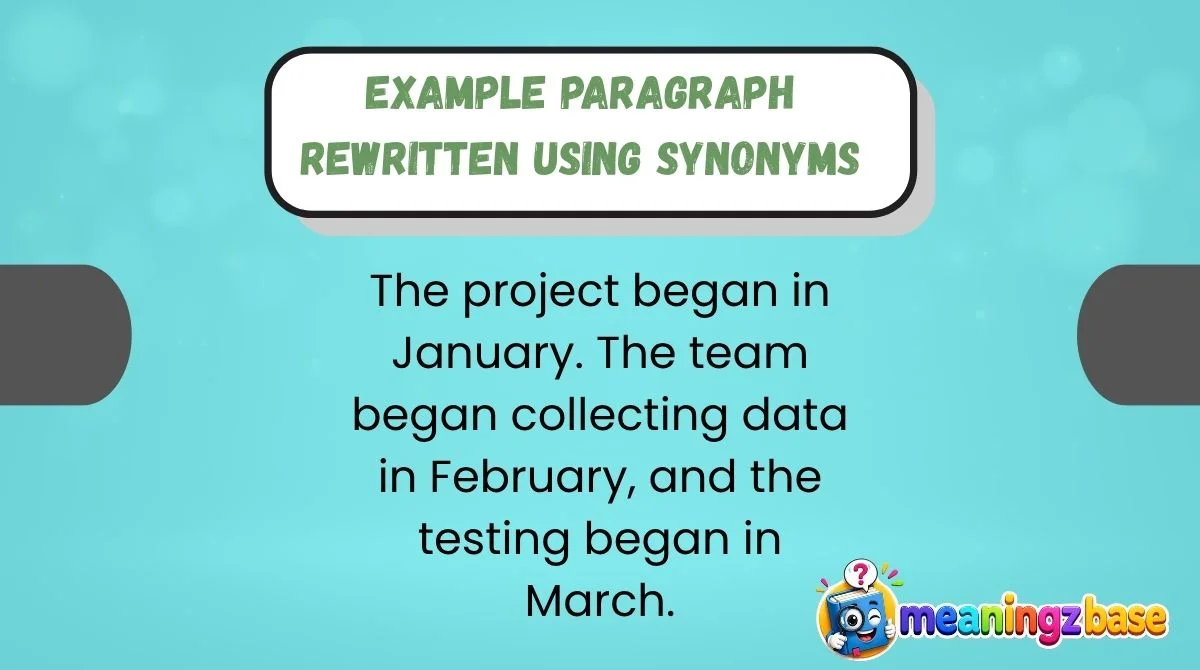
The project began in January. The team began collecting data in February, and the testing began in March. In April, the company began a review of the results. By May, a new phase of the project began.
The repeated use of began makes the paragraph sound dull. We can improve it by choosing alternatives that match each situation.
Rewritten paragraph:
The project commenced in January. The team started collecting data in February, and testing got underway in March. In April, the company initiated a review of the results. By May, the project entered a new phase.
Each replacement adds a slightly different meaning while keeping the paragraph easy to understand.
Another example:
Original sentence:
The discussion began after the teacher asked a question.
Rewrite:
The discussion started after the teacher asked a question.
More vivid rewrite:
The teacher’s question sparked a lively discussion.
The second rewrite is stronger because the question did not merely mark the beginning; it caused the discussion.
FAQs
What is the best synonym for began?
Started is usually the best direct synonym because it is simple, natural, and works in most contexts.
What is a formal synonym for began?
Commenced is one of the strongest formal alternatives. Initiated is also useful when someone or something causes a process to start.
What is another word for began in academic writing?
Good academic choices include commenced, initiated, emerged, originated, arose, developed, and was introduced, depending on the context.
What is a synonym for began in IELTS writing?
Useful IELTS alternatives include commenced, initiated, emerged, developed, originated, arose, and was introduced. Choose based on meaning rather than difficulty.
What is a casual synonym for began?
Started, got started, and kicked off are natural casual alternatives.
What is a stronger word for began?
Words such as erupted, ignited, exploded, surged, and sparked can be stronger, but they add special meanings. They should only be used when those meanings fit.
Can started always replace began?
Usually, but not always. Started is very flexible, while words such as emerged, originated, developed, and triggered carry more specific meanings.
Conclusion
Finding the right synonyms for began can make your writing more varied, clear, and engaging.
The simplest choice is often started, but many other options can express a more exact idea.
Use commenced for formal situations, launched for planned projects or campaigns, sparked for something that causes a reaction, emerged for something that becomes visible, and developed for gradual change.
The most important rule is to focus on meaning, tone, audience, and context. Do not replace began just to use a bigger word.
A strong writer chooses the word that communicates the exact idea with the least confusion.

Evan Blake is a passionate language enthusiast who creates simple and informative content about word meanings, slang, phrases, and modern expressions.
He focuses on making complex or unfamiliar words easy to understand through clear explanations and practical examples.