
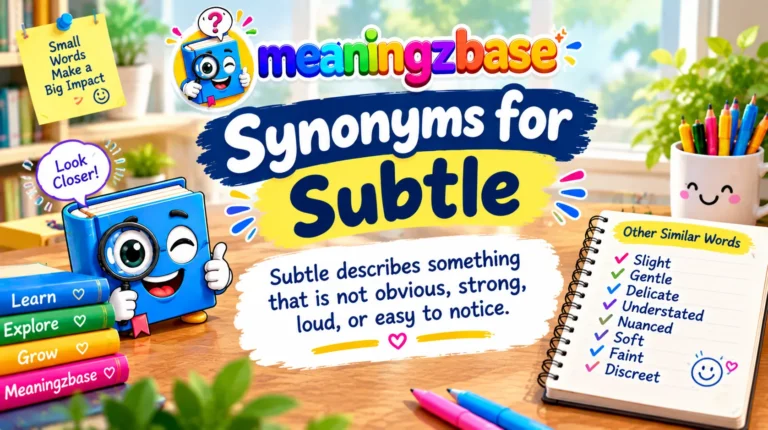
The word subtle is useful, but using the same word again and again can make writing feel flat.
That is why many people search for synonyms for subtle when they want a better word for an essay, email, article, conversation, or creative piece.
The right alternative can make an idea clearer without changing its meaning.
“Subtle” can describe something hard to notice, gently expressed, not obvious, or slightly different. Its meaning can change with the sentence.
For example, a subtle change is small and not easy to see, while a subtle message may be indirect rather than direct.
Having a range of related words helps writers match their vocabulary to the situation. Students may need alternatives for essays or IELTS writing.
Professionals may want a more precise word in reports and emails. In casual speech, a simple replacement can sound more natural.
The key is not to choose the most difficult word. Choose the word that expresses your exact meaning.
The following list explains useful synonyms for subtle, including their tone, meaning, and best use.
What Does “Subtle” Mean?
Subtle describes something that is not obvious, strong, loud, or easy to notice. It can refer to a small difference, a hidden meaning, a gentle action, or a quality that is noticed only with careful attention.
The tone of subtle is usually neutral. It works well in everyday conversation, professional writing, academic work, and creative writing.
For example:
“There was a subtle change in her voice.”
Here, the change was real but small. It was not dramatic or easy to notice.
The word can also mean indirect. For example:
“He gave me a subtle hint that he wanted to leave.”
In this case, the person did not say what he wanted directly. He suggested it in a quiet or indirect way.
The best synonym depends on which meaning you want. Words such as slight, faint, and delicate often describe something small or hard to notice. Words such as indirect, implicit, and implied are better when you mean that an idea is not stated clearly.
15+ Best Synonyms for “Subtle”
1. Slight
Definition: Small in degree, amount, or effect.
Tone: Neutral / Casual / Formal
Example: There was a slight change in the weather.
Best for: Small differences, changes, or effects.
2. Faint
Definition: Weak, light, or difficult to detect.
Tone: Neutral / Literary
Example: A faint smell of flowers filled the room.
Best for: Smells, sounds, colors, signs, and physical sensations.
3. Delicate
Definition: Gentle, fine, or easily affected.
Tone: Formal / Literary
Example: The painting has a delicate balance of light and color.
Best for: Art, feelings, details, designs, and sensitive situations.
4. Understated
Definition: Expressed in a quiet way without trying to attract attention.
Tone: Formal / Professional
Example: Her understated style made the presentation feel polished.
Best for: Style, humor, design, emotions, and communication.
5. Unobtrusive
Definition: Not attracting attention or getting in the way.
Tone: Formal / Academic
Example: The small camera was placed in an unobtrusive location.
Best for: Objects, designs, behavior, and features that should not distract people.
6. Indirect
Definition: Communicated without saying something clearly or directly.
Tone: Neutral / Formal
Example: He gave an indirect answer to the question.
Best for: Speech, messages, criticism, hints, and communication.
7. Implicit
Definition: Understood without being directly stated.
Tone: Academic / Formal
Example: The report contains an implicit warning about future risks.
Best for: Academic, professional, and analytical writing.
8. Implied
Definition: Suggested without being directly expressed.
Tone: Neutral / Formal
Example: Her expression carried an implied message of concern.
Best for: Messages, meanings, suggestions, and opinions.
9. Inconspicuous
Definition: Not easily seen or noticed.
Tone: Formal
Example: The entrance was hidden behind an inconspicuous door.
Best for: Places, objects, people, and physical features.
10. Restrained
Definition: Controlled and not excessive in emotion or expression.
Tone: Formal / Professional
Example: He gave a restrained response to the criticism.
Best for: Emotions, reactions, writing styles, and behavior.
11. Muted
Definition: Soft, limited, or less strong than usual.
Tone: Formal / Literary
Example: The room was decorated in muted shades of blue and gray.
Best for: Colors, sounds, emotions, and reactions.
12. Nuanced
Definition: Showing small but important differences or details.
Tone: Academic / Formal
Example: The author gives a nuanced view of the problem.
Best for: Opinions, arguments, analysis, social issues, and complex ideas.
13. Refined
Definition: Polished, elegant, or carefully developed.
Tone: Formal / Literary
Example: The restaurant is known for its refined atmosphere.
Best for: Taste, style, behavior, art, design, and ideas.
14. Sophisticated
Definition: Complex, polished, or developed in a thoughtful way.
Tone: Formal / Academic
Example: The software uses a sophisticated system to detect errors.
Best for: Technology, ideas, systems, style, and analysis.
15. Gentle
Definition: Soft, calm, kind, or not forceful.
Tone: Casual / Neutral
Example: She gave him a gentle reminder about the meeting.
Best for: Actions, reminders, criticism, sounds, and behavior.
16. Quiet
Definition: Not loud, forceful, or attention-seeking.
Tone: Casual / Neutral
Example: He made a quiet suggestion during the meeting.
Best for: Suggestions, actions, personalities, and forms of communication.
17. Tactful
Definition: Careful not to upset or offend someone.
Tone: Formal / Professional
Example: She was tactful when discussing his mistake.
Best for: Criticism, difficult conversations, workplace communication, and advice.
18. Discreet
Definition: Careful and private, especially when something should not attract attention.
Tone: Formal / Professional
Example: The manager made a discreet inquiry about the issue.
Best for: Private matters, actions, conversations, and sensitive situations.
19. Low-key
Definition: Calm, simple, and not designed to attract much attention.
Tone: Informal / Casual
Example: They planned a low-key celebration at home.
Best for: Social events, plans, personalities, and casual conversation.
20. Hushed
Definition: Very quiet or spoken in a soft voice.
Tone: Literary / Neutral
Example: They discussed the news in hushed voices.
Best for: Voices, places, moods, and scenes.
Stronger Alternatives
Sometimes subtle is too weak for the idea you want to express. If the feature is difficult to notice but still powerful or meaningful, a stronger word may work better.
1. Nuanced
Use nuanced when an idea contains several layers or small differences. It is especially useful in academic writing.
Example: The study offers a nuanced explanation of the results.
2. Sophisticated
Use sophisticated when something is advanced, complex, or highly developed.
Example: The company developed a sophisticated security system.
3. Complex
Use complex when something has many connected parts or meanings.
Example: The issue is more complex than it first appears.
4. Intricate
Use intricate for something containing many small, carefully connected details.
Example: The artist created an intricate pattern on the wall.
5. Profound
Use profound when the meaning or effect is deep and important.
Example: The experience had a profound effect on her life.
6. Significant
Use significant when the effect or difference is important rather than merely small.
Example: The policy led to a significant improvement in safety.
7. Distinctive
Use distinctive when a quality is clear enough to make something stand out.
Example: The building has a distinctive architectural style.
8. Powerful
Use powerful when something creates a strong emotional or practical effect.
Example: The film delivers a powerful message about friendship.
Softer or Polite Alternatives
When you want to make your language less direct or less harsh, these words can replace subtle depending on the context.
1. Gentle
A good choice for soft actions, reminders, or criticism.
Example: She offered a gentle reminder about the deadline.
2. Tactful
Use this when someone communicates carefully to avoid causing offense.
Example: He gave a tactful response to the sensitive question.
3. Diplomatic
Use this when dealing with disagreement or sensitive matters.
Example: The manager gave a diplomatic answer.
4. Considerate
Use this when an action shows care for another person’s feelings.
Example: It was considerate of her to raise the issue privately.
5. Mild
Use mild when something is not severe, strong, or extreme.
Example: The report included mild criticism of the plan.
6. Reserved
Use reserved for someone who does not openly show feelings or opinions.
Example: He remained reserved during the discussion.
7. Careful
Use careful when someone chooses words or actions with attention.
Example: She was careful with her comments during the meeting.
8. Measured
Use measured when a response is calm, controlled, and thoughtful.
Example: The director gave a measured response to the criticism.
Academic & IELTS-Friendly Alternatives
Academic and IELTS writing often benefits from precise vocabulary. However, advanced words should only be used when they fit the meaning.
1. Implicit
Best when something is understood rather than directly stated.
Example: The policy contains an implicit assumption about consumer behavior.
2. Nuanced
Best for complex ideas that contain small but meaningful differences.
Example: The article presents a nuanced argument about education.
3. Indirect
Useful when information is communicated without a direct statement.
Example: The findings provide indirect evidence of the problem.
4. Understated
Useful for controlled expression that avoids exaggeration.
Example: The author uses an understated style to discuss the issue.
5. Discreet
Useful when something is intentionally kept private or out of public attention.
Example: The organization conducted a discreet investigation.
6. Unobtrusive
Useful for something that does not distract or attract attention.
Example: The researchers used an unobtrusive method of observation.
7. Refined
Useful when describing something polished or carefully developed.
Example: The researchers developed a refined method for collecting data.
8. Delicate
Useful for sensitive situations or fine distinctions.
Example: The researchers faced a delicate ethical issue.
9. Restrained
Useful when describing controlled language, emotion, or behavior.
Example: The report uses a restrained tone throughout.
10. Sophisticated
Useful when describing an advanced method, system, or argument.
Example: Modern technology allows more sophisticated forms of data analysis.
11. Intricate
Useful when something involves many connected details.
Example: The researchers examined the intricate relationship between income and education.
12. Complex
A safe and widely useful academic alternative when something has many parts or factors.
Example: Climate change is a complex global issue.
For IELTS, precision matters more than using the longest or most unusual word. Nuanced, implicit, indirect, complex, and sophisticated can be useful, but only when their exact meanings match the sentence.
Synonyms You Should Avoid
Not every related word can replace subtle. Some words look similar but change the meaning.
1. Secret
Secret means something deliberately kept hidden. Subtle does not always involve hiding something.
Incorrect: She made a secret change to her hairstyle.
Better: She made a subtle change to her hairstyle.
2. Invisible
Invisible means impossible to see. Something subtle may be visible but difficult to notice.
Incorrect: There was an invisible difference in the design.
Better: There was a subtle difference in the design.
3. Weak
Weak describes a lack of strength, power, or ability. It is not always the same as subtle.
Example: A subtle argument can still be very strong.
4. Hidden
Hidden means deliberately or physically kept out of sight. A subtle message may be easy to see but hard to understand.
Example: The advertisement contains a subtle message.
5. Quiet
Quiet usually relates to sound or a calm manner. It does not always describe an indirect or difficult-to-notice meaning.
Example: “A quiet sound” works, but “a quiet argument” may not mean the same thing as “a subtle argument.”
The main lesson is simple: a synonym should match both the meaning and the situation. Two words can be related without being interchangeable.
How to Choose the Right Synonym in Writing
Choosing the best synonym is not about finding the most impressive word. It is about finding the word that communicates your exact idea.
Context
First, ask what subtle means in your sentence.
Does it mean:
- Small?
- Hard to notice?
- Indirect?
- Gentle?
- Private?
- Complex?
- Controlled?
If you mean a small change, slight is often better.
Example: There was a slight difference between the two results.
If you mean an unstated meaning, implicit or implied may be better.
Example: The statement contains an implicit criticism.
Tone
Think about how the sentence should sound.
For casual writing, slight, gentle, or quiet may feel natural.
For professional writing, understated, tactful, or measured may work better.
For academic writing, implicit, nuanced, or complex can provide greater precision.
Audience
Your reader also matters.
A simple word is usually best when writing for a general audience. Do not replace an easy word with a difficult one just to sound intelligent.
For example:
Simple: The report shows a slight change.
More academic: The report indicates a nuanced shift.
The second sentence is not automatically better. It is better only if nuanced shift accurately describes the evidence.
Clarity
Always choose clarity over variety.
If subtle is the clearest word, keep it. Synonyms should make writing more precise, not more confusing.
A good writer does not avoid repeating a word at all costs. A good writer changes words when the change improves meaning, rhythm, or tone.
Example Paragraph Rewritten Using Synonyms
Original sentence:
The manager made a subtle change to the company policy. He also gave a subtle hint that more changes might happen soon.
Rewrite 1 — Professional:
The manager made a slight change to the company policy. He also gave an indirect hint that further changes might happen soon.
Rewrite 2 — Academic:
The manager introduced a nuanced change to the company policy. His statement also contained an implicit suggestion that additional changes could follow.
Rewrite 3 — Simple and natural:
The manager made a small change to the company policy. He also gave a quiet hint that more changes could come soon.
Each version changes the tone slightly. The first is professional, the second is more academic, and the third is easy and conversational.
This shows why synonyms should not be treated as exact replacements. The best choice depends on what the writer wants the reader to understand.
FAQs
What is the best synonym for subtle?
There is no single best synonym. Slight, indirect, understated, implicit, nuanced, and delicate can all work, depending on the meaning.
What is another word for subtle in a sentence?
Common alternatives include slight, faint, delicate, understated, indirect, implicit, implied, and nuanced.
What is a stronger word for subtle?
Depending on the context, stronger choices include nuanced, sophisticated, intricate, profound, significant, and powerful.
What is a polite synonym for subtle?
For polite communication, gentle, tactful, diplomatic, considerate, measured, and mild can be useful.
What is the academic synonym for subtle?
Implicit, nuanced, indirect, understated, and sophisticated are useful academic alternatives when their meanings fit the context.
Is “subtle” a positive or negative word?
Subtle is usually neutral. It can have a positive or negative meaning depending on the sentence. A subtle design may be elegant, while a subtle insult may be unpleasant.
What is the difference between subtle and slight?
Slight usually means small in amount or degree. Subtle often means difficult to notice, understand, or detect. For example, a slight change is small, while a subtle message may have a hidden or indirect meaning.
Conclusion
Finding the right synonyms for subtle can make writing clearer, more precise, and more natural.
The best replacement depends on the meaning you want to express.
Use slight for small changes, faint for weak signs or sensations, indirect for unclear communication, implicit for unstated ideas, nuanced for complex differences, and tactful for careful communication. In professional and academic writing, precision is more important than using difficult vocabulary.
A strong writer chooses the word that fits the context, tone, audience, and intended meaning. Instead of replacing “subtle” simply to avoid repetition, use a synonym when it adds a clearer shade of meaning.

Evan Blake is a passionate language enthusiast who creates simple and informative content about word meanings, slang, phrases, and modern expressions.
He focuses on making complex or unfamiliar words easy to understand through clear explanations and practical examples.