
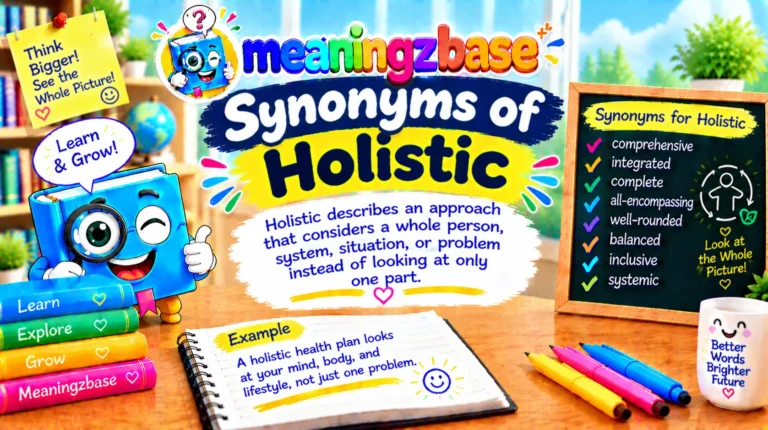
When you need to describe something that looks at the whole picture rather than just one part, the word holistic is often the first choice.
But using the same word again and again can make your writing feel flat. This is why many writers, students, professionals, and English learners search for synonyms for holistic.
Choosing the right alternative can make a sentence clearer and more natural.
In academic writing, you may need a more precise word such as comprehensive or integrated. In professional writing, all-encompassing or broad-based may work better.
In casual speech, whole-picture can sound easier and more natural.
The key is not simply to replace holistic with any similar word. Each alternative has its own meaning, strength, and tone.
Some focus on completeness, while others stress connections between different parts.
This guide explains the best synonyms for holistic, including stronger options, softer alternatives, academic choices, and words that can cause confusion.
What Does “Holistic” Mean?
Holistic describes an approach that considers a whole person, system, situation, or problem instead of looking at only one part.
For example, a holistic approach to education may consider a student’s academic progress, emotional needs, social skills, and personal growth. A holistic business strategy may look at customers, employees, costs, long-term goals, and wider market conditions together.
The word usually has a thoughtful and broad tone. It suggests that different parts are connected and should be understood together.
Holistic is common in education, healthcare, business, psychology, personal development, environmental studies, and academic writing. It can also appear in everyday language when someone wants to describe a complete way of looking at an issue.
The best synonym depends on what you want to emphasize. If you mean “covering everything,” comprehensive may be best. If you mean “joining different parts,” integrated may be more accurate. If you mean “looking at the entire system,” whole-system or system-wide may fit better.
15+ Best Synonyms for “Holistic”
Comprehensive
Definition: Covering all or most important parts of a subject or situation.
Tone: Formal / Academic
Example: The school developed a comprehensive plan to improve student learning.
Comprehensive is one of the closest general alternatives to holistic. It works well when you want to stress completeness rather than the relationship between different parts.
All-Encompassing
Definition: Including a very wide range of things, areas, or concerns.
Tone: Formal / Academic
Example: The report provides an all-encompassing view of the company’s future goals.
This word suggests that almost nothing important has been left out. It is useful when describing a very broad plan, review, or strategy.
Integrated
Definition: Combining different parts so they work together as one connected approach.
Tone: Formal / Academic
Example: The hospital uses an integrated approach to patient care.
Integrated is especially useful when the connection between separate areas matters. It is often stronger than holistic when describing systems, services, or methods that actively work together.
Whole
Definition: Considering something as a complete unit rather than as separate pieces.
Tone: Casual / General
Example: We need to understand the whole situation before making a decision.
Whole is simple and natural. It does not sound technical, which makes it a good choice for everyday writing.
Complete
Definition: Including all the important parts or information needed.
Tone: General / Formal
Example: The manager requested a complete review of the project.
Complete focuses on having nothing important missing. It is useful when clarity is more important than a specialized tone.
Broad
Definition: Covering many areas, ideas, or factors rather than focusing narrowly on one.
Tone: General / Academic
Example: The study takes a broad view of the causes of poverty.
Use broad when the main idea is a wide scope. It does not always suggest that every part is connected.
Wide-Ranging
Definition: Covering many different subjects, areas, or factors.
Tone: Formal / Academic
Example: The committee conducted a wide-ranging review of the policy.
This phrase works well for reports, research, discussions, and investigations that cover several related areas.
All-Round
Definition: Considering many different aspects of a person, activity, or situation.
Tone: Informal / General
Example: The program aims to support the all-round development of young learners.
All-round is common in British English and is especially useful for education and personal development.
Total
Definition: Including the entire amount, extent, or range of something.
Tone: General / Formal
Example: The plan requires a total review of the company’s operations.
Total can suggest completeness, but it is not always a direct synonym for holistic. Use it when you mean the entire thing rather than a connected approach.
Unified
Definition: Brought together so that separate parts form one clear or consistent whole.
Tone: Formal / Academic
Example: The team created a unified strategy for customer service.
Unified highlights togetherness. It is useful when several ideas, teams, or actions are being brought into one approach.
Coordinated
Definition: Planned or organized so that different parts work effectively together.
Tone: Formal / Professional
Example: The project requires a coordinated response from several departments.
This word is useful when different people or activities must work together. It is less broad than holistic but can be more precise.
Systematic
Definition: Done in an organized way that considers the relevant steps or parts.
Tone: Academic / Professional
Example: Researchers used a systematic method to examine the problem.
Systematic focuses on order and method. It should not be used as a direct replacement for holistic when the idea of seeing the entire picture is the main point.
Far-Reaching
Definition: Having an effect on many areas or reaching across a large range.
Tone: Formal / Literary
Example: The new law could have far-reaching effects on small businesses.
This alternative is best when you are talking about effects, influence, or consequences rather than an approach.
Multi-Dimensional
Definition: Involving several different sides, factors, or areas.
Tone: Academic / Formal
Example: Poverty is a multi-dimensional problem with economic and social causes.
This is a strong option when a topic has several important layers that must be considered.
Inclusive
Definition: Taking different people, needs, ideas, or factors into account.
Tone: Formal / Professional
Example: The company needs a more inclusive approach to employee development.
Inclusive works when the focus is on making sure different needs or viewpoints are considered.
Interconnected
Definition: Having parts that are closely linked and affect one another.
Tone: Academic / Formal
Example: The report shows that economic and environmental issues are interconnected.
This word is ideal when you want to stress relationships between parts of a larger system.
Extensive
Definition: Covering a large amount or wide range of information or activity.
Tone: Formal / Academic
Example: The researchers carried out extensive testing before releasing the product.
Extensive means broad or large in scope, but it does not necessarily mean that all parts are considered together.
360-Degree
Definition: Looking at an issue from many or all important angles.
Tone: Professional / Informal
Example: The company conducted a 360-degree review of its customer experience.
This phrase is popular in business writing. It sounds modern and practical, but it can feel less academic than comprehensive or integrated.
Stronger Alternatives
Sometimes holistic is not strong enough for what you want to say. These alternatives can add greater force:
- All-encompassing — Use it when an approach covers nearly every important area.
- Comprehensive — Best when you want to stress thorough coverage.
- Exhaustive — Use when an examination is extremely detailed and leaves very little unexplored.
- Far-reaching — Best for effects, influence, or consequences that extend across many areas.
- Multi-dimensional — Useful for complicated subjects with many important sides.
- System-wide — Best when an action or change affects an entire organization or system.
- All-inclusive — Useful when you want to emphasize that different groups, factors, or areas are included.
Be careful with exhaustive. It is much stronger than holistic. A holistic review may consider the whole picture without examining every possible detail.
Softer or Polite Alternatives
In some situations, you may want a word that sounds less technical, absolute, or forceful.
- Broad — A simple way to describe a wide view.
- Balanced — Useful when different sides or needs are given fair attention.
- Well-rounded — A friendly choice for people, education, skills, or development.
- Whole-person — Helpful when discussing someone’s needs beyond one narrow area.
- Inclusive — Polite and useful when different needs or viewpoints matter.
- Wide-ranging — A neutral way to show that several areas are covered.
- Complete — Clear and easy to understand without sounding overly technical.
- Thoughtful — Suitable when you want to stress careful consideration rather than full coverage.
For example, instead of saying, “We need a holistic solution,” a softer sentence could be, “We need a balanced solution that considers everyone’s needs.”
Academic & IELTS-Friendly Alternatives
If you are writing an essay, research paper, university assignment, or IELTS response, choosing precise vocabulary can improve your writing. However, advanced words should only be used when they fit the meaning.
Comprehensive
A strong academic choice for something that covers the major parts of a subject.
Example: The government needs a comprehensive strategy to address unemployment.
Integrated
Useful when separate elements are combined into one approach.
Example: An integrated education system can address both academic and practical skills.
Multi-Dimensional
Best for problems that have several connected causes or effects.
Example: Climate change is a multi-dimensional challenge that affects societies in different ways.
Interconnected
Useful for showing that different factors influence one another.
Example: Economic growth and environmental protection are often interconnected.
Systematic
Best when the method is organized, structured, and carefully planned.
Example: A systematic analysis of the data revealed several important trends.
Wide-Ranging
Useful when research or discussion covers many areas.
Example: The researchers conducted a wide-ranging investigation into public attitudes.
All-Encompassing
A formal option for a plan or approach intended to include almost every major factor.
Example: The city needs an all-encompassing plan for sustainable development.
Broad-Based
Useful for policies, support, strategies, and approaches that involve many groups or areas.
Example: The country needs a broad-based approach to improve access to education.
Holistic
You can still use the original word when it is the most precise choice.
Example: A holistic approach considers the academic, social, and emotional needs of students.
Coordinated
A good choice when different groups or actions must work together.
Example: A coordinated response is needed to address the country’s housing shortage.
For IELTS, do not replace holistic simply to sound more advanced. A clear and accurate word is usually better than an unusual word used incorrectly.
Synonyms You Should Avoid
Not every word that sounds similar to holistic has the same meaning.
Universal
Universal means applying to everyone or everything. It does not necessarily mean considering all parts of a situation.
Why to avoid it: A universal policy and a holistic policy can have very different meanings.
Complete
Although complete can work in some sentences, it may suggest that nothing is missing rather than that different parts are being considered together.
Why to avoid it: It focuses on completeness, not connections.
Total
Total often means the entire amount or full extent.
Why to avoid it: It can sound too absolute when you simply mean a broad approach.
Detailed
Detailed means containing many facts or small pieces of information.
Why to avoid it: Something can be highly detailed while still focusing on only one part of a problem.
General
General means broad or not highly specific.
Why to avoid it: A general approach may actually ignore important details, while a holistic approach aims to consider the important parts together.
The main lesson is simple: similar words are not always interchangeable. Check the exact meaning before replacing holistic.
How to Choose the Right Synonym in Writing
Choosing the best synonym is not just about finding a word with a similar meaning. Think about four things.
Context
First, ask what you are describing.
If you are describing a plan that covers many areas, comprehensive may fit.
If you are describing several departments working together, integrated or coordinated may be better.
If you are describing a complicated problem with many sides, multi-dimensional may be the strongest choice.
Tone
Think about how your sentence should sound.
For academic writing, choose words such as comprehensive, integrated, systematic, or interconnected.
For professional writing, broad-based, coordinated, and 360-degree may work well.
For casual writing, simple words such as whole, broad, or well-rounded are often easier.
Audience
Your reader matters.
A university professor may expect precise academic vocabulary. A business client may prefer clear professional language. A general reader may understand whole-picture approach more easily than a technical phrase.
Good writing is not about using the hardest word. It is about using the right word for the reader.
Clarity
Finally, ask whether your synonym makes the sentence easier to understand.
Compare:
“Managers need a holistic approach to employee development.”
with:
“Managers need a comprehensive approach to employee development.”
The second sentence may be clearer if the writer means that the plan should cover several areas. But if the writer means that physical, emotional, social, and professional factors are connected, holistic may remain the better choice.
Example Paragraph Rewritten Using Synonyms
Original sentence:
“A holistic approach to education helps students develop academically, socially, emotionally, and personally.”
Rewrite using different synonyms:
“A comprehensive approach to education supports students across several areas of development. An integrated model can connect academic learning with social and emotional growth. A well-rounded education also gives learners opportunities to build practical skills, confidence, and personal responsibility.”
Another example:
Original sentence:
“The company needs a holistic strategy to improve customer satisfaction.”
Rewrite using synonyms:
“The company needs a comprehensive strategy to improve customer satisfaction. This broad-based plan should consider product quality, customer support, pricing, communication, and user experience. A coordinated effort across departments can help turn these separate improvements into one effective customer experience.”
These examples show why good synonym use is more than changing one word. Sometimes the best rewrite changes the sentence structure as well. This makes the writing sound more natural and avoids repetitive vocabulary.
FAQs
What is the best synonym for holistic?
Comprehensive is one of the closest general synonyms for holistic. However, integrated, all-encompassing, well-rounded, or multi-dimensional may be better depending on the context.
What is a simple word for holistic?
Simple alternatives include whole, complete, broad, and balanced. The best choice depends on what you want to emphasize.
Is comprehensive the same as holistic?
They are similar but not identical. Comprehensive mainly means covering the important parts of something, while holistic often suggests understanding those parts as a connected whole.
What is a professional synonym for holistic?
Good professional alternatives include comprehensive, integrated, broad-based, coordinated, and 360-degree.
What is an academic synonym for holistic?
Academic options include comprehensive, integrated, systematic, multi-dimensional, and interconnected. Choose based on the exact meaning of your sentence.
What is the opposite of holistic?
Possible opposites include narrow, limited, fragmented, or one-dimensional. The correct opposite depends on the context.
Can I use holistic in IELTS writing?
Yes. Holistic is suitable for IELTS when it accurately expresses your meaning. However, do not use it simply to sound advanced. Words such as comprehensive and integrated can sometimes be more precise.
Conclusion
Finding the right synonyms for holistic can make your writing clearer, stronger, and less repetitive.
The best alternative depends on what you want to communicate.
Use comprehensive when you mean broad coverage, integrated when different parts work together, multi-dimensional when a subject has several important sides, and well-rounded when discussing balanced development.
In academic writing, precision matters more than using complicated vocabulary. In professional and casual writing, simple language may communicate the idea better. The goal is not to replace holistic every time it appears.
Instead, choose the word that matches your meaning, audience, and tone most naturally.

Evan Blake is a passionate language enthusiast who creates simple and informative content about word meanings, slang, phrases, and modern expressions.
He focuses on making complex or unfamiliar words easy to understand through clear explanations and practical examples.