
People often search for synonyms for emotion because using the same word again and again can make writing sound flat.
The word emotion is useful, but it cannot express every kind of feeling. A writer may need a word for joy, fear, love, anger, excitement, sadness, or a deep inner response.
Choosing the right word makes the meaning clearer and the sentence more natural.
Word variety is helpful in school essays, university assignments, business writing, stories, speeches, emails, and everyday conversation.
It is also useful for IELTS and other English tests, where a wider vocabulary can help show language control.
However, not every synonym for emotion means exactly the same thing. Some words are formal, while others sound natural in casual speech.
Some describe a strong feeling, while others suggest a quiet or lasting state.
The best choice depends on the situation, your audience, and the exact feeling you want to describe.
What Does “Emotion” Mean?
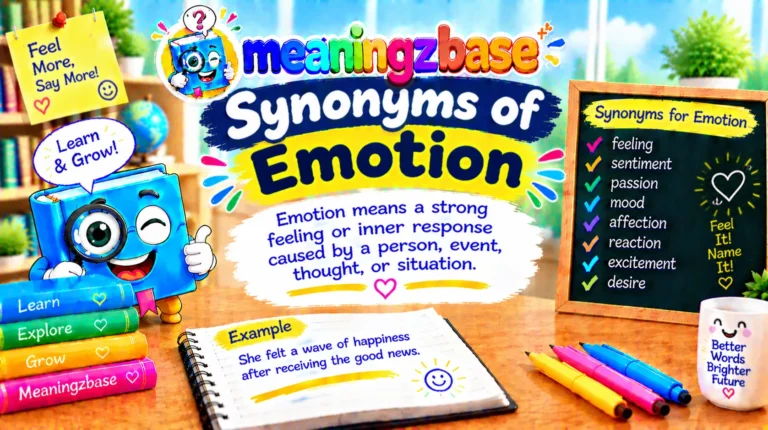
Emotion means a strong feeling or inner response caused by a person, event, thought, or situation.
It can describe feelings such as happiness, sadness, anger, fear, love, surprise, or excitement. The word is common in both spoken and written English.
The tone of emotion is neutral. It works well in casual conversation, professional writing, academic work, and general descriptions.
For example:
“She could not hide her emotion when she heard the news.”
Here, emotion refers to the strong feeling she experienced at that moment.
The word can also be used when talking about feelings in a general way:
“Music can create powerful emotions.”
When you want to be more specific, a synonym may be better. For example, joy tells the reader that the feeling is positive, while grief points to deep sadness.
15+ Best Synonyms for “Emotion”
Feeling
Definition: A general word for an emotional state or personal response.
Tone: Casual / Neutral
Example:
“She could not explain the feeling she had after the meeting.”
Feeling is one of the safest replacements for emotion. It sounds natural in almost every type of writing.
Sentiment
Definition: A feeling, attitude, or opinion about someone or something.
Tone: Formal / Academic
Example:
“The public sentiment toward the new policy has changed.”
Sentiment often describes a shared or expressed feeling rather than a sudden personal emotion.
Passion
Definition: A very strong feeling of love, interest, or enthusiasm for something.
Tone: Formal / Literary
Example:
“Her passion for teaching inspired many of her students.”
Use passion when the feeling is powerful and lasting.
Affection
Definition: A warm feeling of care, love, or fondness toward someone.
Tone: Formal / Casual
Example:
“He showed great affection for his younger brother.”
This word is useful when the emotion is gentle and positive.
Mood
Definition: A person’s emotional state at a particular time.
Tone: Casual / Neutral
Example:
“His cheerful mood improved after lunch.”
Mood is often used for a longer emotional state rather than one sudden feeling.
Reaction
Definition: An emotional or mental response to something that happens.
Tone: Neutral / Academic
Example:
“Her reaction to the announcement surprised everyone.”
Use reaction when you want to focus on how someone responds to an event.
Response
Definition: A feeling, thought, or action caused by something.
Tone: Formal / Academic
Example:
“Anger was a natural response to the unfair treatment.”
Response is broader than emotion, so it works best when feelings and actions are connected.
Sensation
Definition: A physical or mental experience that a person notices.
Tone: Formal / Academic
Example:
“He felt a strange sensation of fear before entering the room.”
Sensation is not always an emotion. It can also describe a physical experience, so context matters.
Affect
Definition: A person’s visible or overall emotional state.
Tone: Academic / Formal
Example:
“The patient’s affect appeared calm during the interview.”
Affect is common in psychology and academic writing. It is less natural in everyday conversation.
Excitement
Definition: A strong feeling of happiness, energy, or anticipation.
Tone: Casual / Neutral
Example:
“The children shouted with excitement when the doors opened.”
Use excitement when someone feels eager, happy, or highly energized.
Enthusiasm
Definition: Strong interest, energy, or excitement about something.
Tone: Formal / Casual
Example:
“She spoke about the project with great enthusiasm.”
Enthusiasm often relates to an activity, idea, goal, or subject that someone strongly enjoys.
Distress
Definition: A state of great worry, sadness, or emotional pain.
Tone: Formal / Academic
Example:
“The accident caused serious emotional distress.”
This is a stronger word and usually describes a difficult emotional state.
Delight
Definition: A feeling of great pleasure or happiness.
Tone: Literary / Formal
Example:
“The children watched the performance with delight.”
Delight is more expressive than the simple word happiness.
Joy
Definition: A deep or strong feeling of happiness and pleasure.
Tone: Literary / Neutral
Example:
“The birth of her child filled her with joy.”
Joy is useful when happiness is especially deep or meaningful.
Grief
Definition: Deep sadness, especially after a major loss.
Tone: Formal / Literary
Example:
“She struggled with grief after losing her close friend.”
Do not use grief for ordinary sadness. It usually describes serious emotional pain caused by loss.
Anguish
Definition: Extreme emotional pain, suffering, or distress.
Tone: Literary / Formal
Example:
“He cried out in anguish after hearing the terrible news.”
Anguish is much stronger than ordinary sadness or worry.
Empathy
Definition: The ability to understand and share another person’s feelings.
Tone: Formal / Academic
Example:
“Good leaders show empathy when their employees face difficulties.”
Empathy is not simply an emotion. It describes emotional understanding and connection with another person.
Resentment
Definition: A lasting feeling of anger or bitterness caused by unfair treatment or disappointment.
Tone: Formal / Academic
Example:
“Years of unfair treatment created deep resentment.”
Use resentment when anger remains over time.
Anxiety
Definition: A feeling of worry, fear, or nervousness about something uncertain.
Tone: Formal / Academic / Casual
Example:
“She felt anxiety before giving her presentation.”
Anxiety is more specific than the general word emotion because it identifies a particular emotional state.
Admiration
Definition: A strong feeling of respect or approval for someone or something.
Tone: Formal / Neutral
Example:
“He has great admiration for his grandfather.”
This word works well when the emotion is based on respect.
Stronger Alternatives: More Intense Options
Sometimes emotion does not feel strong enough. If you want to show a powerful reaction, choose a more intense word.
Passion — Use it for deep love, strong interest, or powerful commitment.
Anguish — Use it for extreme emotional pain.
Despair — Use it when someone feels that there is little or no hope.
Elation — Use it for extremely strong happiness or excitement.
Rage — Use it for very powerful anger.
Ecstasy — Use it for an extremely intense feeling of happiness or pleasure.
Fury — Use it for intense anger, especially when someone is extremely upset.
Devotion — Use it for very strong love, loyalty, or commitment.
For example, instead of writing:
“She felt a strong emotion after winning.”
You could write:
“She felt overwhelming elation after winning.”
The second sentence gives the reader a much clearer picture of the intensity.
Softer or Polite Alternatives
Not every feeling needs a powerful word. In polite, professional, or gentle writing, softer vocabulary can sound more natural.
Concern — A polite way to describe worry about a person or situation.
Unease — A mild feeling that something is not quite right.
Discomfort — A gentle way to describe an unpleasant feeling.
Fondness — A soft feeling of liking or affection.
Appreciation — A positive feeling of recognizing someone’s value or effort.
Warmth — A gentle feeling of kindness, affection, or friendliness.
Interest — A mild positive feeling of wanting to know or learn more.
Preference — A personal liking for one choice over another.
For example, instead of saying:
“I have strong negative emotions about the decision.”
a more polite version could be:
“I have some concerns about the decision.”
This sounds calmer and more suitable for workplace communication.
Academic & IELTS-Friendly Alternatives
Academic writing benefits from precise vocabulary. However, advanced words should only be used when they fit the meaning.
Sentiment
Useful when discussing public opinion or shared feelings.
Example:
“Public sentiment toward environmental policies has changed.”
Affect
Useful in psychology, research, and formal discussions of emotional states.
Example:
“Stress can influence a person’s affect and behavior.”
Emotional Response
Useful when explaining how people react to events.
Example:
“The film created a strong emotional response among viewers.”
Psychological State
Useful when discussing a person’s mental or emotional condition.
Example:
“Social pressure can affect an individual’s psychological state.”
Distress
Useful when describing serious worry, suffering, or emotional pain.
Example:
“Financial problems may cause considerable emotional distress.”
Anxiety
Useful when discussing worry, fear, or nervousness.
Example:
“Many students experience anxiety before important examinations.”
Empathy
Useful in essays about relationships, education, leadership, and society.
Example:
“Empathy can help people communicate more effectively.”
Resentment
Useful when discussing long-term anger caused by unfairness.
Example:
“Economic inequality may create resentment among disadvantaged groups.”
Enthusiasm
Useful when discussing motivation, education, employment, or public participation.
Example:
“Students showed considerable enthusiasm for the new learning program.”
Attitude
Useful when describing a person’s general way of thinking or feeling about something.
Example:
“A positive attitude can improve workplace cooperation.”
Sentimental Attachment
Useful when discussing emotional connections to people, objects, places, or memories.
Example:
“Many people have a strong sentimental attachment to their childhood homes.”
Emotional State
Useful when describing someone’s feelings at a particular time.
Example:
“A person’s emotional state can influence decision-making.”
For IELTS, precision is more important than simply choosing the most difficult word. A natural word used correctly is better than an advanced word used incorrectly.
Synonyms You Should Avoid: Context Warning
Some words may look like synonyms for emotion, but they can change the meaning.
Thought
A thought is an idea in the mind, not necessarily a feeling.
Incorrect: “She had a happy thought of fear.”
Better: “She had a feeling of fear.”
Opinion
An opinion is a belief or judgment. It is not automatically an emotion.
Example: “I think the plan will work” expresses an opinion, not an emotion.
Idea
An idea is something someone thinks about or imagines. It should not normally replace emotion.
Sensation
A sensation can describe a physical experience, such as warmth, pain, or pressure. It may also describe a mental experience, but it is not always emotional.
Desire
A desire means a strong wish to have or do something. It can be linked to emotion, but it is more specific.
For example:
“She felt a strong desire to travel.”
This does not mean exactly the same as:
“She felt a strong emotion.”
The first sentence identifies what she wanted, while the second only describes an emotional experience.
How to Choose the Right Synonym in Writing
Context
First, look at what is happening in the sentence. Is the person happy, worried, angry, excited, or sad? Choose a word that matches the situation.
For example, joy fits happiness, while anguish fits extreme pain.
Tone
Think about how your writing should sound.
For casual writing, use simple words such as feeling, mood, excitement, or concern.
For academic writing, words such as sentiment, affect, distress, and emotional response may be more suitable.
For creative writing, words such as anguish, delight, passion, and despair can create stronger images.
Audience
Your readers matter. A simple word is often better for a general audience. Technical terms may be useful for experts.
For example, affect may work well in a psychology paper but sound unnatural in a casual message.
Clarity
Never choose a synonym just because it sounds impressive. The main goal is to communicate your meaning clearly.
Compare:
“The child experienced profound emotional distress.”
with:
“The child felt very upset.”
The first is more formal. The second is simpler and easier to understand.
Both can be correct, depending on the audience.
Example Paragraph Rewritten Using Synonyms
Original Sentence
“The emotion she felt after receiving the award was very strong. She was happy, excited, and proud because her hard work had finally been recognized.”
Rewrite Using Different Synonyms
“The feeling she experienced after receiving the award was overwhelming. She was filled with delight and excitement, while a deep sense of pride grew from knowing that her hard work had finally been recognized.”
Another Formal Version
“Her emotional response to receiving the award was intense. She expressed great enthusiasm and satisfaction because her years of effort had finally received recognition.”
The meaning stays similar, but the vocabulary changes the tone. The first rewrite feels more expressive, while the second is more suitable for formal writing.
FAQs
What is the best synonym for emotion?
Feeling is the best general synonym for emotion. It is simple, natural, and suitable for most situations.
What are five common synonyms for emotion?
Five common alternatives are feeling, sentiment, mood, reaction, and response. Each has a slightly different meaning, so context is important.
What is a strong word for emotion?
Words such as passion, anguish, rage, despair, elation, and fury can describe powerful emotions. The right choice depends on whether the feeling is positive or negative.
What is a formal synonym for emotion?
Sentiment, affect, emotional response, and emotional state can work in formal writing. Affect is especially common in psychology and related academic fields.
What is the best synonym for emotion in IELTS?
There is no single best IELTS synonym. Feeling, sentiment, emotional response, attitude, anxiety, empathy, and distress can all be useful when they accurately match the meaning.
Can feeling and emotion be used in the same way?
Often, yes, but they are not always identical. Feeling is more common in everyday English, while emotion can sound more formal or general.
How can I avoid repeating the word emotion?
First, identify the exact feeling you mean. Then choose a precise word such as joy, fear, anger, affection, anxiety, excitement, or resentment instead of using emotion repeatedly.
Conclusion
Finding the right synonyms for emotion can make writing clearer, richer, and more natural.
The best replacement depends on the exact feeling, the strength of that feeling, the audience, and the tone of the text.
Simple choices such as feeling and mood work well in everyday English, while sentiment, affect, and emotional response suit more formal contexts.
Stronger words such as anguish, passion, and elation add intensity, while concern, fondness, and warmth create a softer tone.
For IELTS and academic writing, focus on accuracy rather than difficult vocabulary.
A precise, natural synonym is always more effective than an advanced word that does not fit the context.

Evan Blake is a passionate language enthusiast who creates simple and informative content about word meanings, slang, phrases, and modern expressions.
He focuses on making complex or unfamiliar words easy to understand through clear explanations and practical examples.