
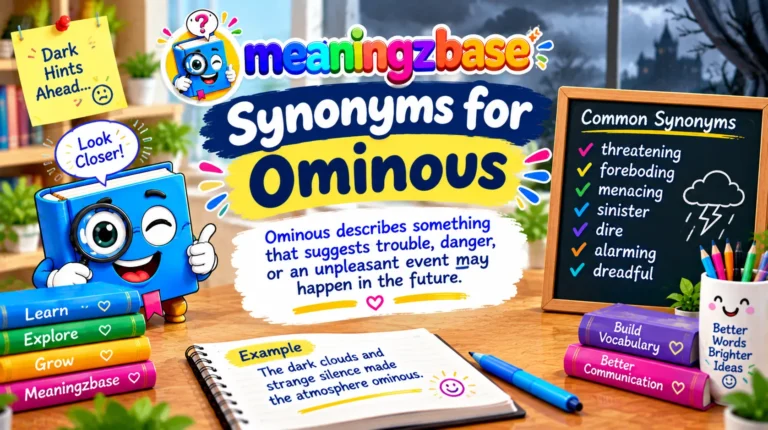
When you search for synonyms for ominous, you may be trying to make your writing clearer, stronger, or more varied.
The word ominous is useful, but using the same word again and again can make writing feel flat.
A good synonym can help you show fear, danger, doubt, or a sense that something bad may happen.
Word choice matters in many types of writing. Students may need better vocabulary for essays, reports, or IELTS answers.
Professionals may want precise words for business reports, news, or formal communication. In casual writing, a simpler alternative may sound more natural.
The best synonym depends on what you want to say.
Some alternatives suggest clear danger, while others describe something that simply feels worrying or threatening. Some sound formal or literary, while others work well in everyday speech.
This guide explores useful synonyms for ominous, from simple choices such as threatening and foreboding to stronger options such as menacing and sinister.
You will also learn which words to avoid, how to choose the right alternative, and how to use these words naturally.
What Does “Ominous” Mean?
Ominous describes something that suggests trouble, danger, or an unpleasant event may happen in the future.
It often creates a feeling that something bad is coming, even when there is no clear proof.
For example:
The dark clouds looked ominous.
This sentence does not say that a storm will definitely happen. Instead, the clouds give a strong feeling that bad weather may be approaching.
The word can describe people, places, sounds, signs, events, expressions, or situations.
Common examples include:
- an ominous warning
- an ominous silence
- an ominous sound
- an ominous sign
- an ominous message
- an ominous feeling
- an ominous prediction
The tone is usually serious, dark, or worrying. It is common in news writing, fiction, essays, reports, and everyday speech.
15+ Best Synonyms for “Ominous”
Threatening
Definition: Suggesting danger, harm, or trouble.
Tone: Formal / Casual
Example: The threatening clouds covered the entire sky.
Threatening is one of the closest everyday alternatives to ominous. It works especially well when something appears likely to cause harm.
Foreboding
Definition: Creating a strong feeling that something bad may happen.
Tone: Literary / Formal
Example: A sense of foreboding filled the empty house.
Foreboding is especially useful when you want to describe a feeling rather than direct danger.
Menacing
Definition: Showing that someone or something may cause harm.
Tone: Formal / Literary
Example: The dog gave the stranger a menacing stare.
Menacing is stronger than ominous. It often suggests an active threat.
Sinister
Definition: Suggesting something harmful, evil, or dangerous.
Tone: Literary / Formal
Example: The abandoned building had a sinister appearance.
Sinister is a strong choice when something feels dark, strange, or possibly evil.
Alarming
Definition: Causing worry or making people feel that something is wrong.
Tone: Formal / Casual
Example: The sudden rise in prices was alarming.
Alarming is useful when the focus is on the reaction of people rather than a dark atmosphere.
Worrying
Definition: Causing concern or making someone feel uneasy.
Tone: Casual / Formal
Example: The latest report contained some worrying results.
This is a softer alternative and works well in everyday and professional writing.
Disturbing
Definition: Causing fear, concern, or discomfort.
Tone: Formal / Casual
Example: The investigation revealed some disturbing facts.
Disturbing is useful when something makes people uncomfortable or deeply concerned.
Threatening
Definition: Giving a clear impression of possible danger or harm.
Tone: Formal / Casual
Example: The threatening noise came from outside the room.
This word can describe both physical danger and situations that may become harmful.
Dark
Definition: Suggesting sadness, danger, evil, or an unpleasant future.
Tone: Casual / Literary
Example: The announcement seemed to carry a dark message.
Dark is broad and flexible. It is often useful in creative writing.
Gloomy
Definition: Suggesting sadness, failure, or an unpleasant outcome.
Tone: Casual / Formal
Example: Experts gave a gloomy outlook for the industry.
Gloomy is often better than ominous when the focus is on a negative future rather than immediate danger.
Menacing
Definition: Making someone feel that harm or danger is close.
Tone: Literary / Formal
Example: A menacing figure stood near the entrance.
This word creates a stronger sense of immediate threat.
Unsettling
Definition: Making someone feel nervous, uncomfortable, or unsure.
Tone: Casual / Literary
Example: There was something unsettling about his sudden silence.
Unsettling is a good choice when something feels wrong but is not clearly dangerous.
Eerie
Definition: Strange and frightening in a quiet or unusual way.
Tone: Casual / Literary
Example: An eerie silence fell over the village.
Eerie works especially well for unusual places, sounds, silence, and situations.
Forewarning
Definition: A sign or warning that trouble may happen.
Tone: Formal / Academic
Example: The early signs served as a forewarning of greater problems.
Forewarning focuses on the warning itself rather than the mood around it.
Perilous
Definition: Full of serious danger or risk.
Tone: Formal / Literary
Example: The hikers faced a perilous journey through the mountains.
Perilous is stronger than ominous because it describes a situation that is actually dangerous.
Hazardous
Definition: Likely to cause harm or danger.
Tone: Formal / Academic
Example: Workers were warned about the hazardous conditions.
Use hazardous for real and measurable danger, especially in technical, workplace, or safety writing.
Menacing
Definition: Appearing likely to cause harm or trouble.
Tone: Formal / Literary
Example: The dark figure looked menacing in the distance.
It is particularly effective when describing a person, expression, object, or action that seems threatening.
Sinister
Definition: Giving the impression that something harmful or evil is involved.
Tone: Literary / Formal
Example: The strange message had a sinister tone.
Use sinister when you want a darker and more mysterious feeling.
Stronger Alternatives
Sometimes ominous does not feel strong enough. If your sentence needs to communicate serious danger or a powerful sense of fear, consider these alternatives:
- Menacing — Use it when a person, object, or action seems ready to cause harm.
- Sinister — Best when something feels dark, evil, or secretly harmful.
- Perilous — Use it for situations involving serious and real danger.
- Threatening — Useful when danger appears direct or obvious.
- Alarming — Best when something causes strong concern.
- Terrifying — Use it when something creates intense fear.
- Dangerous — Choose it when there is actual risk rather than just a warning sign.
- Grave — Useful for serious situations, especially in formal writing.
For example, compare these sentences:
The situation looked ominous.
The situation looked menacing.
The situation was perilous.
The first suggests that trouble may come. The second suggests a stronger threat. The third says the situation itself is dangerous.
Softer or Polite Alternatives
Not every situation needs a dramatic word. In professional, polite, or neutral writing, a softer replacement may be better.
- Worrying — Good for expressing concern without sounding dramatic.
- Concerning — Useful in professional and workplace writing.
- Unsettling — Good when something feels uncomfortable or unusual.
- Uncertain — Useful when the future is unclear.
- Unfavorable — Appropriate for formal discussions of negative outcomes.
- Doubtful — Use when success or a positive result seems unlikely.
- Troubling — Shows concern about a problem or development.
- Gloomy — Useful for a negative future outlook.
For example, instead of saying:
The results were ominous.
A professional report might say:
The results were concerning.
This sounds less dramatic while still showing that the results deserve attention.
Academic & IELTS-Friendly Alternatives
For academic writing and IELTS, vocabulary should be accurate rather than simply complicated. The following alternatives can help when they match the meaning you need:
- Concerning — showing that something deserves attention or worry.
- Alarming — causing serious concern.
- Threatening — suggesting possible harm or danger.
- Disturbing — causing concern or discomfort.
- Unfavorable — likely to produce a negative result.
- Adverse — harmful or negative in effect.
- Precarious — uncertain and likely to become dangerous or difficult.
- Hazardous — involving a real risk of harm.
- Perilous — involving serious danger.
- Troubling — causing concern about a situation or development.
- Gloomy — suggesting a poor future outcome.
- Uncertain — showing that the future result is not clear.
For IELTS writing, context is more important than using the longest or rarest word.
For example:
The economic outlook is ominous.
could become:
The economic outlook is concerning.
Or:
The economic outlook is unfavorable.
The best choice depends on the evidence and the level of seriousness you want to communicate.
Avoid forcing words such as perilous into an academic essay simply because they sound advanced. A simple, accurate word is usually better than an impressive word used incorrectly.
Synonyms You Should Avoid
Some words may look similar to ominous, but they do not always carry the same meaning.
Dangerous
Dangerous means that something actually creates or involves danger. Ominous only suggests that something bad may happen.
Incorrect: The dark clouds were dangerous.
Better: The dark clouds looked ominous.
Scary
Scary means something causes fear. It does not always suggest that a future problem is coming.
Example: The horror movie was scary.
You could not always replace scary with ominous without changing the meaning.
Sad
Sad describes unhappiness. It does not necessarily suggest danger or future trouble.
Example: She looked sad after hearing the news.
Calling her expression ominous would suggest something more serious or threatening.
Negative
Negative is very broad. It can describe an opinion, result, attitude, or effect, but it may lose the sense of warning found in ominous.
Evil
Evil suggests moral wrongdoing or wickedness. Ominous does not always involve evil.
For example:
The dark clouds looked ominous.
It would be incorrect to assume the clouds were evil.
Understanding these differences helps you avoid awkward or misleading word choices.
How to Choose the Right Synonym in Writing
Choosing the right synonym is not just about finding a word with a similar meaning. You should consider four main factors.
Context
First, ask what the word describes.
Is it a person, event, sound, prediction, report, or feeling?
For example:
- ominous silence → unsettling or eerie silence
- ominous warning → alarming warning
- ominous future → gloomy or uncertain future
- ominous figure → menacing figure
- ominous situation → threatening or concerning situation
Tone
Think about how strong you want your sentence to sound.
For a mild tone, use concerning or worrying.
For a stronger tone, use threatening or menacing.
For a dark literary tone, use sinister or foreboding.
Audience
Your audience also affects word choice.
A school essay may benefit from concerning, adverse, or unfavorable.
A business report may sound better with alarming, concerning, or precarious.
A novel may benefit from sinister, eerie, or foreboding.
Casual conversation usually works better with simple words such as worrying or scary.
Clarity
Never choose a synonym simply because it sounds sophisticated.
Ask:
Does this word say exactly what I mean?
If the answer is yes, use it.
For example, hazardous is excellent for unsafe working conditions, but ominous may be better for a strange feeling before an unexpected event.
Example Paragraph Rewritten Using Synonyms
Original Sentence
The dark clouds looked ominous, and the sailors knew that a dangerous storm might be coming.
Rewritten With “Threatening”
The dark clouds looked threatening, and the sailors knew that a dangerous storm might be coming.
This version makes the clouds appear more directly connected to danger.
Rewritten With “Foreboding”
The dark clouds created a sense of foreboding among the sailors, who feared that a storm was approaching.
This version focuses more on the sailors’ feelings.
Rewritten With “Menacing”
The menacing clouds gathered above the sea as the sailors prepared for the approaching storm.
This version creates a stronger and more dramatic image.
Rewritten With “Gloomy”
The gloomy sky gave the sailors little hope that the weather would improve.
Here, gloomy changes the focus from possible danger to a poor outlook.
Rewritten With “Unsettling”
The unsettling change in the sky made the sailors wonder whether a storm was approaching.
This version is softer and focuses on uncertainty.
FAQs
What is the best synonym for ominous?
Threatening is one of the closest general synonyms. However, foreboding, menacing, sinister, and unsettling may be better depending on the context.
What is a simple synonym for ominous?
Simple alternatives include worrying, threatening, scary, concerning, and unsettling. The best choice depends on the sentence.
What is a stronger word than ominous?
Menacing, sinister, perilous, and threatening can sound stronger than ominous. Terrifying is stronger when the focus is intense fear.
What is a positive opposite of ominous?
Words such as hopeful, promising, reassuring, encouraging, and favorable can express the opposite idea, depending on the context.
Is foreboding the same as ominous?
They are closely related but not identical. Ominous describes something that suggests future trouble, while foreboding often refers to the feeling or sense that trouble is coming.
What is the best synonym for ominous in IELTS?
For IELTS, concerning, alarming, adverse, unfavorable, precarious, and threatening can work well when their meanings fit the context. Accuracy is more important than complexity.
Can ominous describe a person?
Yes. It can describe a person’s appearance, behavior, expression, or presence when that person creates a feeling that something bad may happen. However, menacing may be more precise when the person appears to pose a direct threat.
Conclusion
Knowing different synonyms for ominous can make your writing more precise, natural, and engaging.
The best alternative depends on the meaning and tone you want to create.
Use threatening for possible danger, foreboding for a sense that trouble is coming, menacing for a direct threat, sinister for a dark or possibly evil feeling, and unsettling for something that causes discomfort or uncertainty.
In academic and professional writing, words such as concerning, alarming, adverse, and unfavorable may be more suitable.
The goal is not to use the most complicated word. The goal is to choose the word that communicates your exact meaning clearly.

Evan Blake is a passionate language enthusiast who creates simple and informative content about word meanings, slang, phrases, and modern expressions.
He focuses on making complex or unfamiliar words easy to understand through clear explanations and practical examples.