
When you want to say that someone conveys an idea, feeling, message, or piece of information, using the same word again and again can make your writing feel flat.
This is why many writers search for synonyms of convey. Finding the right alternative can make a sentence clearer, stronger, or more natural.
The word convey is useful in many settings. You can use it when talking about sharing information, expressing emotions, communicating ideas, or showing meaning through words and actions.
However, its best replacement depends on the situation. A word that works well in an academic essay may sound too formal in a text message. Likewise, a casual word may not fit a business report.
A good vocabulary gives you more control over your writing. Students can use better alternatives in essays and IELTS responses.
Professionals can choose precise words for reports, emails, and presentations. In everyday speech, simple alternatives can make communication easier.
This guide explains the best synonyms of convey, their meanings, tones, examples, and common uses.
It also covers stronger, softer, academic, and IELTS-friendly alternatives so you can choose the right word with confidence.
What Does “Convey” Mean?
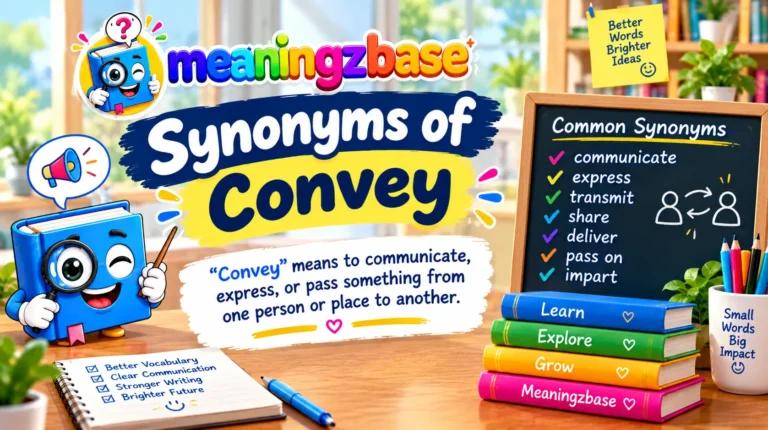
Convey means to communicate, express, or pass something from one person or place to another.
The word can describe the sharing of an idea, message, feeling, meaning, opinion, information, or impression. It can also mean physically carrying or transferring something, although the communication meaning is more common in writing.
For example:
Her smile conveyed a sense of relief.
Here, conveyed means that her smile showed or communicated her feeling without using words.
You can also say:
The report conveys important information about climate change.
In this sentence, conveys means communicates or presents information.
The tone of convey is generally neutral to formal. It is common in academic writing, business communication, journalism, and professional speech. In casual conversation, people may choose simpler words such as tell, show, or share.
The best synonym depends on what you are trying to communicate. If you mean sharing facts, communicate or * 전달* would fit better. If you mean showing an emotion, express or show may be more natural. If you mean making an idea understood, explain or clarify can be stronger choices.
15+ Best Synonyms for “Convey”
Communicate
Definition: To share information, thoughts, or feelings with another person.
Tone: Formal / Neutral
Example: The manager communicated the new safety rules to the staff.
Communicate is one of the closest general alternatives to convey. It works well when information moves from one person to another.
Express
Definition: To show or put a thought, feeling, or opinion into words or actions.
Tone: Neutral / Formal
Example: She expressed her concern about the proposed changes.
Use express when the focus is on a person’s feelings, views, or thoughts.
Tell
Definition: To give information to someone through spoken or written words.
Tone: Casual / Neutral
Example: Please tell me what happened during the meeting.
Tell is simple and natural. It is often better than convey in everyday conversation.
Explain
Definition: To make an idea, fact, or situation easier to understand.
Tone: Neutral / Academic
Example: The teacher explained the difficult concept with a simple example.
Use explain when the goal is not just to share information but to make it clear.
Share
Definition: To give information, thoughts, feelings, or ideas to another person.
Tone: Casual / Neutral
Example: She shared her ideas with the rest of the team.
Share sounds friendly and natural. It is especially useful when information is given openly.
Communicate
Definition: To pass a message, idea, or feeling from one person to another.
Tone: Formal / Academic
Example: The diagram communicates the main idea clearly.
This word works well when discussing both verbal and non-verbal communication.
Reveal
Definition: To make something known that was previously hidden or unknown.
Tone: Formal / Literary
Example: The investigation revealed important details about the case.
Reveal is not a perfect synonym for every use of convey. It is best when previously unknown information becomes known.
Indicate
Definition: To show or point to a fact, meaning, or possible situation.
Tone: Formal / Academic
Example: The results indicate that the new method is more effective.
Indicate is particularly useful in reports, research, and analytical writing.
Demonstrate
Definition: To clearly show an idea, fact, quality, or result.
Tone: Formal / Academic
Example: The study demonstrates the benefits of regular exercise.
Use demonstrate when evidence or action makes something clear.
Impart
Definition: To give knowledge, information, or a particular quality to someone.
Tone: Formal / Literary
Example: The course imparts valuable skills to new employees.
Impart is more formal than share or tell. It often appears in education and professional writing.
Deliver
Definition: To give or communicate a message, speech, warning, or piece of information.
Tone: Formal / Neutral
Example: The director delivered an important message to the team.
Deliver works especially well with speeches, announcements, warnings, and messages.
Pass On
Definition: To give information, news, advice, or knowledge to another person.
Tone: Casual / Neutral
Example: Please pass on the news to everyone in the office.
This phrase is useful when information moves from one person to another.
Describe
Definition: To give details about something so another person can understand or imagine it.
Tone: Neutral / Academic
Example: The writer describes the village in great detail.
Describe is useful when conveying the appearance, nature, or features of something.
Present
Definition: To give information, ideas, or evidence in an organized way.
Tone: Formal / Academic
Example: The researcher presented her findings to the committee.
Use present for reports, arguments, research findings, presentations, and formal discussions.
Portray
Definition: To show or represent a person, situation, or idea in a particular way.
Tone: Literary / Formal
Example: The novel portrays life in a small coastal town.
Portray is common when discussing books, films, art, media, and public images.
Depict
Definition: To represent or show something through words, pictures, art, or media.
Tone: Formal / Literary
Example: The painting depicts a peaceful countryside scene.
Depict is especially useful for visual or literary representation.
Signal
Definition: To give a sign that communicates a particular meaning or intention.
Tone: Neutral / Formal
Example: His silence signaled that he disagreed with the decision.
Use signal when an action, gesture, or event gives a clear sign.
Suggest
Definition: To communicate an idea indirectly rather than stating it directly.
Tone: Neutral / Academic
Example: The evidence suggests that the policy needs to be changed.
Suggest is useful when the meaning is not stated as a definite fact.
Reflect
Definition: To show or represent a particular quality, feeling, or situation.
Tone: Formal / Academic
Example: Her actions reflected a strong sense of responsibility.
Use reflect when something reveals an underlying quality or state.
Stronger Alternatives
Sometimes convey is too weak for the meaning you want. A stronger verb can show that a message, feeling, or idea has a powerful effect.
Emphasize
Use emphasize when you want to make a particular point especially clear or important.
Example: The report emphasizes the need for better public transport.
Highlight
Use highlight when you want to draw special attention to an important point.
Example: The study highlights the risks of poor sleep.
Stress
Use stress when you strongly point out the importance of something.
Example: The doctor stressed the importance of a healthy diet.
Reinforce
Use reinforce when you make an existing idea, message, or belief stronger.
Example: The final example reinforced the speaker’s main argument.
Assert
Use assert when someone states an opinion or claim strongly and confidently.
Example: The writer asserts that education should be accessible to everyone.
Declare
Use declare when someone makes a statement openly, firmly, or officially.
Example: The company declared its commitment to reducing waste.
Proclaim
Use proclaim for a very strong, public, or formal statement.
Example: The leader proclaimed his support for the new plan.
These stronger alternatives should be used with care. A word such as proclaim may sound dramatic if the original message is simple. Always match the strength of the verb with the strength of the message.
Softer or Polite Alternatives

Some situations call for a gentle tone. A softer alternative can prevent your writing from sounding too direct or forceful.
Suggest
Suggest is useful when you want to present an idea without making it sound like an order.
Example: I suggest that we review the plan once more.
Mention
Use mention when you refer to something briefly.
Example: She mentioned the issue during the meeting.
Note
Note is polite and useful when drawing attention to a fact.
Example: Please note that the office will close early today.
Share
Share sounds friendly and cooperative.
Example: I wanted to share some feedback about the project.
Point Out
Use point out when you want someone to notice a fact without sounding too forceful.
Example: She politely pointed out a mistake in the report.
Clarify
Use clarify when your goal is to remove confusion.
Example: Could you clarify what you mean by this statement?
Explain
Explain can sound helpful and neutral when someone needs more information.
Example: He explained the changes in a calm and simple way.
Academic & IELTS-Friendly Alternatives
Academic writing needs precise vocabulary. Instead of using convey repeatedly, you can choose a more exact verb based on the meaning.
Communicate
Useful for discussing the transfer of ideas, information, or findings.
Example: Charts can communicate complex information in a simple format.
Indicate
Useful for research results, evidence, trends, and data.
Example: The results indicate a clear link between the two factors.
Demonstrate
Useful when evidence clearly shows a result or fact.
Example: The findings demonstrate the value of early education.
Illustrate
Useful when an example, chart, or case makes an idea easier to understand.
Example: This example illustrates the impact of social media on young people.
Suggest
Useful when evidence points toward an idea without proving it completely.
Example: The findings suggest that public awareness has increased.
Highlight
Useful for drawing attention to an important issue or result.
Example: The research highlights the need for further investigation.
Indicate
Useful for formal descriptions of signs, evidence, and trends.
Example: The data indicate a steady rise in online learning.
Establish
Use establish when evidence helps prove or firmly support a fact.
Example: The study established a strong relationship between income and education.
Illustrate
Use illustrate when an example helps explain an abstract point.
Example: The case study illustrates the challenges faced by rural communities.
Portray
Use portray when discussing how literature, film, art, or media represents something.
Example: The film portrays the effects of war on ordinary families.
Articulate
Use articulate when someone expresses an idea clearly and effectively.
Example: The student articulated her argument with confidence.
These words can improve IELTS essays because they allow you to show a wider range of vocabulary. However, advanced vocabulary is useful only when it is accurate. A simple word used correctly is better than a complex word used incorrectly.
Synonyms You Should Avoid
Not every word that seems similar to convey can replace it in every sentence. Some alternatives change the meaning.
Transport
Transport can mean physically moving people or objects. It usually does not replace convey when you mean communicating an idea.
Incorrect: The speaker transported his opinion clearly.
Better: The speaker communicated his opinion clearly.
Carry
Carry can sometimes describe transferring something, but it sounds unnatural when used for most abstract messages.
Weak: The essay carried an important idea.
Better: The essay conveyed an important idea.
Transfer
Transfer often focuses on moving something from one place or person to another. It can work with information but may sound technical.
Example: The system transfers data securely.
It is not always the best choice for feelings or impressions.
Announce
Announce means making information public or official. It is stronger and more specific than convey.
Example: The company announced its new policy.
Do not use announce when someone simply expresses a personal feeling.
Imply
Imply means communicating something indirectly. It should not replace convey when the message is direct.
Example: His words implied that he was unhappy.
The difference is important: something can be conveyed directly or indirectly, while imply specifically suggests an indirect meaning.
How to Choose the Right Synonym in Writing
Choosing a synonym is not just about finding a word with a similar dictionary meaning. You need to consider the complete sentence.
Context
First, ask what you are conveying.
Are you sharing information? Use communicate, share, or deliver.
Are you showing an emotion? Use express, show, or reflect.
Are you making an idea clear? Use explain, clarify, or illustrate.
Are you drawing attention to something? Use highlight or emphasize.
Tone
Think about how your sentence should sound.
For casual writing, words such as tell, share, and pass on are natural.
For professional writing, communicate, present, and indicate are useful.
For academic writing, demonstrate, establish, illustrate, and articulate can provide greater precision.
Audience
Consider who will read your work.
A message to a friend does not need complicated vocabulary. A university essay may require more formal language. A business report should sound professional but still remain easy to understand.
Clarity
Never replace convey simply because you want a more advanced word. Your main goal should be clear communication.
For example, tell is often clearer than impart. If both words fit, choose the one your audience will understand more easily.
Example Paragraph Rewritten Using Synonyms
Original sentence:
The teacher conveyed the importance of teamwork to the students.
This sentence is correct, but you can change the verb depending on the meaning and tone.
Using “explained”:
The teacher explained the importance of teamwork to the students.
This suggests that the teacher made the idea easier to understand.
Using “emphasized”:
The teacher emphasized the importance of teamwork to the students.
This shows that the teacher gave special importance to teamwork.
Using “highlighted”:
The teacher highlighted the importance of teamwork to the students.
This draws attention to teamwork as an important point.
Using “communicated”:
The teacher communicated the importance of teamwork to the students.
This focuses on the transfer of the message.
Using “demonstrated”:
The teacher demonstrated the importance of teamwork through a group activity.
This is stronger because the teacher shows the value of teamwork through action.
Using “reinforced”:
The teacher reinforced the importance of teamwork through several classroom activities.
This suggests that the teacher strengthened an idea that students had already learned.
The best choice depends on the exact meaning. If the teacher simply gave information, communicated works well. If the teacher strongly focused on the point, emphasized is better. If the teacher used an activity to show the value of teamwork, demonstrated is more precise.
FAQs
What is the best synonym for convey?
Communicate is one of the closest general synonyms for convey. However, express, explain, share, indicate, or demonstrate may be better depending on the sentence.
What is a simple synonym for convey?
Simple alternatives include tell, show, share, and give. These are often easier to use in everyday English.
What is a formal synonym for convey?
Formal alternatives include communicate, impart, indicate, demonstrate, articulate, and present.
What is the synonym of convey in academic writing?
Good academic choices include indicate, demonstrate, illustrate, suggest, establish, highlight, and communicate. Choose the word that matches your exact meaning.
What is the synonym of convey feelings?
For feelings, express, show, reflect, communicate, and reveal are useful choices.
Can “express” replace “convey”?
Yes, when you are talking about feelings, opinions, thoughts, or ideas. For example, “She conveyed her concern” can become “She expressed her concern.”
Is “communicate” stronger than “convey”?
Not necessarily. Both can describe sharing information or meaning. Communicate often focuses on the act of sharing, while convey can focus more on the meaning or impression that reaches the reader or listener.
Conclusion
The best synonyms of convey depend on your meaning, audience, and tone.
Words such as communicate, express, explain, share, indicate, demonstrate, present, portray, reveal, emphasize, highlight, and articulate can all replace convey in the right context, but they are not identical in every situation.
Use simple words when clarity matters most, formal terms in professional writing, and precise academic vocabulary when writing essays or IELTS responses.
Instead of changing a word just to sound advanced, choose the alternative that communicates your exact meaning. Strong vocabulary is not about using the hardest word—it is about using the right word.

Evan Blake is a passionate language enthusiast who creates simple and informative content about word meanings, slang, phrases, and modern expressions.
He focuses on making complex or unfamiliar words easy to understand through clear explanations and practical examples.