
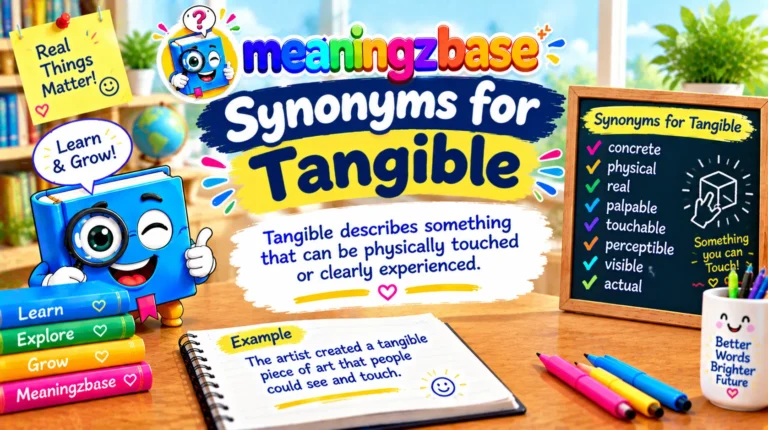
The word tangible is useful, but using the same word too often can make writing feel flat.
That is why many writers search for synonyms for tangible when they want a better word for a specific idea.
“Tangible” can describe something you can physically touch, such as a book, chair, or piece of equipment.
It can also describe something real and easy to notice, such as a tangible benefit, tangible result, or tangible improvement.
Because the word has more than one common use, the best replacement depends on the sentence.
Choosing the right synonym can make your writing more precise. In academic work, you may need a formal word that explains an idea clearly.
In professional writing, you may want to show that a result is real and measurable. In casual conversation, a simpler word such as real or physical may sound more natural.
A strong vocabulary also helps you avoid unnecessary repetition. However, replacing a word just to sound advanced is not always helpful.
The goal is not to use the most complicated synonym. The goal is to choose the word that gives your reader the clearest meaning.
This guide explores the best synonyms for tangible, including formal, academic, casual, stronger, softer, and IELTS-friendly options.
What Does “Tangible” Mean?
Tangible describes something that can be physically touched or clearly experienced. It can also describe something real, definite, or measurable rather than vague or imaginary.
For example:
- A tangible object can be touched.
- A tangible benefit is a real and noticeable advantage.
- A tangible result is a clear result that can often be measured.
The tone of tangible is usually formal or neutral. It is common in business, academic writing, reports, news writing, and professional communication.
The word is especially useful when you want to contrast something real with something abstract.
Example:
“The project produced tangible benefits for local businesses.”
Here, “tangible” does not mean that the benefits can literally be touched. It means the benefits are real and noticeable.
15+ Best Synonyms for “Tangible”
1. Physical
Definition: Something that exists in a material form and can normally be touched or handled.
Tone: Neutral / Formal
Example:
“The company needs physical evidence before approving the claim.”
2. Concrete
Definition: Something clear, definite, and based on real facts or evidence.
Tone: Formal / Academic
Example:
“The report provides concrete evidence of improvement.”
3. Real
Definition: Something that actually exists or happens rather than being imaginary or theoretical.
Tone: Casual / Neutral
Example:
“The program has made a real difference in the community.”
4. Actual
Definition: Something that truly exists or happened, rather than something expected or imagined.
Tone: Formal / Neutral
Example:
“We need to compare the expected cost with the actual cost.”
5. Material
Definition: Something that has a physical form or has clear importance or effect.
Tone: Formal / Academic
Example:
“The company reported material improvements in production.”
6. Definite
Definition: Something clear, certain, or not vague.
Tone: Formal / Neutral
Example:
“There is no definite proof that the change caused the problem.”
7. Noticeable
Definition: Something that is easy to see, feel, or recognize.
Tone: Neutral / Casual
Example:
“The new system led to a noticeable increase in speed.”
8. Evident
Definition: Something that is clearly seen or understood from available facts.
Tone: Formal / Academic
Example:
“The benefits of the new policy became evident within months.”
9. Observable
Definition: Something that can be seen, detected, or identified through observation.
Tone: Academic / Formal
Example:
“The researchers found an observable change in behavior.”
10. Measurable
Definition: Something that can be assessed or expressed using evidence, numbers, or clear standards.
Tone: Academic / Professional
Example:
“The training produced measurable improvements in employee performance.”
11. Substantial
Definition: Something large, important, or significant enough to have a clear effect.
Tone: Formal / Academic
Example:
“The company made substantial progress during the second quarter.”
12. Significant
Definition: Something important enough to have a noticeable effect or meaning.
Tone: Formal / Academic
Example:
“The study found a significant improvement in test scores.”
13. Demonstrable
Definition: Something that can be clearly shown or supported with evidence.
Tone: Formal / Academic
Example:
“The new method offers demonstrable advantages over the old system.”
14. Verifiable
Definition: Something that can be checked and shown to be true.
Tone: Formal / Academic
Example:
“Researchers should use verifiable information in their reports.”
15. Substantiated
Definition: Something supported by facts, evidence, or reliable information.
Tone: Formal / Academic
Example:
“The claim must be substantiated by independent research.”
16. Concrete
Definition: Something specific and clear rather than general or abstract.
Tone: Formal / Academic
Example:
“Students need concrete examples to understand the theory.”
17. Manifest
Definition: Something clearly visible, present, or easy to recognize.
Tone: Formal / Literary
Example:
“The effects of poor planning were manifest by the end of the project.”
18. Palpable
Definition: Something so strong or clear that it can almost be physically felt.
Tone: Literary / Formal
Example:
“There was a palpable sense of excitement in the room.”
19. Concrete-World
Definition: Something connected to real, physical experience rather than abstract thought.
Tone: Academic / Explanatory
Example:
“The lesson connects abstract ideas with concrete-world examples.”
20. Hands-on
Definition: Something involving direct physical action, practice, or experience.
Tone: Casual / Professional
Example:
“The course gives students hands-on experience with modern equipment.”
Stronger Alternatives: More Intense Options
Sometimes tangible is not strong enough. You may want to show that something is highly visible, important, measurable, or undeniable.
Substantial
Use substantial when the result is large or important.
Example:
“The company achieved substantial growth.”
Significant
Use significant when something has an important effect or meaning.
Example:
“The policy brought significant changes to the workplace.”
Pronounced
Use pronounced when a difference or effect is especially clear.
Example:
“There was a pronounced improvement in customer satisfaction.”
Striking
Use striking when something is unusually noticeable.
Example:
“The study revealed a striking difference between the two groups.”
Dramatic
Use dramatic when the change is large, sudden, or impressive.
Example:
“The new system caused a dramatic reduction in processing time.”
Compelling
Use compelling when evidence or results are strong enough to persuade people.
Example:
“The researchers presented compelling evidence.”
Undeniable
Use undeniable when something is extremely difficult to question or reject.
Example:
“The project had an undeniable impact on the local economy.”
Concrete and measurable
This phrase is useful when you want to emphasize both reality and evidence.
Example:
“The program delivered concrete and measurable results.”
Softer or Polite Alternatives

Not every situation requires a strong word. In sensitive or professional writing, softer alternatives can sound more balanced.
Noticeable
This is a gentle way to say that something can be seen or recognized.
Example:
“There was a noticeable improvement in the team’s communication.”
Apparent
Use apparent when something seems clear without making an overly strong claim.
Example:
“The benefits of the change soon became apparent.”
Observable
This is useful when you want to describe something that can be seen without exaggerating its importance.
Example:
“Only a small observable difference was found.”
Evident
Use this when evidence makes something reasonably clear.
Example:
“The need for additional training was evident.”
Recognizable
Use this when something can be identified without claiming that it is especially important.
Example:
“There was a recognizable change in the company’s approach.”
Discernible
Use discernible when a difference can be noticed, although it may be small.
Example:
“Only a discernible change appeared after the first month.”
Perceptible
Use this when something can be noticed or sensed.
Example:
“There was a perceptible shift in public opinion.”
Clear
Use clear when you want a simple and reader-friendly alternative.
Example:
“The project produced clear benefits for the community.”
Academic & IELTS-Friendly Alternatives
For academic essays and IELTS writing, word choice should be accurate rather than unnecessarily difficult. These alternatives can help you express the idea of something real, clear, observable, or measurable.
Concrete
A strong choice for specific evidence, examples, or results.
Example:
“Governments should provide concrete solutions to environmental problems.”
Measurable
Best when a result can be assessed using numbers or defined standards.
Example:
“The policy has produced measurable economic benefits.”
Observable
Useful when something can be identified through research or observation.
Example:
“The researchers recorded observable changes in student behavior.”
Evident
Good for formal claims supported by available evidence.
Example:
“The advantages of renewable energy are evident in many countries.”
Demonstrable
Useful when an idea or benefit can be clearly shown.
Example:
“The approach has demonstrable benefits for small businesses.”
Verifiable
Best when information or claims can be checked.
Example:
“Academic arguments should be based on verifiable evidence.”
Substantial
Useful when discussing large or important effects.
Example:
“Investment in education can bring substantial social benefits.”
Significant
A common academic choice for important effects or differences.
Example:
“The research found a significant relationship between income and education.”
Definite
Useful when something is clear and certain.
Example:
“There is no definite evidence that the policy reduced unemployment.”
Empirical
Best when something is based on observation, testing, or collected data.
Example:
“The argument should be supported by empirical evidence.”
Quantifiable
Use this when something can be expressed or measured numerically.
Example:
“The program produced quantifiable improvements in productivity.”
Substantiated
Use this when a claim has been supported with evidence.
Example:
“The conclusion should be based on substantiated findings.”
Synonyms You Should Avoid: Context Warning
Not every word that seems similar to tangible works in every sentence. Some alternatives can change the meaning.
Solid
Solid can mean physical, but it can also mean reliable, strong, or well-founded. It is not always a direct replacement.
Problem:
“The company achieved a solid benefit.”
This sounds less natural than “a tangible benefit.”
Touchable
Touchable usually focuses only on the ability to touch something. It does not carry the broader meaning of “real” or “measurable.”
Better:
“The project produced tangible benefits.”
Visible
Visible means something can be seen. Tangible can refer to something that cannot be seen but is still real or measurable.
For example, a financial benefit may be tangible without being visible.
Realistic
Realistic means practical or likely to work. It does not necessarily mean physically real or measurable.
Example:
“A realistic plan” is not the same as “a tangible plan.”
Practical
Practical means useful or suitable for real situations. It is related to tangible in some contexts, but the two words do not always mean the same thing.
Example:
“A practical solution” focuses on usefulness, while “a tangible result” focuses on a clear, real outcome.
How to Choose the Right Synonym in Writing
Choosing a synonym is not simply about finding another word with a similar dictionary meaning. You should consider the purpose of the sentence.
Context
First, ask what tangible means in your sentence.
Does it mean:
- physically touchable?
- real?
- clear?
- measurable?
- important?
- noticeable?
- supported by evidence?
If you mean something physical, physical may be the best choice.
If you mean a clear result, concrete or measurable may work better.
If you mean an important effect, significant or substantial could be more accurate.
Tone
Think about the type of writing.
For casual writing, choose simple words such as real, clear, or noticeable.
For business writing, measurable, concrete, substantial, and demonstrable can work well.
For academic writing, empirical, verifiable, observable, and substantiated may be suitable when their meanings fit.
Audience
Your readers should understand the word without effort.
If you are writing for children or a general audience, real is often better than substantiated.
If you are writing a research paper, more precise academic vocabulary may be appropriate.
Strong writing is not about using the biggest word. It is about using the right word.
Clarity
Never replace tangible simply because you want to avoid repetition.
Ask whether the new word makes your meaning clearer.
Compare:
“The program created tangible benefits.”
with:
“The program created measurable financial benefits.”
The second sentence is stronger if you have data showing the financial change. It gives the reader more information.
Example Paragraph Rewritten Using Synonyms
Original Sentence
“The new training program produced tangible benefits for employees. Workers gained better skills, improved their confidence, and became more productive.”
Rewrite Using “Concrete”
“The new training program produced concrete benefits for employees. Workers gained better skills, improved their confidence, and became more productive.”
Rewrite Using “Measurable”
“The new training program produced measurable benefits for employees. Productivity increased, skills improved, and workers reported greater confidence.”
Rewrite Using “Significant”
“The new training program produced significant benefits for employees. Workers developed stronger skills, gained confidence, and improved their productivity.”
Rewrite Using “Noticeable”
“The new training program produced noticeable benefits for employees. Workers showed better skills, greater confidence, and improved productivity.”
Rewrite Using “Substantial”
“The new training program produced substantial benefits for employees. Workers developed valuable skills, became more confident, and contributed more effectively to their work.”
These versions are similar, but each creates a slightly different meaning. Measurable suggests evidence or numbers, while significant focuses on importance. Noticeable is softer, and substantial suggests a larger effect.
FAQs
What is the best synonym for tangible?
The best synonym depends on the sentence. Concrete, physical, real, measurable, definite, and observable are among the most useful choices.
What is a simple synonym for tangible?
Real is one of the simplest alternatives. Physical is also useful when you mean something that can be touched.
Is concrete a synonym for tangible?
Yes, concrete can replace tangible when you mean something clear, definite, or based on real evidence. However, it is not always suitable when tangible means physically touchable.
What is the opposite of tangible?
Common opposites include intangible, abstract, theoretical, imaginary, and conceptual. The best choice depends on the context.
What is a professional synonym for tangible?
Concrete, measurable, demonstrable, substantial, and material can work well in professional writing, depending on the intended meaning.
What is an academic synonym for tangible?
Academic alternatives include concrete, observable, measurable, empirical, verifiable, demonstrable, and substantiated. Choose the word based on the exact claim.
Can I use real instead of tangible?
Yes, in many casual or general sentences. However, real is broader and less precise. If you mean a result that can be measured or demonstrated, measurable or concrete may be better.
Conclusion
The best synonyms for tangible depend on what you want the reader to understand.
Use physical when you mean something that can be touched, concrete when you mean something clear and definite, and measurable when evidence or numbers can show the result.
Words such as real, noticeable, evident, substantial, significant, observable, demonstrable, and verifiable can also work when their meanings match the context.
Good vocabulary is not about replacing every familiar word with a more difficult one. It is about choosing the most accurate word for your audience, tone, and purpose.
By selecting synonyms carefully, you can make academic essays, professional documents, website content, and everyday writing clearer and more varied.

Evan Blake is a passionate language enthusiast who creates simple and informative content about word meanings, slang, phrases, and modern expressions.
He focuses on making complex or unfamiliar words easy to understand through clear explanations and practical examples.