
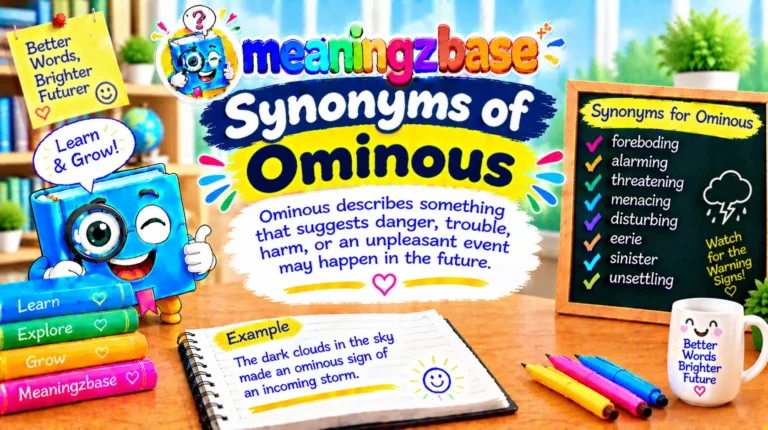
The word ominous is often used when something feels like a warning of danger, trouble, or a bad event.
People search for synonyms of ominous when they want to avoid repeating the same word or need a better word for a particular sentence.
Choosing the right synonym can make writing clearer, more natural, and more interesting.
Word variety matters in school essays, stories, reports, emails, and everyday conversations.
A writer may need a strong word to describe a frightening situation, while another sentence may need a softer word that only suggests concern.
Using the same word again and again can make writing feel flat.
The right alternative also depends on the setting. In academic writing, words such as threatening, foreboding, and alarming can describe a serious situation.
In professional writing, concerning or warning may sound more suitable. In casual speech, unsettling, creepy, or scary may feel more natural.
This guide explains the best synonyms of ominous, their meanings, tones, examples, stronger and softer alternatives, and the words you should avoid in the wrong context.
What Does “Ominous” Mean?
Ominous describes something that suggests danger, trouble, harm, or an unpleasant event may happen in the future.
It is often used when there is a warning sign, but the bad event has not happened yet. For example, dark clouds can look ominous before a storm, or a strange silence can feel ominous before something frightening happens.
The tone of ominous is usually serious, negative, threatening, or mysterious. It is common in stories, news reports, essays, movies, and descriptions of uncertain situations.
For example:
The ominous clouds gathered over the town.
This sentence suggests that the clouds may signal a storm or another unpleasant event.
The word can describe both real and imagined warnings. You might call a dangerous sound ominous, but you can also describe a person’s threatening behavior or a strange message as ominous.
15+ Best Synonyms for “Ominous”
1. Foreboding
Definition: A feeling or sign that something bad may happen soon.
Tone: Literary / Formal
Example: The dark forest gave the hikers a sense of foreboding.
2. Threatening
Definition: Showing a possible danger, attack, or harmful event.
Tone: Formal / Casual
Example: The threatening clouds warned us that a storm was coming.
3. Menacing
Definition: Suggesting danger or creating fear because harm seems possible.
Tone: Formal / Literary
Example: A menacing figure stood outside the empty building.
4. Alarming
Definition: Causing worry, fear, or concern because something seems wrong or dangerous.
Tone: Formal / Academic
Example: The sudden rise in water levels was alarming.
5. Unsettling
Definition: Making someone feel nervous, uncomfortable, or unsure.
Tone: Casual / Formal
Example: There was something unsettling about the abandoned house.
6. Sinister
Definition: Giving the impression that something harmful, evil, or unpleasant is connected with it.
Tone: Literary / Formal
Example: The stranger’s sinister smile made everyone uncomfortable.
7. Dark
Definition: Suggesting sadness, danger, fear, or an unpleasant future.
Tone: Casual / Literary
Example: The conversation took a dark turn after the news arrived.
8. Threatening
Definition: Showing signs that danger, damage, or trouble could occur.
Tone: Formal / Casual
Example: The threatening noise came from somewhere beneath the floor.
9. Warning
Definition: Indicating that a problem, danger, or harmful event may be near.
Tone: Formal / Academic
Example: The unusual temperature change was a warning of severe weather.
10. Gloomy
Definition: Creating a feeling of sadness, darkness, or little hope.
Tone: Casual / Literary
Example: The gloomy sky made the village look deserted.
11. Menacing
Definition: Appearing likely to cause harm or fear.
Tone: Formal / Literary
Example: The menacing sound of thunder echoed across the valley.
12. Alarming
Definition: Serious enough to cause fear, concern, or immediate attention.
Tone: Formal / Academic
Example: Doctors were concerned about the alarming number of cases.
13. Eerie
Definition: Strange and frightening in a way that is difficult to explain.
Tone: Casual / Literary
Example: An eerie silence filled the hallway.
14. Frightening
Definition: Causing fear or making someone feel afraid.
Tone: Casual / Formal
Example: The frightening sound woke the entire family.
15. Unpromising
Definition: Suggesting that a situation is unlikely to have a good result.
Tone: Formal / Academic
Example: The team’s early performance looked unpromising.
16. Darkening
Definition: Suggesting that a situation is becoming more serious, negative, or troubling.
Tone: Literary / Formal
Example: The darkening situation forced the company to change its plans.
17. Dire
Definition: Extremely serious and suggesting an urgent or dangerous situation.
Tone: Formal / Academic
Example: The region faced dire conditions after weeks without rain.
18. Ill-omened
Definition: Traditionally believed to be a sign that something bad will happen.
Tone: Literary / Formal
Example: The sailors considered the strange bird an ill-omened sign.
19. Ominous-looking
Definition: Having an appearance that suggests danger, trouble, or something unpleasant.
Tone: Casual / Descriptive
Example: The ominous-looking building stood alone at the edge of town.
20. Concerning
Definition: Causing worry because something appears wrong, risky, or uncertain.
Tone: Professional / Academic
Example: The latest results are concerning for local residents.
21. Troubling
Definition: Causing worry or suggesting that a situation may become worse.
Tone: Formal / Academic
Example: The report revealed several troubling changes.
22. Disturbing
Definition: Causing strong discomfort, worry, or fear.
Tone: Formal / Casual
Example: The documentary showed some disturbing events.
23. Dreadful
Definition: Extremely unpleasant, serious, or frightening.
Tone: Formal / Literary
Example: The travelers feared a dreadful night ahead.
24. Forewarning
Definition: An earlier sign or message that something bad may happen.
Tone: Formal / Academic
Example: The sudden silence was a forewarning of the coming conflict.
25. Portentous
Definition: Giving the impression that an important or serious event is about to happen.
Tone: Literary / Formal
Example: The speaker’s portentous words changed the mood of the meeting.
Stronger Alternatives
Sometimes ominous is not strong enough. If the situation clearly creates fear or suggests serious harm, a more powerful word can create a stronger effect.
Menacing is useful when a person, object, sound, or action seems ready to cause harm. It works well for threatening characters, animals, behavior, and surroundings.
Sinister is stronger when something seems connected with evil or harmful intentions. It is especially common in fiction and dramatic descriptions.
Dire works when the situation itself is extremely serious. It is better for conditions, circumstances, warnings, or consequences than for a simple strange feeling.
Terrifying is appropriate when something actually causes intense fear. Unlike ominous, it does not merely suggest danger.
Grave is useful when the seriousness of a situation matters more than fear. It works especially well in professional and formal writing.
Menacingly can describe an action or manner that creates a strong sense of threat. For example, a character may speak menacingly.
Dreadful can describe something deeply unpleasant or frightening, although its exact meaning depends on context.
Use these stronger words carefully. A strong synonym should match the actual level of danger. Calling every strange situation dire or terrifying can make writing sound exaggerated.
Softer or Polite Alternatives
Not every warning needs a frightening word. In professional, academic, or polite writing, a softer alternative may communicate concern without creating unnecessary fear.
Concerning is one of the most useful choices. It shows that something deserves attention but does not automatically suggest disaster.
Troubling communicates worry about a situation without sounding extremely dramatic.
Unsettling works when something feels uncomfortable, strange, or difficult to explain.
Uncertain is useful when the future result is unclear rather than clearly dangerous.
Questionable can describe something that raises doubts or concerns about its quality, safety, or reliability.
Worrying is simple and direct. It works well in everyday and professional communication.
Cautionary is useful when something serves as a warning or teaches people to avoid a possible problem.
Concerning signs can replace a stronger phrase when you want to focus on facts that deserve attention rather than predict a negative outcome.
For example:
The results were ominous.
can become:
The results were concerning.
The second version sounds less dramatic and is often better for a professional report.
Academic & IELTS-Friendly Alternatives
In academic and IELTS writing, word choice should be precise rather than simply difficult. The following alternatives can help describe risk, concern, uncertainty, or warning signs.
Foreboding
Useful when describing a strong expectation that something unpleasant may happen.
Example: The growing tension created a sense of foreboding among residents.
Threatening
Useful for describing conditions or events that may cause harm.
Example: Threatening weather conditions forced schools to close.
Alarming
Useful when evidence creates serious concern.
Example: The study found an alarming increase in pollution levels.
Concerning
Useful in reports when discussing results that require attention.
Example: The findings reveal several concerning trends.
Troubling
Useful for describing social, economic, or environmental problems.
Example: The survey revealed troubling changes in public behavior.
Unsettling
Useful when something causes discomfort or uncertainty.
Example: The results presented an unsettling picture of the region’s future.
Serious
Useful when the main focus is the importance of a problem rather than fear.
Example: The country faces serious economic challenges.
Grave
Useful for very serious circumstances, risks, or consequences.
Example: Water shortages could have grave consequences for rural communities.
Adverse
Useful in academic and professional writing for harmful or unfavorable effects.
Example: Extreme weather can have adverse effects on agricultural production.
Hazardous
Useful when something presents a direct risk to health, safety, or the environment.
Example: Workers should avoid hazardous conditions during the operation.
When writing an IELTS essay, do not replace ominous with an advanced word simply to sound impressive. The synonym must match the exact meaning of the sentence.
Synonyms You Should Avoid
Some words may appear similar to ominous, but they do not always carry the same meaning.
Scary
Scary means something causes fear. It does not necessarily suggest that a future problem is coming.
Why avoid it: It describes a reaction rather than a warning sign.
Sad
Sad describes an unhappy emotional state.
Why avoid it: Something can be ominous without being sad.
Angry
Angry describes strong irritation or rage.
Why avoid it: Anger is different from a suggestion of future danger.
Mysterious
Mysterious means difficult to understand or explain.
Why avoid it: Something can be mysterious without being dangerous or negative.
Dangerous
Dangerous means capable of causing harm.
Why avoid it: It often describes an actual risk, while ominous can describe something that only suggests danger.
For example:
The dark clouds looked ominous.
This means the clouds seemed to suggest that bad weather was coming. Saying mysterious clouds would change the meaning because mystery is not the same as a warning of danger.
How to Choose the Right Synonym in Writing
Context
First, ask what the sentence actually means. Is something predicting trouble, causing fear, creating concern, or simply looking strange?
If it predicts a negative event, foreboding may work well. If it creates direct fear, frightening may be better. If it suggests actual harm, threatening or menacing may fit.
Tone
Think about how your sentence should sound.
For formal writing, consider concerning, grave, alarming, or threatening.
For storytelling, words such as sinister, eerie, foreboding, and menacing can create atmosphere.
For casual writing, scary, unsettling, or worrying may sound more natural.
Audience
Your reader also matters. A school essay should use clear words that are easy to understand. A professional report should avoid dramatic language when a neutral term is more accurate.
For a general audience:
The situation was worrying.
For formal writing:
The situation was concerning.
Clarity
Never choose a synonym only because it sounds impressive. The best word is the one that communicates your exact meaning.
Compare:
The evidence was ominous.
The evidence was concerning.
The evidence was alarming.
These sentences have different levels of intensity. Concerning suggests worry, alarming suggests stronger concern, while ominous focuses more on the sense that the evidence may signal something bad ahead.
Example Paragraph Rewritten Using Synonyms
Original Sentence
The dark clouds looked ominous as the hikers continued toward the mountain.
This sentence suggests that the clouds appeared to warn the hikers of possible bad weather or trouble.
Rewrite 1: Using “Threatening”
The dark clouds looked threatening as the hikers continued toward the mountain.
This version gives a stronger sense of danger.
Rewrite 2: Using “Foreboding”
The dark clouds created a sense of foreboding as the hikers continued toward the mountain.
This version sounds more literary and focuses on the feeling that something unpleasant may happen.
Rewrite 3: Using “Unsettling”
The dark clouds created an unsettling atmosphere as the hikers continued toward the mountain.
This version is softer. It focuses on discomfort rather than clear danger.
Rewrite 4: Using “Alarming”
The dark clouds became alarming as the hikers continued toward the mountain.
This version suggests that the clouds caused serious concern.
Rewrite 5: Using “Menacing”
The dark clouds looked menacing as the hikers continued toward the mountain.
This creates a stronger and more dramatic image.
The important point is that these words are not always perfect replacements. Each one changes the feeling or strength of the original sentence.
FAQs
What is the best synonym for ominous?
There is no single best synonym for every sentence. Foreboding, threatening, menacing, alarming, unsettling, and sinister are useful choices, depending on the context.
What is a simple synonym for ominous?
Threatening, worrying, scary, and unsettling are simple alternatives. The best choice depends on whether the sentence describes danger, fear, or concern.
What is the opposite of ominous?
Common opposites include promising, hopeful, reassuring, encouraging, and auspicious. These words suggest a positive or safe future rather than possible trouble.
Is “threatening” a synonym for ominous?
Yes, in many situations. Both can suggest possible danger. However, threatening usually gives a clearer sense of danger, while ominous often suggests that something bad may happen.
Is “sinister” the same as ominous?
They are closely related but not identical. Sinister often suggests something evil or harmful, while ominous mainly suggests that something bad may happen.
What is a formal synonym for ominous?
Formal choices include foreboding, threatening, alarming, concerning, grave, and portentous. Choose one based on the exact meaning of your sentence.
What is an IELTS synonym for ominous?
For IELTS writing, useful choices include concerning, alarming, threatening, adverse, grave, and serious. Always choose the word that accurately fits the context rather than using advanced vocabulary unnecessarily.
Conclusion
Learning synonyms of ominous can make your writing more precise and expressive.
The word itself describes something that suggests danger, trouble, or an unpleasant event may happen.
Depending on the situation, you can use foreboding, threatening, menacing, alarming, unsettling, sinister, concerning, troubling, or other alternatives.
Stronger words are useful when the danger feels serious, while softer choices are better for professional or neutral writing.
The most important rule is to consider context, tone, audience, and clarity before replacing ominous.
A good synonym should not only sound different; it should preserve the meaning you want your reader to understand.

Evan Blake is a passionate language enthusiast who creates simple and informative content about word meanings, slang, phrases, and modern expressions.
He focuses on making complex or unfamiliar words easy to understand through clear explanations and practical examples.