
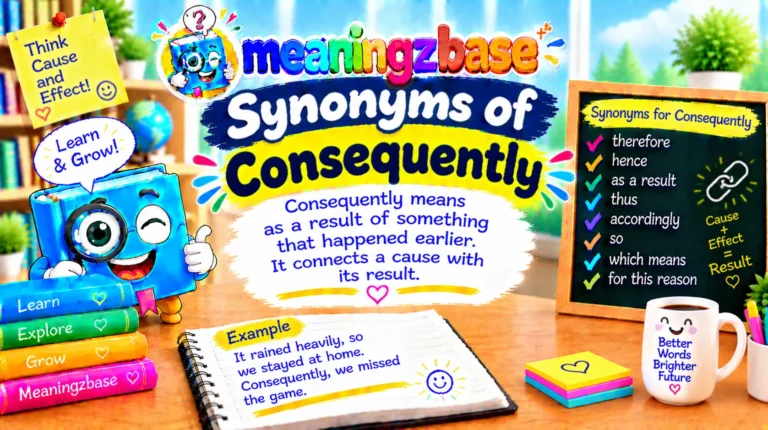
When people search for synonyms for consequently, they are often looking for a better way to show that one event, action, or fact leads to another.
The word consequently is useful, but using it again and again can make writing feel repetitive.
Finding the right alternative can make your sentences smoother, clearer, and more natural.
Word variety matters in school writing, essays, reports, emails, articles, and everyday communication.
Some alternatives work well in academic writing, while others sound more natural in casual conversation.
For example, therefore may fit a formal essay, while so is often better for a simple conversation.
Understanding these differences helps you choose a word based on meaning, tone, and audience rather than simply replacing one word with another.
This guide covers more than 15 useful alternatives to consequently, including formal, academic, casual, stronger, and softer choices.
Each synonym includes a simple definition and example so you can see how it works in a real sentence.
What Does “Consequently” Mean?
Consequently means as a result of something that happened earlier. It connects a cause with its result. When one action or situation produces another outcome, consequently can introduce that outcome.
Example:
The road was covered with snow. Consequently, the school closed for the day.
In this example, the snow is the cause, and the school closure is the result.
The word consequently usually has a formal or academic tone. It is common in essays, reports, research writing, news writing, business documents, and formal explanations. It is less common in relaxed conversation, where people usually say so or because of that.
Consequently normally appears before the result of an earlier event:
Cause: The company lost several major customers.
Result: Consequently, it reduced its staff.
It can also appear in the middle of a sentence:
The company lost several major customers and consequently reduced its staff.
The key idea is simple: consequently = because of that, this happened next.
15+ Best Synonyms for “Consequently”
Therefore
Therefore means for that reason or because of what was just stated. It is one of the closest formal alternatives to consequently.
Tone: Formal / Academic
Example: The evidence was incomplete; therefore, the case required further review.
Thus
Thus means in this way or as a result. It is short and commonly used in academic, professional, and analytical writing.
Tone: Formal / Academic
Example: The team worked together effectively, thus completing the project ahead of schedule.
Hence
Hence means as a result or for this reason. It is concise and often appears in formal or academic writing.
Tone: Formal / Academic
Example: The store had no electricity; hence, it could not open that morning.
As a Result
As a result directly shows that something happened because of an earlier event. It is clear and easy to understand.
Tone: Formal / Neutral
Example: Heavy rain flooded the streets. As a result, many roads were closed.
As a Consequence
As a consequence means because of that event or action. It clearly highlights the connection between cause and effect.
Tone: Formal / Academic
Example: He ignored the safety rules. As a consequence, the machine was damaged.
For This Reason
For this reason introduces a result by pointing back to the cause. It is useful when you want to make the connection especially clear.
Tone: Formal / Neutral
Example: The instructions were unclear. For this reason, several students made the same mistake.
Because of This
Because of this explains that the following situation happened due to something already mentioned.
Tone: Neutral / Casual
Example: The weather changed suddenly. Because of this, we canceled the outdoor event.
Because of That
Because of that has a similar meaning but sounds more conversational than consequently.
Tone: Informal / Casual
Example: I missed the bus, and because of that, I arrived late.
For That Reason
For that reason means because of that particular fact or situation. It works well when the cause has just been explained.
Tone: Neutral / Formal
Example: The road was unsafe. For that reason, drivers were advised to use another route.
As Such
As such can introduce a result based on the nature or status of something already mentioned. It is common in professional writing, although it should be used carefully.
Tone: Formal / Professional
Example: The document was incomplete and, as such, could not be approved.
Accordingly
Accordingly means in a way that fits the situation or as a result of the facts. It often describes an action taken after considering a situation.
Tone: Formal / Professional
Example: The demand for the product increased, and the company adjusted its production accordingly.
So
So is one of the simplest ways to show a result. It is much more common in everyday speech than consequently.
Tone: Informal / Casual
Example: I was tired, so I went to bed early.
That’s Why
That’s why explains the reason for a result in a natural and conversational way.
Tone: Casual / Informal
Example: The shop was closed. That’s why we went somewhere else.
Due to This
Due to this means that the previous situation caused the following result. It is more formal than because of this.
Tone: Formal / Professional
Example: The flight was delayed due to bad weather. Due to this, passengers had to wait several hours.
As a Direct Result
As a direct result strongly connects an outcome to a specific cause. It is useful when the relationship between the two is clear and immediate.
Tone: Formal / Academic
Example: The factory reduced waste. As a direct result, its operating costs fell.
As a Result of This
As a result of this clearly points back to an earlier action or event.
Tone: Formal / Neutral
Example: The company improved its customer service. As a result of this, complaints decreased.
In Consequence
In consequence can mean as a result, but it is uncommon in modern everyday English. It may appear in older or highly formal writing.
Tone: Literary / Formal
Example: The rules were ignored and, in consequence, the agreement was canceled.
It Follows That
It follows that introduces a conclusion that logically comes from the information already given. It is more about logical reasoning than a simple cause-and-effect event.
Tone: Academic / Formal
Example: The two measurements were identical. It follows that the original calculation was correct.
For This Cause
For this cause can express a reason leading to a result, but it is uncommon in modern English. In most situations, for this reason is more natural.
Tone: Literary / Formal
Example: The area was considered unsafe, and for this cause, access was restricted.
In Turn
In turn can show that one result leads to another result or response. It does not always mean exactly consequently, so context matters.
Tone: Neutral / Academic
Example: Better training improved employee performance, which in turn increased customer satisfaction.
Stronger Alternatives
Sometimes you want to show that the connection between a cause and its result is especially strong. In these cases, a stronger phrase can give your writing more force.
As a Direct Consequence
Use this when the result clearly follows from a particular cause.
Example: The company broke the agreement. As a direct consequence, it lost the contract.
As an Immediate Result
Use this when the result happens soon after the cause.
Example: The alarm failed. As an immediate result, the staff did not receive the warning.
As a Natural Consequence
Use this when the outcome is an expected result of the situation.
Example: Regular practice improves skill and confidence as a natural consequence.
As a Serious Consequence
Use this when the result has an important or harmful effect.
Example: The organization ignored the warning, leading to a serious consequence for its operations.
With the Result That
Use this phrase when you want to explain the specific outcome of an action.
Example: The company changed its schedule, with the result that customers had more appointment options.
It Follows Directly That
This is useful when the result is a clear logical outcome of the facts.
Example: The data shows a steady increase in demand. It follows directly that more workers will be needed.
As a Consequence of This
This phrase gives extra emphasis to the cause-and-effect relationship.
Example: Several roads were damaged by the storm. As a consequence of this, transportation was disrupted.
These stronger options should not be added simply to make writing sound more impressive. Choose them when the strength of the cause-and-effect relationship truly matters.
Softer or Polite Alternatives
Consequently is not normally rude, but some alternatives can make a sentence sound more natural, less severe, or more conversational. This can be useful in emails, customer messages, friendly explanations, and everyday communication.
Because of This
This is clear and gentle. It explains the result without sounding overly formal.
Example: Because of this, we may need to change the meeting time.
Because of That
This sounds friendly and conversational.
Example: The train was delayed, and because of that, I arrived a little late.
So
So is simple and natural. It works especially well in everyday speech.
Example: The store was busy, so I decided to come back later.
That’s Why
This phrase sounds direct but friendly.
Example: I had another appointment. That’s why I could not stay longer.
For That Reason
This option remains polite while keeping a clear connection between the reason and result.
Example: For that reason, we suggest contacting the support team first.
Because of These Changes
Use this when several changes have caused the result.
Example: Because of these changes, the delivery date may be slightly different.
This Means That
This phrase is useful when explaining an effect in simple language.
Example: The deadline has moved. This means that you have two extra days.
As a Result
Although formal enough for professional writing, as a result is also easy and friendly enough for many general situations.
Example: The team finished early. As a result, everyone had more time to review the work.
Academic & IELTS-Friendly Alternatives
For academic essays and IELTS writing, it is useful to understand several ways to express cause and effect. However, advanced vocabulary should still be used naturally. A simple phrase used correctly is often better than a complicated phrase used incorrectly.
Therefore
Therefore is excellent for showing a logical result.
Example: Public transport reduces the number of private cars; therefore, it can help lower traffic congestion.
Thus
Thus is concise and useful in formal arguments.
Example: The policy reduced unnecessary spending, thus improving financial stability.
Hence
Hence works well when presenting a direct conclusion or result.
Example: The population is increasing rapidly; hence, more housing will be required.
Consequently
The original word remains useful in academic writing when a clear result follows a previous point.
Example: Many people now work remotely. Consequently, demand for flexible office space has changed.
As a Result
This is highly useful in IELTS because it is clear, natural, and easy to apply.
Example: More people use bicycles. As a result, some cities are creating additional cycling lanes.
As a Consequence
This formal phrase clearly introduces an outcome.
Example: Forest areas are being reduced. As a consequence, many species are losing their natural habitats.
Accordingly
Use accordingly when an action or decision is made in response to a situation.
Example: The needs of the population have changed, and government services should be adjusted accordingly.
For This Reason
This phrase works well when explaining why a particular conclusion or action follows.
Example: Online education offers greater flexibility. For this reason, it has become more attractive to many learners.
It Follows That
This is especially useful for logical arguments and conclusions.
Example: The results show a strong link between exercise and well-being. It follows that regular activity may support a healthier lifestyle.
As a Direct Result
Use this when the evidence supports a clear cause-and-effect link.
Example: The city expanded its bus network. As a direct result, access to public transport improved in several areas.
In Turn
Use in turn when one effect produces another effect.
Example: Better education can increase employment, which in turn may improve household income.
Synonyms You Should Avoid
Not every phrase that seems similar to consequently can replace it in every sentence. Some words describe related ideas but have different meanings.
Therefore vs. Thereby
Thereby means by that action or method. It does not simply mean as a result.
Incorrect: The company lowered prices, thereby customers bought more products.
Better: The company lowered prices; therefore, customers bought more products.
Hence vs. Since
Since can introduce a reason, but it often focuses on the cause rather than presenting the result.
Example: Since the road was closed, we took another route.
Here, since introduces the reason, not the consequence.
Thus vs. In This Way
Thus can mean as a result, but it can also mean in this way. Replacing it automatically with in this way may change the meaning.
Example: The scientist changed the method and thus improved the results.
Here, thus means as a result, not simply in this way.
Accordingly vs. Therefore
These words overlap, but accordingly often refers to an action or decision made in response to information.
Example: The schedule changed, so the staff adjusted their plans accordingly.
Using therefore in this exact position may not carry the same meaning.
In Turn vs. Consequently
In turn usually describes a chain where one result causes another result.
Example: Better roads improve transportation, which in turn supports local business.
It should not automatically replace consequently when there is only one simple cause-and-effect relationship.
How to Choose the Right Synonym in Writing
Choosing the right synonym is not only about finding another word with a similar meaning. You should consider the context, tone, audience, and clarity of your sentence.
Context
First, ask what kind of relationship you are showing.
If you are presenting a direct result, therefore, consequently, or as a result may work well.
If you are explaining a logical conclusion, thus, hence, or it follows that may be better.
If you are describing an action taken because of a situation, accordingly may be more suitable.
Tone
Your choice should match the tone of your writing.
For formal writing:
- Therefore
- Consequently
- Thus
- Hence
- Accordingly
For general writing:
- As a result
- For this reason
- Because of this
For casual communication:
- So
- That’s why
- Because of that
Using hence in a casual text message can sound unnecessarily formal. Likewise, using so repeatedly in an academic essay may make the writing feel too conversational.
Audience
Think about who will read your writing.
A research paper may benefit from therefore, thus, or consequently. A school explanation for younger readers may be clearer with so or as a result. A business email may use for this reason or because of this.
The best synonym is the one your audience can understand quickly.
Clarity
Never choose a synonym simply because it sounds advanced. The main goal is to communicate the relationship clearly.
Compare:
The roads were flooded; consequently, traffic was delayed.
The roads were flooded, so traffic was delayed.
Both are correct. The first sounds more formal, while the second is simpler and more conversational.
Good writing uses variety without sacrificing meaning.
Example Paragraph Rewritten Using Synonyms
Original Sentence
The company failed to update its software. Consequently, several security problems appeared.
The sentence is correct, but the same idea can be expressed in different ways depending on the tone.
Using “Therefore”
The company failed to update its software. Therefore, several security problems appeared.
This sounds formal and works well in reports.
Using “As a Result”
The company failed to update its software. As a result, several security problems appeared.
This is clear, natural, and suitable for general or professional writing.
Using “Thus”
The company failed to update its software, thus creating several security problems.
This is concise and works well in formal writing.
Using “Because of This”
The company failed to update its software. Because of this, several security problems appeared.
This version is simple and easy to understand.
Using “So”
The company failed to update its software, so several security problems appeared.
This sounds more natural in everyday communication.
Using “As a Direct Result”
The company failed to update its software. As a direct result, several security problems appeared.
This places stronger emphasis on the direct link between the failure and the problems.
Full Paragraph With Varied Alternatives
The company failed to update its software for several months. As a result, its security system became increasingly outdated. Therefore, the technical team recommended an immediate upgrade. The company followed that advice, and the system was improved accordingly. In turn, the stronger security measures reduced the risk of future problems.
This paragraph shows how different cause-and-effect expressions can work together without repeating consequently in every sentence.
FAQs
What is the best synonym for consequently?
Therefore and as a result are two of the closest and most useful alternatives. The best choice depends on the sentence and the level of formality.
Is therefore the same as consequently?
They are very similar because both can introduce a result. Therefore often emphasizes a logical conclusion, while consequently often emphasizes the outcome of an earlier event or action.
What is a simple synonym for consequently?
So is the simplest common alternative. Because of this and as a result are also clear choices.
Is consequently formal or informal?
Consequently is mainly formal. It is common in academic writing, reports, professional documents, and formal explanations.
Can I use consequently in IELTS writing?
Yes. Consequently can be useful in IELTS writing when it correctly shows a cause-and-effect relationship. However, it should not be repeated too often.
What is the difference between consequently and thus?
Both can introduce a result. Consequently usually focuses on an outcome caused by an earlier situation, while thus can also introduce a logical conclusion or show the result of an action.
What is the opposite of consequently?
There is no single direct opposite of consequently. The word shows a result, so opposite ideas may involve a cause, condition, or contrast rather than another specific linking word.
Conclusion
Choosing the right synonym for consequently can make your writing clearer, smoother, and more suitable for its purpose.
Words such as therefore, thus, hence, as a result, for this reason, accordingly, because of this, and so all express related ideas, but they do not always work in exactly the same way.
Formal writing often benefits from therefore, thus, or consequently, while simple and conversational writing may sound better with so or that’s why.
The key is to consider the cause-and-effect relationship, your audience, and the tone of the sentence.
Good vocabulary is not about using the most complicated word; it is about choosing the clearest word for the situation.

Evan Blake is a passionate language enthusiast who creates simple and informative content about word meanings, slang, phrases, and modern expressions.
He focuses on making complex or unfamiliar words easy to understand through clear explanations and practical examples.