
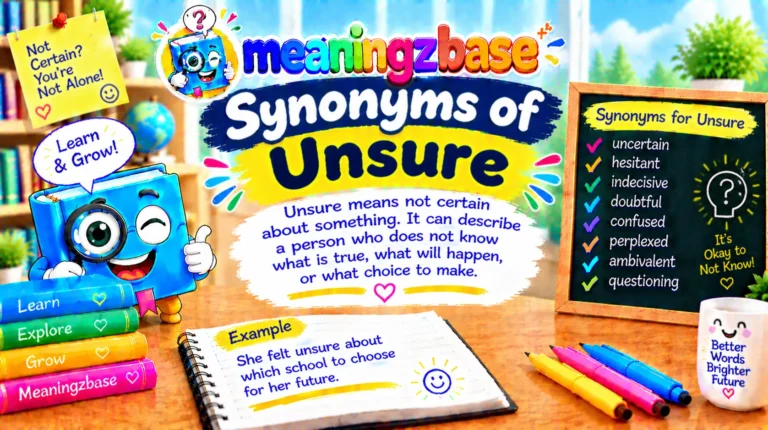
When you are looking for synonyms for unsure, you may want a better way to express doubt, a lack of confidence, or a feeling that you do not know what to believe or do.
The word unsure is common and useful, but using it again and again can make your writing sound plain.
Choosing the right alternative can make your message clearer and more exact.
Word variety matters in many types of writing. In academic work, the right word can show careful thinking.
In professional writing, it can help you sound clear and confident without overstating your point. In casual speech, a simple alternative can make your meaning feel more natural.
However, not every synonym for unsure means exactly the same thing. Some words show doubt. Others suggest confusion, hesitation, worry, or a lack of knowledge.
The best choice depends on what you want to say and who will read it.
This guide covers useful synonyms for unsure, from simple everyday choices to stronger, more formal alternatives.
You will also learn which words to avoid, how to choose the right synonym, and how to use these words naturally in sentences.
What Does “Unsure” Mean?
Unsure means not certain about something. It can describe a person who does not know what is true, what will happen, or what choice to make.
For example:
I am unsure whether I should accept the offer.
Here, the speaker has not made a decision.
The word can also describe a lack of confidence:
She felt unsure about her ability to lead the team.
In this case, unsure means that she does not fully trust her own ability.
The tone of unsure is usually neutral. It works well in casual conversation, professional communication, and general writing. It is also useful when you want to express doubt without sounding too negative.
The meaning changes slightly depending on the situation. You might be unsure about a fact, unsure about a decision, unsure about another person, or unsure about yourself.
That is why choosing a more precise synonym can make your writing stronger.
15+ Best Synonyms for “Unsure”
1. Uncertain
Definition: Not sure about something or unable to know what will happen.
Tone: Formal / Academic
Example: The researchers are uncertain about the long-term effects of the treatment.
Uncertain is one of the closest synonyms for unsure. It is especially useful in formal and academic writing.
2. Doubtful
Definition: Feeling that something may not be true or may not happen.
Tone: Formal / Casual
Example: I am doubtful that the plan will work without more funding.
Doubtful often suggests that you have a reason to question something. It can sound stronger than unsure.
3. Hesitant
Definition: Slow to act or decide because you are not confident about your choice.
Tone: Casual / Professional
Example: She was hesitant to accept the new position.
Use hesitant when the main issue is a decision or action rather than a fact.
4. Doubting
Definition: Not fully believing or trusting something.
Tone: Casual / Formal
Example: He is doubting whether the project can be completed on time.
Doubting focuses on a lack of belief or trust.
5. Uncertain-minded
Definition: Having difficulty reaching a clear opinion or decision.
Tone: Literary / Formal
Example: His uncertain-minded approach made it difficult for the group to move forward.
This expression is less common than uncertain and should be used only when the context supports it.
6. Hesitating
Definition: Pausing before making a decision or taking action.
Tone: Casual / Professional
Example: She was hesitating before giving her final answer.
Hesitating describes an action or behavior, while unsure mainly describes a state of mind.
7. Ambivalent
Definition: Having mixed or conflicting feelings about something.
Tone: Formal / Academic
Example: He felt ambivalent about moving to another city.
Ambivalent is useful when you have both positive and negative feelings. It does not simply mean “not sure.”
8. Confused
Definition: Unable to understand something clearly or decide what to think.
Tone: Casual
Example: I am confused about which option is best.
Confused is stronger than unsure when a lack of understanding is the main problem.
9. Undecided
Definition: Having not yet made a choice.
Tone: Casual / Professional
Example: We are still undecided about where to hold the meeting.
This is one of the best choices when the issue is a decision.
10. Wavering
Definition: Changing between different choices, opinions, or feelings.
Tone: Formal / Literary
Example: Her wavering attitude made it hard to predict her final decision.
Wavering suggests that your position is not stable.
11. Tentative
Definition: Not final or certain and likely to change.
Tone: Formal / Professional
Example: We have a tentative date for the launch.
Tentative often describes plans, answers, or decisions rather than people.
12. Questioning
Definition: Having doubts about whether something is correct, true, or suitable.
Tone: Academic / Formal
Example: The team is questioning whether the current strategy is effective.
This word works well when you are actively examining an idea.
13. Skeptical
Definition: Not ready to believe something because you need more proof.
Tone: Formal / Academic
Example: The manager was skeptical about the claim.
Skeptical is stronger than unsure because it often shows doubt about a claim.
14. In doubt
Definition: Not certain about something.
Tone: Formal / Casual
Example: Her future in the company is still in doubt.
This phrase is useful when the result or truth of something is uncertain.
15. At a loss
Definition: Not knowing what to do, say, or think.
Tone: Casual / Literary
Example: I was at a loss for words after hearing the news.
This phrase is useful when uncertainty leaves you without a clear response.
16. Perplexed
Definition: Very confused because something is difficult to understand.
Tone: Formal / Literary
Example: The unusual result left the scientists perplexed.
Perplexed is stronger than unsure and usually relates to confusion.
17. Unresolved
Definition: Not settled, answered, or decided.
Tone: Formal / Academic
Example: Several important questions remain unresolved.
This word usually describes an issue, question, or matter rather than a person.
18. Insecure
Definition: Lacking confidence in yourself or your ability.
Tone: Casual / Professional
Example: He felt insecure about speaking in front of a large audience.
Use insecure when uncertainty is connected to self-confidence.
Stronger Alternatives
Sometimes unsure does not express enough doubt. If the situation involves serious confusion, strong disbelief, or deep uncertainty, a more powerful word may be better.
1. Deeply uncertain
Use this when there is a high level of doubt.
Example: The company is deeply uncertain about its future market position.
2. Highly doubtful
Use this when you strongly question whether something is true or likely.
Example: It is highly doubtful that the proposal will receive approval.
3. Skeptical
Use this when you need evidence before believing a claim.
Example: Many experts remain skeptical of the explanation.
4. Perplexed
Use this when something is difficult to understand.
Example: The team was perplexed by the sudden change in results.
5. Conflicted
Use this when you have strong feelings pulling you in different directions.
Example: She felt conflicted about leaving her current job.
6. Wavering
Use this when someone repeatedly moves between choices or opinions.
Example: His wavering support caused concern among the other members.
7. Completely undecided
Use this when a person has made no clear choice at all.
Example: I am completely undecided about which course to take.
Softer or Polite Alternatives
Sometimes you want to express uncertainty without sounding negative, critical, or too direct. These softer alternatives can help.
1. Not certain
A simple and gentle replacement for unsure.
Example: I am not certain that this is the best approach.
2. Not entirely sure
This shows some doubt without suggesting complete confusion.
Example: I am not entirely sure how the system works.
3. Still considering
This suggests that you are thinking carefully rather than simply lacking confidence.
Example: We are still considering which option to choose.
4. Still deciding
A polite way to say that you have not reached a decision.
Example: I am still deciding whether to attend the event.
5. Open to other options
This shows that you have not fully committed to one choice.
Example: We are open to other options if the current plan does not work.
6. Not fully convinced
Use this when you have doubts but do not want to reject an idea completely.
Example: I am not fully convinced that this solution will solve the problem.
7. Would like to consider it further
This is a polite and professional way to delay a decision.
Example: I would like to consider it further before giving you a final answer.
Academic & IELTS-Friendly Alternatives
Academic and IELTS writing often benefits from precise vocabulary. However, advanced vocabulary should not be used simply to sound impressive. The word must match the meaning.
1. Uncertain
A strong general choice for academic writing.
Example: The long-term outcome remains uncertain.
2. Ambiguous
Use when something has more than one possible meaning or interpretation.
Example: The wording of the question was ambiguous.
3. Indeterminate
Use when something cannot yet be clearly determined.
Example: The cause of the change remains indeterminate.
4. Inconclusive
Use when evidence does not provide a clear answer.
Example: The findings were inconclusive.
5. Questionable
Use when something may not be reliable, correct, or acceptable.
Example: The reliability of the data is questionable.
6. Skeptical
Use when someone does not easily accept a claim without evidence.
Example: Some researchers remain skeptical of the proposed explanation.
7. Tentative
Use when a conclusion or plan is not final.
Example: The researchers reached a tentative conclusion.
8. Ambivalent
Use when there are mixed feelings or attitudes.
Example: Participants showed an ambivalent attitude toward the policy.
9. Equivocal
Use when a statement or response is unclear and does not give a firm position.
Example: The official gave an equivocal response to the question.
10. Indecisive
Use when someone struggles to make decisions.
Example: An indecisive leadership style can slow progress.
11. Unresolved
Use when a problem or question has not been settled.
Example: Several issues remain unresolved.
12. Subject to doubt
Use in formal writing when the truth or reliability of something is questioned.
Example: The accuracy of the original estimate is subject to doubt.
Synonyms You Should Avoid
Not every word that sounds similar to unsure is a true replacement. Using the wrong word can change your meaning.
1. Ignorant
Ignorant means lacking knowledge about something. It can also sound insulting when used about a person.
Why avoid it: Saying “I am ignorant about the decision” is very different from saying “I am unsure about the decision.”
2. Unreliable
Unreliable means that someone or something cannot be trusted to perform or provide accurate results.
Why avoid it: A person can be unsure while still being reliable.
3. Weak
Weak describes a lack of strength, power, quality, or effectiveness.
Why avoid it: Being unsure does not automatically mean being weak.
4. Wrong
Wrong means incorrect or mistaken.
Why avoid it: Someone who is unsure may still have the correct answer.
5. Fearful
Fearful means feeling afraid or worried about danger.
Why avoid it: Uncertainty and fear can happen together, but they are not the same feeling.
How to Choose the Right Synonym in Writing
Choosing the best synonym is not about finding the most difficult word. It is about finding the word that expresses your exact meaning.
Context
First, ask what kind of uncertainty you mean.
Are you unsure because you lack information? Use uncertain.
Are you unsure because you have mixed feelings? Use ambivalent.
Are you unsure because you cannot decide? Use undecided or hesitant.
Are you unsure because you do not believe a claim? Use skeptical or doubtful.
The situation should guide your choice.
Tone
Think about how your sentence should sound.
For a casual conversation, words such as confused, not sure, and hesitant work well.
For professional writing, uncertain, tentative, and questionable may sound more suitable.
For academic writing, inconclusive, indeterminate, and equivocal can be useful when their meanings fit.
Audience
Your reader also matters.
Simple vocabulary is often better when writing for a broad audience. If everyone can understand uncertain, there is little reason to replace it with a rare word.
For academic readers, more precise vocabulary can help explain complex ideas. However, advanced words should always improve clarity rather than reduce it.
Clarity
Never choose a synonym just because it sounds impressive.
Compare these sentences:
The results are unsure.
This sounds unnatural.
The results are uncertain.
This is clear and natural.
Or:
The evidence is inconclusive.
This is even better when the evidence does not provide a clear answer.
The strongest writing is often the writing that uses the simplest accurate word.
Example Paragraph Rewritten Using Synonyms
Original Sentence
Sarah was unsure about accepting the job because she did not know whether the company would offer her enough support.
Rewritten Using Synonyms
Sarah was hesitant to accept the job because she was uncertain about the level of support the company would provide.
Here, hesitant works well because Sarah is facing a decision. Uncertain works because she does not know what level of support she will receive.
Another Example
Original:
The researchers were unsure about the results because the evidence was not strong enough.
Rewrite:
The researchers were skeptical about the results because the available evidence was inconclusive.
The second version is more precise for academic writing. Skeptical describes the researchers’ attitude, while inconclusive describes the evidence.
Another Example
Original:
Tom was unsure about which option to choose.
Rewrite:
Tom was undecided about which option to choose.
Here, undecided is better because the uncertainty is directly related to a choice.
FAQs
What is the best synonym for unsure?
The best general synonym is uncertain. It works in casual, professional, and academic writing and has almost the same basic meaning as unsure.
What is a stronger word for unsure?
Words such as doubtful, skeptical, perplexed, and deeply uncertain can express stronger forms of doubt. The best choice depends on why someone feels unsure.
What is a polite way to say unsure?
You can say not entirely sure, still considering, still deciding, or not fully convinced. These expressions sound softer and less negative.
What is a good synonym for unsure in academic writing?
Uncertain is the safest general option. Other useful choices include inconclusive, indeterminate, ambiguous, tentative, questionable, and equivocal, depending on the context.
Is hesitant the same as unsure?
Not exactly. Hesitant usually means that someone is slow or reluctant to act because they are uncertain. Unsure has a wider meaning and can refer to facts, choices, feelings, or confidence.
Is doubtful a synonym for unsure?
Yes, but doubtful is often stronger. It can suggest that you believe something may be false or unlikely, while unsure can simply mean that you do not know.
What is the difference between uncertain and undecided?
Uncertain means you do not know or feel sure about something. Undecided usually means you have not made a choice. For example, you can be uncertain about the result but undecided about what action to take.
Conclusion
There are many useful synonyms for unsure, but the right choice depends on your exact meaning.
Uncertain is the closest general alternative, while hesitant is better for decisions, skeptical works for doubts about claims, ambivalent describes mixed feelings, and undecided focuses on an unfinished choice.
In academic writing, words such as inconclusive, indeterminate, tentative, and equivocal can add precision when used correctly.
Good vocabulary is not about using the hardest word available. It is about choosing the clearest word for the situation.
When you match your synonym to the context, tone, audience, and meaning, your writing becomes more natural, accurate, and effective.

Evan Blake is a passionate language enthusiast who creates simple and informative content about word meanings, slang, phrases, and modern expressions.
He focuses on making complex or unfamiliar words easy to understand through clear explanations and practical examples.