
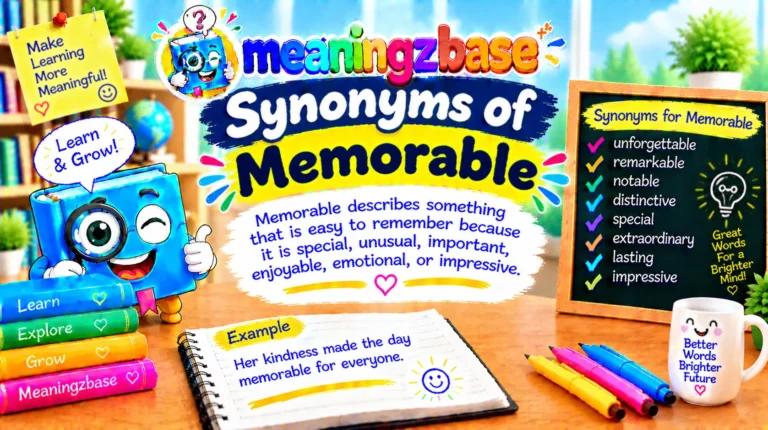
Finding the right words can make your writing clearer, stronger, and more interesting.
If you are searching for synonyms for memorable, you may want a better way to describe a person, event, experience, place, moment, speech, or achievement that stays in your mind.
The word memorable is useful, but using the same word again and again can make writing feel plain.
Choosing a close alternative can help you show exactly why something stands out.
Word variety is important in school assignments, essays, articles, stories, business writing, and everyday conversations.
A formal synonym may work well in an academic essay, while a casual choice may sound more natural when talking with friends.
Some alternatives also add stronger emotion or show that an experience was special, powerful, or impossible to forget.
This guide explains useful synonyms for memorable in simple English.
You will find everyday choices, stronger alternatives, softer options, and advanced vocabulary for academic and IELTS writing.
Each word includes a clear meaning, tone, and example so you can choose the right word for your sentence.
What Does “Memorable” Mean?
Memorable describes something that is easy to remember because it is special, unusual, important, enjoyable, emotional, or impressive. It can describe both positive and negative experiences.
For example, you might say, “It was a memorable trip,” when a journey was so enjoyable or unusual that you are likely to remember it for years.
The tone of memorable is usually positive or neutral. It does not always mean that something was perfect. It simply means that it made a strong enough impression to stay in your memory.
The word is common in everyday speech, school writing, professional communication, reviews, stories, and public speaking.
Example:
“Her memorable speech inspired many students.”
Depending on the context, you can replace memorable with words such as unforgettable, remarkable, distinctive, striking, significant, lasting, or impressive.
15+ Best Synonyms for “Memorable”
Unforgettable
Definition: Something that is so special, powerful, or unusual that you cannot easily forget it.
Tone: Emotional / Informal
Example:
“Our first family vacation together was unforgettable.”
Remarkable
Definition: Something that deserves attention because it is unusual, impressive, or better than expected.
Tone: Formal / Academic
Example:
“She made remarkable progress during the training program.”
Unforgettable
Definition: An experience, person, or event that remains strongly in your mind for a long time.
Tone: Casual / Emotional
Example:
“The concert was an unforgettable experience.”
Significant
Definition: Something important enough to have a lasting effect or meaning.
Tone: Formal / Academic
Example:
“Graduation was a significant moment in his life.”
Notable
Definition: Something worthy of attention because it is important, unusual, or impressive.
Tone: Formal / Academic
Example:
“The scientist made a notable contribution to the field.”
Distinctive
Definition: Something that has special qualities that make it different from other things.
Tone: Formal / Academic
Example:
“The building has a distinctive design that visitors remember.”
Striking
Definition: Something that makes a strong and immediate impression.
Tone: Formal / Literary
Example:
“The artist created a striking image of the city.”
Impressive
Definition: Something that causes admiration because of its quality, size, skill, or effect.
Tone: Casual / Formal
Example:
“Her presentation was impressive and easy to understand.”
Extraordinary
Definition: Something far beyond what is normal, expected, or ordinary.
Tone: Formal / Literary
Example:
“He had an extraordinary ability to connect with people.”
Special
Definition: Something that has a unique personal value or importance.
Tone: Casual
Example:
“Her wedding day was a very special occasion.”
Lasting
Definition: Something that continues to have an effect or remains in someone’s memory for a long time.
Tone: Formal / Academic
Example:
“The teacher had a lasting influence on her students.”
Influential
Definition: Something or someone that has a strong effect on people’s thoughts, actions, or decisions.
Tone: Formal / Academic
Example:
“His influential work changed the way people viewed modern art.”
Celebrated
Definition: Widely admired, recognized, or praised by many people.
Tone: Formal / Literary
Example:
“She became a celebrated writer after publishing her first novel.”
Famous
Definition: Well known by many people.
Tone: Casual / General
Example:
“The museum is famous for its historic paintings.”
Iconic
Definition: Widely recognized as a powerful or important example of something.
Tone: Informal / Modern
Example:
“The film contains several iconic scenes.”
Monumental
Definition: Extremely important or impressive, often because of its great effect or size.
Tone: Formal / Literary
Example:
“The discovery was a monumental achievement for the research team.”
Captivating
Definition: So interesting or attractive that it holds your attention strongly.
Tone: Literary / Formal
Example:
“The speaker gave a captivating performance.”
Evocative
Definition: Something that brings a strong memory, feeling, or image to the mind.
Tone: Literary / Academic
Example:
“The old photograph was evocative of her childhood.”
Enduring
Definition: Continuing for a long time without losing its importance or effect.
Tone: Formal / Literary
Example:
“The author left an enduring mark on literature.”
Stronger Alternatives
Sometimes memorable does not feel strong enough. If an event creates a powerful emotional or mental impression, a stronger word can communicate that effect more clearly.
Unforgettable is useful when you want to show that something remains firmly in your memory.
Extraordinary works when something is far outside the normal range and deserves special attention.
Iconic is useful for a person, image, place, phrase, scene, or object that has become widely recognized.
Striking works when something immediately catches attention because of its appearance, message, or effect.
Monumental is suitable for major achievements, discoveries, changes, or historical moments.
Captivating is better when something holds your attention through beauty, interest, or emotion.
Evocative is especially useful when something brings memories or strong feelings to your mind.
Enduring emphasizes long-lasting importance rather than one powerful moment.
For example:
- “It was a memorable speech.”
- “It was a captivating speech.”
- “It was an extraordinary speech.”
- “It became an iconic speech.”
Each sentence has a different level or type of meaning. The best choice depends on what you want the reader to notice.
Softer or Polite Alternatives
A strong word is not always necessary. In professional, polite, or neutral writing, a softer alternative may sound more natural.
Special is warm and simple. It works well for personal experiences.
Notable is polite and professional when you want to mention something worthy of attention without sounding overly emotional.
Meaningful focuses on personal importance rather than excitement or fame.
Significant shows that something matters or has importance.
Distinctive highlights a unique quality without suggesting that something is extremely powerful.
Lasting focuses on continued impact or memory.
Important is a very general option when the main idea is value rather than emotional impact.
Meaningful can be especially useful when describing a conversation, gift, relationship, experience, or event.
For example, instead of saying, “We had an unforgettable meeting,” a professional writer might say, “We had a meaningful meeting.” This sounds calmer and places more attention on the value of the discussion.
Academic & IELTS-Friendly Alternatives
Academic writing usually benefits from precise vocabulary. Instead of repeatedly using memorable, you can choose a word that explains exactly why something deserves attention.
Significant
Use this when something has importance or a noticeable effect.
Example:
“The event marked a significant change in the community.”
Notable
Use this when something deserves attention or recognition.
Example:
“The study produced several notable findings.”
Remarkable
Use this for an unusual or impressive result.
Example:
“The region experienced remarkable economic growth.”
Distinctive
Use this to describe a quality that makes something different.
Example:
“The city has a distinctive cultural identity.”
Striking
Use this when something creates a strong impression.
Example:
“There is a striking difference between the two groups.”
Enduring
Use this when an effect, influence, or importance continues over time.
Example:
“The movement had an enduring influence on society.”
Lasting
Use this when something continues to affect people or situations.
Example:
“The program had a lasting impact on young learners.”
Influential
Use this when a person, idea, work, or event affects later thinking or behavior.
Example:
“She was an influential figure in modern education.”
Substantial
Use this when something has considerable importance, size, or effect.
Example:
“The project made a substantial contribution to local development.”
Prominent
Use this for someone or something that is well known or important within a particular area.
Example:
“The researcher became a prominent voice in environmental studies.”
For IELTS, do not replace memorable simply because a synonym sounds more advanced. The goal is accuracy, not difficult vocabulary. A simple word used correctly is usually better than an advanced word used incorrectly.
Synonyms You Should Avoid
Not every word connected with being remembered is a true replacement for memorable. Some can change the meaning of your sentence.
Famous
Famous means widely known, but something can be memorable without being famous.
Why avoid it: A private family event may be memorable even if nobody outside the family knows about it.
Important
Important describes value or necessity, not necessarily how easy something is to remember.
Why avoid it: An important meeting is not automatically memorable.
Popular
Popular means liked or supported by many people.
Why avoid it: Popularity and memorability are different ideas.
Historical
Historical usually relates to history or an event of historical importance.
Why avoid it: A birthday can be memorable without being historical.
Emotional
Emotional describes feelings or strong emotion.
Why avoid it: Something can be memorable because it is funny, unusual, beautiful, or surprising rather than emotional.
The key lesson is simple: choose a synonym based on meaning, not just similarity.
How to Choose the Right Synonym in Writing
Choosing the right synonym is easier when you consider four things: context, tone, audience, and clarity.
Context should come first. Ask why the subject is memorable. Is it important, beautiful, unusual, emotional, famous, or powerful? Your answer will point toward the best replacement.
Tone also matters. Casual writing may sound better with special, amazing, or unforgettable. Academic writing may require significant, notable, or remarkable.
Audience affects vocabulary choice. A school essay, business report, social media post, and personal story do not need the same language.
Clarity is more important than using an impressive word. If memorable explains your meaning clearly, there is no need to replace it.
Consider these examples:
- “It was a memorable day.” — General
- “It was a special day.” — Personal and warm
- “It was a significant day.” — Important or formal
- “It was an unforgettable day.” — Strong emotional impact
- “It was a remarkable day.” — Unusual or impressive
- “It was a historic day.” — Connected to an important historical event
These words overlap, but they are not interchangeable in every situation.
Example Paragraph Rewritten Using Synonyms

Original sentence:
“The school trip was memorable because the students visited a famous museum, learned about local history, and spent time together.”
Rewrite using different synonyms:
“The school trip was special because the students visited a notable museum, explored local history, and shared a meaningful experience together.”
Another version:
“The school trip was unforgettable because the students explored a remarkable museum, discovered important parts of local history, and created lasting memories together.”
The second version is stronger and more expressive, but the first version may be better for simple school writing. This shows why synonym choice should depend on the purpose of the sentence.
You can also use different alternatives across a longer paragraph to avoid repeating memorable:
“The graduation ceremony was significant for every student. The principal gave a remarkable speech, and the students shared several special moments with their families. For many graduates, the day created lasting memories that they would carry into the future.”
Here, each word adds a slightly different idea instead of simply repeating the same meaning.
FAQs
What is the best synonym for memorable?
Unforgettable is one of the closest choices when something is very difficult to forget. However, remarkable, notable, significant, and lasting may be better depending on context.
What is a simple word for memorable?
Special is a simple and natural alternative. Other easy choices include important, impressive, and unforgettable.
What is a formal synonym for memorable?
Notable, remarkable, significant, and distinctive can work well in formal writing, depending on the intended meaning.
What is a strong synonym for memorable?
Unforgettable, extraordinary, iconic, and monumental can make the meaning stronger. Each has a different use, so choose according to context.
What is a good synonym for memorable in academic writing?
Significant, notable, remarkable, distinctive, and enduring are useful academic alternatives when their meanings fit the sentence.
Is unforgettable the same as memorable?
They are very close, but unforgettable is stronger. Memorable means something is worth remembering, while unforgettable suggests that forgetting it is especially difficult.
Can memorable describe a person?
Yes. A person can be memorable because of their personality, actions, appearance, achievements, kindness, humor, or influence. For example, “She was a memorable teacher.”
Conclusion
The best synonyms for memorable depend on the exact idea you want to express.
Use unforgettable for a powerful experience, remarkable for something unusually impressive, significant for importance, notable for something worthy of attention, and distinctive for a quality that stands out.
Words such as special, meaningful, and lasting work well in softer or more personal contexts, while enduring, influential, and substantial can fit more advanced writing.
The goal is not to use the most difficult synonym. It is to choose the word that gives your reader the clearest meaning, fits your tone, and sounds natural in context.
With the right vocabulary, your writing can become more precise, varied, and engaging without losing its simple message.

Evan Blake is a passionate language enthusiast who creates simple and informative content about word meanings, slang, phrases, and modern expressions.
He focuses on making complex or unfamiliar words easy to understand through clear explanations and practical examples.